
369 Method Not Working: Emotional Resistance or Misaligned Intention?
The page looks finished. Three lines in the morning, six later, nine at night. Eighteen repetitions, clean enough to look committed.
But if the question “why is the 369 method not working?” keeps returning, the problem may not be the number. Sometimes the method fails because the sentence becomes a performance. You complete it, repeat it, maybe even make it sound more confident than you feel.
Yet by the final line, the words no longer point toward a living intention. They point toward pressure, control, or a desire you have not fully questioned. That does not mean the practice is meaningless. It means the 18th line deserves more attention than the first.
The first line often carries hope. The 18th line carries evidence.
Why the 369 Method Not Working Pattern Starts With Performance
A method can look consistent and still become empty. That is the strange part of repetition. At first, the sentence feels chosen. After enough lines, it can start feeling rehearsed.
The 369 method asks for structure: 3 times, 6 times, 9 times. That structure is the appeal. It gives the desire a shape. It turns a vague longing into a visible ritual of attention. But structure can also hide avoidance.
A person may repeat “I am in a loving relationship” while ignoring the fact that the relationship they want would require different boundaries. Someone may repeat “money flows to me easily” while the sentence secretly carries panic, urgency, or comparison. Someone may repeat “I have my dream career” while the desire belongs more to proving someone wrong than building a life that fits.
The issue is not that the sentence is “negative.” The issue is that it may be too polished to be useful. A useful manifestation phrase does not only sound good. It reveals what you are actually trying to align with.
Performance begins when the page becomes the goal.
You can complete all 18 lines and still avoid the question underneath them: what would change today if this intention were becoming real? Not in a dramatic way. Not in a magical way. In a small, observable way.
If the method only gives you a completed page, it may soothe the feeling of effort without changing your relationship to the desire. That is where many people confuse repetition with movement.
The same thing can happen with signs. A pattern may keep appearing, but nothing in the person’s choices shifts. That is why the question behind signs but nothing changes fits this topic so well: repetition alone is not always transformation.
The 369 method may not be failing because you wrote too little. It may be failing because the sentence never became specific enough to meet your life.
Why the Same Sentence Can Start Saying Something Different by Line 18
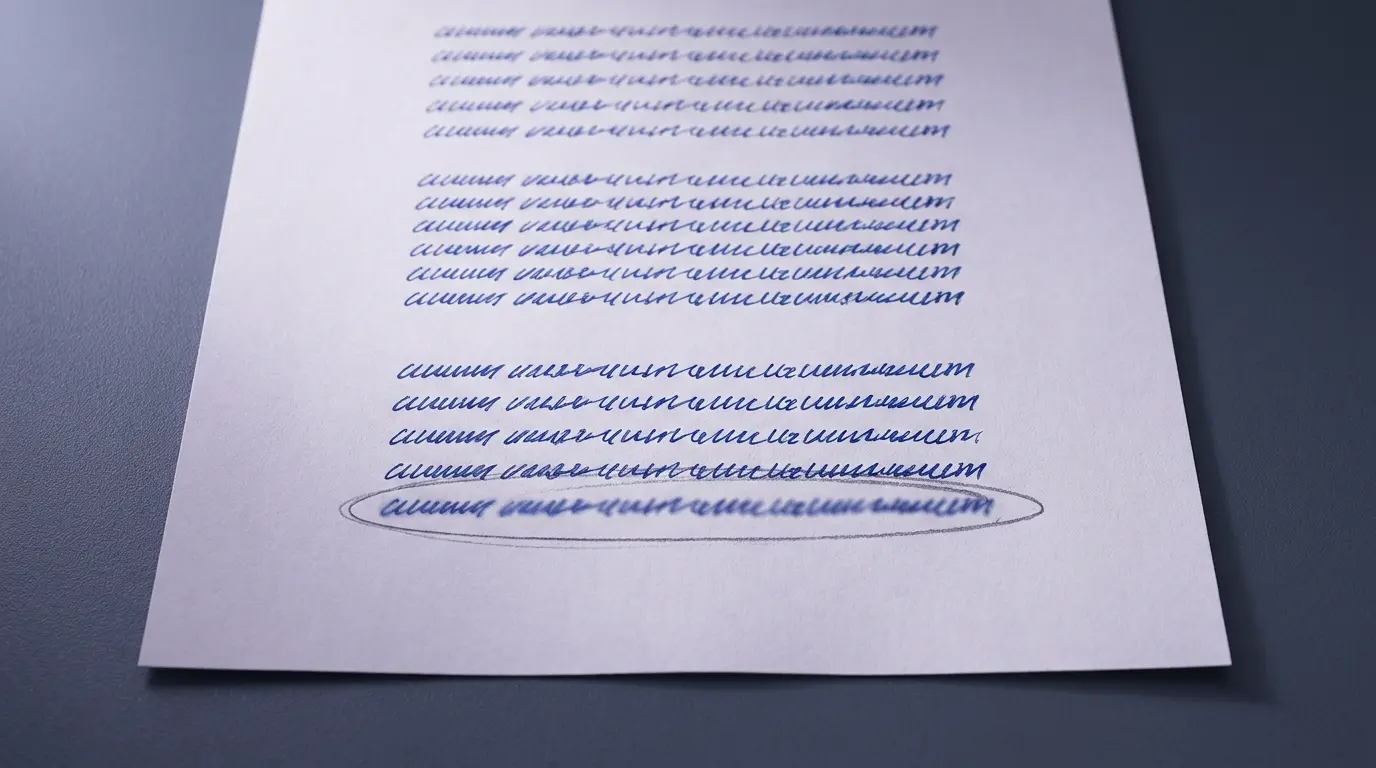
The first line is usually aspirational. The 18th line is diagnostic.
Not medically diagnostic. Emotionally revealing.
By the final repetition, the sentence has been drained of novelty. You are no longer reacting to the excitement of writing it. You are meeting the residue it leaves behind. That residue matters.
If the 18th line feels calmer, the phrase may be organizing your attention. If it feels tighter, the sentence may be pressing on an unresolved fear. If it feels fake, it may be too far away from what you currently believe. If it feels boring, it may have become decoration.
This is the “18th-line problem.”
Most 369 advice focuses on how to start the method. Very little asks what the last line exposes. That last line can reveal three different failures.
First, the phrase may be too outcome-heavy. It tries to control what happens without changing how you relate to the desire. Second, the phrase may be borrowed. It sounds like something a manifestation coach, video caption, or social trend would approve of, but it does not sound like your actual inner language.
Third, the phrase may be emotionally expensive. Repeating it makes you feel farther from the result, not closer to the version of yourself who could receive or pursue it.
The 18th line has a different intelligence from the first because it catches the sentence after the performance fades. The first line asks, “What do I want?” The last line asks, “What does wanting this do to me?”
That distinction changes the entire practice.
If the sentence becomes more desperate by the final line, the method may be amplifying lack. If it becomes more mechanical, it may be protecting you from disappointment. If it becomes clearer, it may be helping you locate the real intention beneath the original wording.
A related writing-based angle appears in scripting method, where past tense can reveal whether a desire sounds believed or performed.
A sentence like “I am wealthy now” may collapse under its own distance. A sentence like “I am becoming someone who handles money with clarity and less avoidance” may feel less glamorous, but more usable.
That does not make it less spiritual. It makes it less theatrical.
The 369 method works best as a mirror, not a receipt from the future.
The Difference Between Emotional Resistance and a Misaligned Intention
Emotional resistance is not automatically a problem. Sometimes resistance appears because the desire matters. Sometimes it appears because the sentence is touching fear, grief, embarrassment, comparison, or old disappointment. Sometimes it appears because part of you knows the wording is not honest.
A misaligned intention is different. A misaligned intention is not simply uncomfortable. It is disconnected from your next real choice.
That is why the same feeling can mean different things.
If you repeat “I am ready for my ideal relationship” and feel fear, that may reflect vulnerability. If you repeat it and immediately picture proving your worth to someone unavailable, the intention may be tangled with an old pattern.
If you repeat “I am financially abundant” and feel nervous, that may reflect unfamiliarity. If the phrase secretly means “I need money to finally feel superior,” the intention may be carrying a hidden demand.
Resistance asks for refinement. Misalignment asks for honesty.
This matters because manifestation language often rewards certainty. It can make doubt seem like failure. But doubt can be information. Discomfort can mark the exact place where the sentence needs to become more precise.
The question is not “Do I believe this perfectly?” The better question is: “What part of this sentence feels false, forced, or performative by the final repetition?”
This is where the 369 method becomes less about attracting an outcome and more about editing an intention until it stops lying. That editing does not need to be dramatic.
This is also why manifesting often feels easier after letting go of the grip on the outcome.
Change “They text me today” into “I am no longer building my peace around one notification.” Change “I am rich overnight” into “I am making clearer decisions with the money already moving through my life.” Change “My dream life is here” into “I am choosing one behavior that belongs to the life I keep claiming.”
The wording becomes less cinematic. It also becomes harder to fake.
This is close to the difference between the law of assumption as a posture and manifestation as a performance. One asks what identity you are inhabiting. The other can become a display of confidence without inner coherence.
What Manifestation Research Can and Cannot Say About This Practice
A real study by Dixon, Hornsey, and Hartley examined belief in manifestation, not the 369 method itself. Their research explored manifestation beliefs involving positive self-talk, visualization, symbolic actions, and the idea of cosmically attracting success.
Across three studies with 1,023 participants, they developed a Manifestation Scale and found that more than one third of participants endorsed manifestation beliefs. This does not prove the 369 method works. It also does not prove the method fails.
It gives a useful boundary: manifestation is a belief system with psychological and behavioral dimensions. It can shape confidence, expectations, risk perception, and how people interpret success or delay.
For this article, the study supports only one careful point: belief in manifestation deserves to be examined responsibly. The 369 method should not be framed as a guaranteed mechanism. It can be treated as a symbolic practice that may help some people organize attention, test intention, and notice where desire becomes pressure.
That is enough. A reflective practice does not need to pretend to be clinical evidence.
How to Rewrite the Practice Around One Observable Shift

If the 369 method is not working, do not start by asking whether you repeated it correctly. Start by asking whether the sentence points to anything observable.
An observable shift is not a miracle deadline. It is a change you could recognize in your next choice, tone, boundary, focus, or interpretation.
The sentence should pass a simple test: by the 18th line, does this phrase point toward one way I will meet the desire differently?
If the answer is no, the sentence may be too abstract.
“I am loved” is beautiful, but vague. “I stop treating inconsistent attention as proof of my worth” is less pretty. It is also much harder to perform without noticing what it asks of you.
“I am successful” is broad. “I choose the task that supports the future I keep repeating” gives the affirmation a place to land.
“I attract money easily” may feel exciting. “I stop making fear-based decisions with the money already in front of me” may be more useful.
The point is not to drain the method of mystery. The point is to stop using mystery as a hiding place.
For this article, the solution is not a technique with a dramatic name. It is a sentence standard.
A 369 sentence should include three qualities: it should name the desire without begging for it, avoid making another person’s behavior the only proof, and imply one observable shift in how you relate to the desire.
That last quality is the most important. If nothing in your posture, choice, or attention could shift after repeating the sentence, the phrase may be too detached from your life.
This is also where manifestation can become subtly self-defeating. When someone repeats a desire from urgency, the practice may begin to feel like gripping. The desire gets louder, but the person feels smaller.
That is why pushing away what you want belongs beside this topic. Not because desire is wrong, but because pressure can disguise itself as devotion.
A better 369 sentence does not need to sound impressive. It needs to become harder to lie to yourself while repeating it.
Here is the practical audit: read the first line and the 18th line as if two different people wrote them. The first person wants. The second person reveals what wanting is doing.
If the 18th line feels frantic, remove the deadline. If it feels fake, reduce the claim. If it feels borrowed, use words you would actually say. If it feels empty, connect it to one observable shift. If it feels calmer, keep it close.
This keeps the method symbolic, grounded, and honest. It also protects the reader from turning a spiritual practice into a private punishment system.
The goal is not to force certainty. The goal is to notice whether the sentence still deserves your repetition.
The Last Line Knows More Than the First One
The 369 method can fail quietly. Not with a dramatic sign. Not with a clear rejection. Sometimes it fails by letting you finish every line while avoiding the one thing the sentence keeps exposing.
A desire repeated 18 times does not become aligned just because it becomes familiar.
By the final line, the page has usually shown you something. Maybe the phrase is too far from your real belief. Maybe it is aimed at controlling someone else. Maybe it carries a deadline that turns hope into pressure. Maybe it is not your desire anymore.
That does not make the practice useless. It makes it revealing.
The next time the 369 method feels like it is not working, do not only inspect the result. Inspect the sentence after it has survived all 18 lines.
Does it still feel alive?
Or is it just a beautiful way to ask for control?
This article is informational, symbolic, and reflective. It is not medical, psychological, financial, or spiritual advice, and it does not diagnose, treat, or promise any outcome from manifestation practices.




Alex Turner
Alex Turner is the author behind Signs of Universe, a website focused on dreams, spiritual meanings, and symbolic signs. His approach combines research and intuitive interpretation to help readers understand the subtle messages that appear in everyday life.