

Not every rupture inside you is a breakdown.
Sometimes the strange part is not the intensity. It is the precision. The way certain rooms feel louder. The way small talk starts sounding thin. The way your own life begins to feel slightly misaligned, even when nothing obvious has changed. That is why so many people start searching for spiritual awakening signs when stress alone no longer explains the pattern.
Some of these shifts show up socially. Some in perception. Some in the way meaning suddenly becomes harder to fake. And some are unsettling because they resemble overload before they resemble insight. The point is not to romanticize confusion. It is to read it more carefully. A real inner shift often leaves a different kind of trace than ordinary strain does.
When the Shift Feels Social Before It Feels Spiritual
A lot of spiritual awakening signs begin in your relationships before they begin in your beliefs.
You stop performing interest.
You notice how many conversations run on repetition, status, and emotional habit. Not because you became superior. Because your tolerance for inner noise changed.
1. Familiar conversations start feeling strangely empty
This is one of the most common spiritual awakening signs people dismiss too fast.
Nothing dramatic happens.
You simply leave certain interactions feeling thinner than before. You hear the script inside the exchange. The same complaint. The same posture. The same role you have been expected to play.
From a Jungian angle, this may reflect tension between the social self and a deeper process of individuation. The old persona still works. It just no longer feels fully inhabited.
That discomfort matters.
Stress usually makes everything feel heavy. An inner shift often makes the false parts feel obvious.
2. Solitude stops feeling like punishment
Another of the quieter spiritual awakening signs is this: being alone starts feeling cleaner than being surrounded.
Not happier all the time. Cleaner.
You may still crave connection. Yet performative company becomes harder to tolerate than silence. Some somatic practitioners observe that this kind of withdrawal may reflect a search for lower noise, not just avoidance.
The difference is subtle.
Isolation linked to collapse often feels draining and numb. Solitude linked to inner change may feel intense, but it also creates sharper self-contact.
The Signs That Move Through Perception, Sensitivity, and Meaning
Some spiritual awakening signs do not arrive as beliefs at all.
They arrive as altered texture. A room feels too charged. Music lands deeper. Crowds feel invasive. Your usual filters stop buffering experience the way they used to.
3. Your sensitivity rises before your understanding does
This is where many people assume stress is the whole story.
You react faster to sound, tone, tension, pacing, and atmosphere. A place that once felt normal now feels abrasive. Certain people leave a residue you can almost track physically.
That does not prove anything mystical.
Still, it may indicate that your inner sorting system has become less willing to flatten what it notices. In plain terms, you are picking up more before you know what to do with it.
That gap creates confusion.
And confusion is part of why spiritual awakening signs are so often misread in the early phase.
4. Coincidences feel less random, but not fully clear
A repeated phrase. The same image in different places. A person appearing just as an old issue returns.
This is one of the spiritual awakening signs that people either overhype or dismiss.
Both moves miss the point.
The useful question is not, “Was this sent to me?” The useful question is, “Why did this pattern land with unusual force now?”
Meaningful repetition often matters less as proof and more as pressure. It pushes attention toward something unfinished.
5. Old roles begin to feel physically hard to perform
This sign is easy to miss because it sounds emotional, but it often shows up in the body first.
You feel resistance before you can explain it.
A laugh feels forced. A job title feels too tight. A social identity that once fit now creates friction. Some phenomenological writers describe inner change this way: the self stops moving smoothly inside inherited structures.
That friction is not always liberation.
Sometimes it is the beginning of a longer unraveling. Still, when spiritual awakening signs are real, they often expose where you have been living by continuity rather than truth.
Why Confusion, Grief, and Emotional Static May Still Belong to the Process
People expect awakening to feel bright.
Many phases do not.
Some spiritual awakening signs look like grief before they look like clarity, because something is ending even if no one else can see it.
6. You feel emotionally between versions of yourself
This is not just sadness.
It is discontinuity.
You can still function. You can still answer messages. Yet underneath, a quiet split has opened between who you have been and who you can still convincingly remain.
That middle state can feel ugly.
It may include irritation, boredom, tenderness, and sudden detachment in the same week. Some traditions would call that purification. Jung might frame part of it as tension between the managed self and the emerging whole.
Either way, the emotional weather turns unstable because your old internal arrangement is losing authority.
7. You stop wanting the things that once organized your life
This tends to alarm people.
Especially when the old goals were respectable.
You may lose appetite for approval, speed, endless messaging, constant productivity, or relationships built on familiar roles. One of the clearest spiritual awakening signs is not gaining a new desire right away. It is no longer being animated by the old one.
That can feel flat.
It can also feel honest for the first time in years.
The danger is rushing to replace the old structure with a spiritual identity that is just another costume. The better move is slower. Notice what has stopped compelling you before you force a new meaning onto it.
A Personal Filter for Reading Spiritual Awakening Signs More Honestly
Not all spiritual awakening signs mean the same thing.
That is why the pattern matters more than the episode.
A rough day is a rough day. A repeated shift with the same emotional fingerprint deserves more attention.
Ask what returns, not what shocks
The loudest moment is not always the truest one.
Watch for recurrence.
Does the same social fatigue appear after the same type of interaction? Does the same sensitivity rise in the same environments? Do certain signs appear right before a hard truth becomes impossible to avoid?
Repetition carries weight.
Notice the aftereffect
Stress tends to leave depletion, agitation, or scatter.
A deeper inner shift may still hurt, but it often leaves a form of unwanted clarity behind it. You see a pattern you cannot unsee. You feel less able to lie to yourself afterward.
That aftereffect matters more than the intensity of the moment.
Compare the sign to the life around it
Context changes interpretation.
If your sensitivity rises only during overload, stress may be enough to explain it. If it rises during moments of moral friction, relational misfit, or sudden honesty, the sign may be pointing somewhere deeper.
This is where many spiritual awakening signs become useful.
Not as proof. As instruction.
Use a seven-sign check before calling it “just stress”
Next time the pattern hits, run a cleaner question.
Is this about social emptiness, solitude, sensitivity, repetition, role friction, identity transition, or the loss of old desire?
If yes, you may be inside a cluster of spiritual awakening signs rather than one isolated bad week.

FAQ — Spiritual Awakening Signs
What are the most common spiritual awakening signs?
The most common spiritual awakening signs include emotional sensitivity, social withdrawal, repeated inner questioning, loss of interest in old roles, and a stronger reaction to environments or patterns that once felt normal.
Can spiritual awakening signs feel like stress or anxiety?
Yes. Spiritual awakening signs can resemble stress at first because both can bring sensitivity, confusion, and emotional intensity. The difference often appears in the pattern and in the kind of clarity left behind afterward.
Why do spiritual awakening signs make you want to be alone?
For many people, spiritual awakening signs increase sensitivity to noise, roles, and emotional performance. Solitude may feel more regulating because it reduces interference and makes inner signals easier to notice.
Are spiritual awakening signs supposed to feel scary?
They can. Spiritual awakening signs often disturb your familiar identity before they offer a stable new one. Fear does not automatically mean something is wrong. It may mean the old structure is losing its grip.
How long do spiritual awakening signs last?
There is no fixed timeline. Some spiritual awakening signs appear in short bursts. Others return over months. The key is not duration alone, but whether the same pattern keeps returning with meaning, friction, or clarity.
The Part of You That No Longer Fits Will Keep Speaking
A real shift does not always enter like light.
Sometimes it enters like refusal.
Refusal to keep shrinking your perception. Refusal to keep calling every inner rupture stress. Refusal to keep wearing identities that still function but no longer feel inhabited. That is why spiritual awakening signs can feel disruptive long before they feel coherent.
The next time one appears, do one specific thing before you explain it away: name which of the seven signs it resembles most. Not in broad terms. Precisely. That small act changes the whole reading.
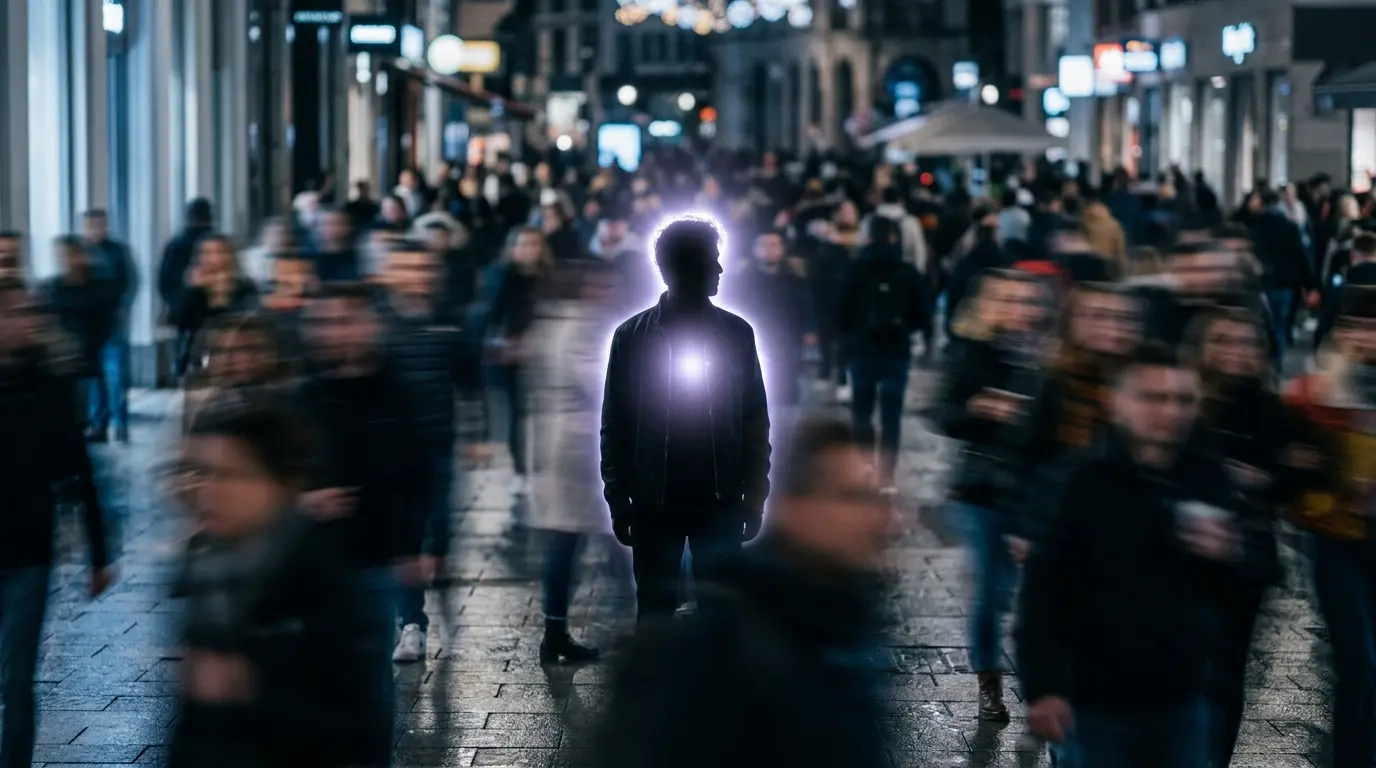
This article offers symbolic and reflective interpretations of an inner shift. The glowing silhouette running through these images is a metaphor, not evidence, and nothing here replaces mental health, medical, or clinical guidance when distress becomes overwhelming.
When the old self goes quiet, related signals get louder:
- See why emotional intensity can start feeling like a full-body language in Why Do You Feel Things Too Deeply? The Weight of Being Spiritually Sensitive
- Track what it may reveal when connection thins out even in familiar company in Feeling Alone Even Around People Spiritual Meaning: Are You Vibrating Above Your Current Environment?
- Look closer at what fading attachment to familiar bonds may reflect in Losing Interest in People You Once Loved Spiritual Meaning: Is This Awakening or Depression?