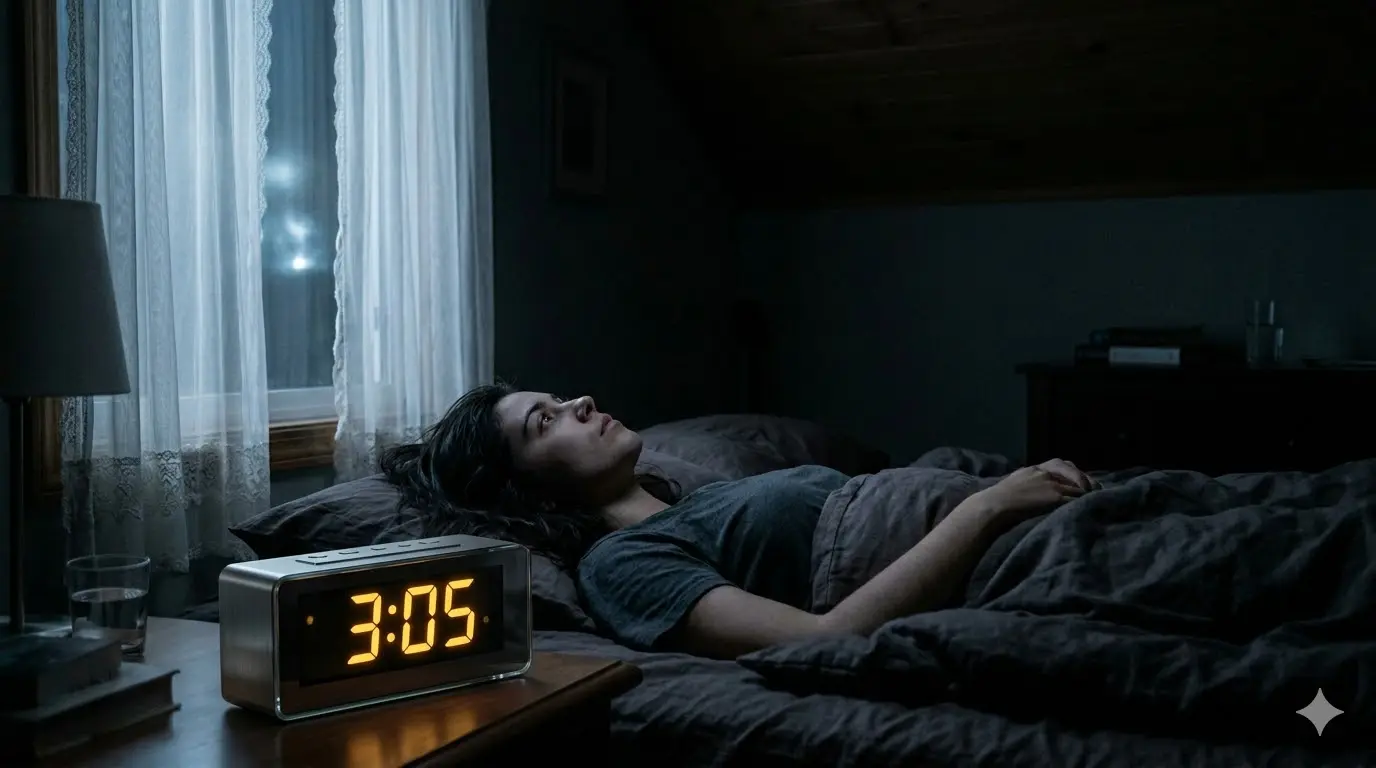
It happens again. You open your eyes and the room is completely still — no alarm, no sound, nothing. You reach for your phone and the numbers stare back at you: 3:47 AM.
This is the third time this week.
Most people roll over and try to force themselves back to sleep, but the waking up between 3am and 5am spiritual meaning is often much deeper than just insomnia. Something about this particular hour feels different — heavier, almost intentional. Like the silence itself is trying to say something.
What is really happening during these early hours is a fascinating blend of biology and mysticism. Repeatedly waking up between 3 AM and 5 AM is actually one of the most widely reported spiritual experiences across different cultures. For instance, ancient Chinese medicine maps this specific window to certain organs and the heavy emotional states tied directly to them. Meanwhile, various spiritual traditions view this exact timeframe as the moment when the boundary between worlds is at its absolute thinnest.
At the same time, your sleep cycle naturally shifts during these hours, making you biologically more alert. For a lot of people, this disruptive pattern kicks off right in the middle of major life transitions or periods of deep inner growth. Ultimately, finding yourself wide awake in the dark can act as both a physiological signal and a spiritual invitation, and understanding how those two overlap changes the entire experience.
What Actually Happens to Your Body Between 3AM and 5AM
Before diving into the spiritual layer, it helps to understand what your body is physically doing at this hour — because the two are more connected than most people realize.
The Sleep Cycle at This Hour
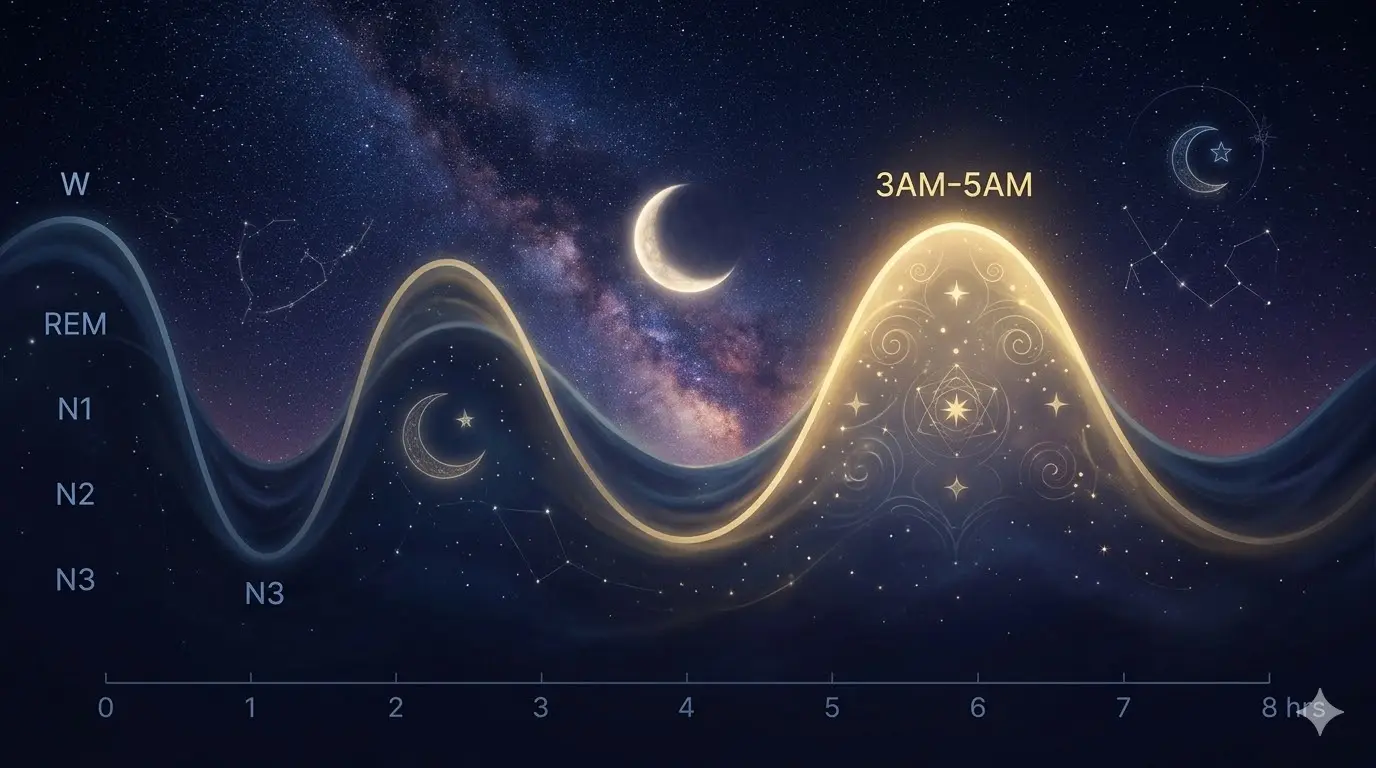
By 3AM, most people have completed their deepest stages of slow-wave sleep. The body begins shifting toward lighter REM cycles, where dreaming is more vivid and the mind is more active.
Body temperature starts to rise slightly. Cortisol — your primary stress hormone — begins its early morning climb, preparing you for waking. This biological shift makes the 3–5AM window a naturally lighter phase of sleep.
For people under stress, grieving, or going through major change, this window becomes the moment the body “comes up for air.” Whatever was suppressed during the day resurfaces when the defenses are down.
Why This Window Is Different
This isn’t just any two-hour block. The 3–5AM period sits at the intersection of physiological vulnerability and what many traditions call heightened spiritual receptivity.
Your prefrontal cortex — responsible for logic and planning — is still in a reduced state. Your limbic system, which governs emotion, intuition and pattern recognition, is more active.
In plain terms: at 3AM, you are wired to feel more than think. That’s not a weakness — it may be exactly why messages from your deeper self tend to arrive at this hour.
🔮 Waking Up Between 3AM and 5AM: The Spiritual Meaning Across Traditions
The experience of waking at this hour isn’t new. Cultures separated by thousands of miles and thousands of years have all pointed to something significant about this window — and their explanations are surprisingly consistent.
Chinese Medicine and the Body Clock
Traditional Chinese Medicine (TCM) uses what’s called the Chinese Body Clock — a 24-hour cycle in which vital energy, or qi, flows through different organ systems at specific times.
The 3–5AM window corresponds to the Lung meridian. In TCM, the lungs aren’t just respiratory organs — they’re associated with grief, letting go, and the processing of deep emotional pain.
Waking during this window, according to TCM, may signal unresolved grief, suppressed sadness, or a need to release something you’ve been holding too tightly — a relationship, an identity, a version of yourself that no longer fits.
The hour just before — 1–3AM — corresponds to the Liver, which governs anger and emotional stagnation. If you wake closer to 3AM feeling restless or irritable, the liver meridian may be signaling excess emotional tension.
The “Devil’s Hour” and Its Origins
The term “Devil’s Hour” or “Witching Hour” has been applied to 3AM across multiple Western traditions, though its meaning has been distorted over centuries. The original concept wasn’t about evil — it was about liminality.
Liminal means threshold. This hour was considered a doorway state, a crack between the ordinary world and something larger. Medieval Christian theology positioned 3AM as the inverse of 3PM — the hour of Christ’s death — making it a time of particular spiritual intensity.
What most people miss is that “intensity” was never meant to be feared. It was a marker for heightened awareness, for prayer, for listening.
Biblical and Christian Perspectives
Across multiple accounts in the Bible, significant encounters happen in the night hours. Samuel hears God’s voice in the night. Jacob wrestles with an angel until dawn. The Psalms repeatedly reference crying out to God in the night watches.
The “fourth watch of the night” referenced in Matthew 14 corresponds roughly to the 3–6AM window — the time Jesus walked on water toward his disciples.
Many contemplative Christian traditions, including Benedictine monasticism, built their entire prayer structure around waking at 3AM for Vigils — treating this hour not as an interruption of sleep, but as a sacred appointment.
Eastern Spiritual Traditions
In Hindu tradition, the period between 3AM and 6AM is called Brahma Muhurta — literally “the hour of Brahma,” the creator god. It’s considered the most auspicious time for meditation, prayer and spiritual practice.
The mind is considered naturally clearer during this window, the ego quieter, the connection to higher consciousness more direct. Yogis and monks have structured their practices around waking at this hour for thousands of years — not because they couldn’t sleep, but because they understood what this time offered.
Buddhist tradition similarly holds the pre-dawn hours as powerful for meditation, describing the mind at this time as less cluttered by daily noise and more open to insight.

What Time You Wake Up Says About You — Hour by Hour
The exact time within this window carries its own nuance. This isn’t superstition — it draws from both TCM meridian theory and patterns reported consistently across spiritual communities.
3:00–3:30 AM
This is the most commonly reported window. Waking here sits right at the boundary between the Liver and Lung meridians — emotionally, this intersection touches both unexpressed anger and deep sadness.
Spiritually, many traditions point to 3AM specifically as a moment of thinning between conscious and unconscious, between the personal and the transpersonal. If you wake here, you may be in the middle of a significant internal transition — even if your outer life looks unchanged.
3:30–4:00 AM
Waking in this window often comes with a sense of alertness that feels almost urgent — like you were called rather than disturbed. Many people report vivid dream fragments, sudden clarity about a problem, or an inexplicable sense of presence.
In TCM, the Lung meridian is now fully active. The emotional invitation here is toward release — letting go of what no longer serves you, particularly in relationships or self-concept.
4:00–4:30 AM
This is where Brahma Muhurta begins according to most Vedic calculations. Waking here feels less heavy than the 3AM window — there’s a quieter, more expansive quality to it.
People who wake at this time often describe feeling called toward something creative, devotional, or contemplative. The mind is unusually still. If you’ve been receiving downloads — sudden insights, creative ideas, vivid inner guidance — this window is when they tend to arrive.
4:30–5:00 AM
By this point, the horizon is beginning to shift. The Lung meridian gives way to the Large Intestine meridian, which in TCM governs the ability to release what is no longer needed — physically and emotionally.
Waking here often corresponds to a readiness to move forward, to act on something you’ve been avoiding. The energy shifts from introspective to preparatory. This window tends to attract people who are close to a breakthrough — not still in the middle of one.
Signs It’s a Spiritual Awakening — Not Just Poor Sleep
This is the question most people are really asking. Because poor sleep is real, stress is real, and not every 3AM wakeup carries cosmic significance. So how do you tell the difference?
Emotional and Physical Signs
These patterns tend to accompany spiritual awakening rather than simple sleep disruption:
- You wake suddenly, fully alert — not groggy or disoriented
- There’s a physical sensation in the chest, throat or crown of the head
- You feel an inexplicable sense of presence, warmth or calm — not fear
- Emotions surface quickly: grief, love, longing, awe
- You feel watched over rather than disturbed
- Dreams just before waking carry unusual clarity or symbolic density
Sleep disruption from stress or anxiety, by contrast, tends to feel anxious, restless, and mentally noisy. The mind races about to-do lists, unresolved conflicts, financial worries.
The quality of waking matters as much as the time.
Recurring Patterns and Synchronicities
One wakeup proves nothing. A pattern does.
If you’re waking at the same time repeatedly — especially during a period of major life change, loss, relationship shift, or inner questioning — that repetition itself becomes meaningful data.
Pay attention to what’s happening in your life when the pattern starts. Spiritual awakenings rarely arrive in a vacuum. They tend to emerge when old structures are crumbling, when the self is being reorganized at a deeper level than conscious thought can manage.

💡 The Science Behind It: What Researchers Actually Say
Dismissing the 3AM phenomenon as purely spiritual misses half the picture. But so does dismissing it as purely biological. The most honest answer lives in the overlap.
Cortisol, REM Cycles and Stress
Sleep researchers have documented what’s called the “early morning awakening” pattern — a well-recognized phenomenon in which people consistently wake between 3 and 5AM, particularly during periods of elevated stress, depression, or major life transition.
Cortisol begins rising around 2–3AM to prepare the body for waking. In people with elevated baseline stress, this cortisol spike arrives earlier and more sharply, pulling them out of sleep before the cycle is complete.
The REM stage dominant in this window is also the most emotionally active phase of sleep. Emotional memories are consolidated, dreams are most vivid, and the mind is processing experiences that couldn’t be addressed during waking hours.
So the science says: your body brings unprocessed emotion to the surface at 3AM. The spiritual traditions say the same thing — just in a different language.
When Spirituality and Biology Overlap
What’s striking is how consistently the scientific and spiritual descriptions converge without referencing each other.
TCM’s Lung meridian pointing to grief at 3AM. Research linking early morning waking to depression and unprocessed loss. Brahma Muhurta describing the mind as clear and open. Neuroscience confirming reduced prefrontal activity and heightened limbic sensitivity at this hour.
These aren’t competing explanations. They’re different maps of the same territory. One uses the language of energy and meridians. The other uses cortisol and REM architecture. Both are pointing at a window of time when what’s hidden tends to surface.
⚠️ What To Do When You Wake Up at These Hours
Knowing why it happens is only useful if it changes how you respond. Here’s what actually helps — both practically and spiritually.
Practical Rituals for 3AM Wakeups
The worst thing you can do is reach for your phone. The blue light, the scroll, the news — all of it drives cortisol higher and makes returning to sleep almost impossible.
Instead:
- Stay still for a moment. Notice how your body feels. Is there tension? Emotion? A sensation you can’t name? Don’t rush past it.
- Keep a notebook by your bed. If thoughts, images or feelings surface, write them down. Not to analyze — just to acknowledge. Many people report that simply naming what arose allows them to return to sleep.
- Regulate your breath. A slow 4-count inhale, hold for 4, exhale for 6 naturally lowers cortisol and signals safety to the nervous system.
Journaling, Breathwork, Prayer and Meditation
If sleep doesn’t return within 20–30 minutes, lean into the hour rather than fighting it.
This is the practice that contemplatives across every tradition have pointed to. Not analyzing. Not planning. Simply being present with what’s arising.
- Journaling: Write stream-of-consciousness for 5–10 minutes. No editing. Let whatever is underneath come forward.
- Meditation or silent prayer: Sit upright, soften your body, and simply listen. Many people report this as the most profound meditation of their day — the mind is already stripped of its usual noise.
- Breathwork: Box breathing or 4-7-8 breathing both work well for returning the nervous system to baseline without suppressing whatever the hour is bringing up.
The shift in perspective is this: instead of treating 3AM as something happening to you, consider what happens when you treat it as something happening for you.
FAQ
Q: Is waking up at 3AM every night a sign of spiritual awakening? Not always — but repeatedly waking at the same time during a period of major inner change is one of the most commonly reported experiences during spiritual awakening. If the wakeup feels calm, clear and oddly purposeful rather than anxious, that’s worth paying attention to.
Q: What does it mean to wake up at 3AM according to the Bible? Several biblical accounts describe significant spiritual encounters happening in the night hours. The “night watches” referenced in Psalms and the fourth watch of the night in Matthew both point to the pre-dawn hours as a time of divine encounter. Many contemplative Christian traditions built their prayer life around waking at 3AM specifically.
Q: What does Chinese medicine say about waking up between 3AM and 5AM? According to Traditional Chinese Medicine’s body clock, the 3–5AM window corresponds to the Lung meridian — an organ system associated with grief, letting go, and deep emotional processing. Consistently waking during this window may signal unresolved sadness or a need to release something emotionally significant.
Q: How do I stop waking up at 3AM every night? If the wakeups are stress-driven, reducing evening cortisol is key: no screens after 9PM, a consistent bedtime, and a wind-down practice that includes slow breathing or light stretching. If the pattern feels spiritually significant, resisting it often intensifies it. Many people find that leaning into the hour — journaling, meditating or praying during the wakeup — resolves it more quickly than trying to sleep through it.
Q: What is the spiritual significance of waking up at 4AM specifically? In Vedic tradition, 4AM falls within Brahma Muhurta — considered the most spiritually auspicious hour of the day for meditation, prayer and inner clarity. Waking here is seen not as a disruption but as a natural invitation toward contemplative practice. The mind at this hour is considered unusually open, clear and receptive.
Conclusion
There’s something both unsettling and quietly sacred about being awake at 3AM when the rest of the world is asleep.
The waking up between 3AM and 5AM spiritual meaning isn’t one single answer — it’s a convergence of signals. Your biology surfaces what your waking mind avoids. Ancient traditions mapped this hour as a threshold. Your inner life uses the silence to get louder.
None of these explanations require you to abandon skepticism or adopt a belief system wholesale. What they ask for is simpler: curiosity. A willingness to pay attention to patterns. To sit with what arises at 3AM instead of immediately pushing it back down.
The next time you open your eyes in the dark and see that it’s 3AM again — before you reach for your phone, before you start calculating how many hours of sleep remain — take one breath and ask: what is this hour asking of me?
You might be surprised by what answers.
To wrap things up, the symbolic, spiritual, and cultural interpretations shared in this piece are simply offered to give you some food for thought. They are meant purely for informational and reflective purposes, rather than serving as any sort of medical, psychological, or professional advice.
If your early morning wake-ups become a persistent issue that negatively affects your daily life, the best course of action is always to reach out to a qualified healthcare provider to ensure your body is getting the rest it needs.