
Dreaming of Being Chased but You Can’t Run: Fear, Pressure, or Avoidance?
The footsteps are already behind you and your legs feel like they belong to someone else. You command them to move. Nothing happens. Dreaming of being chased but can’t run is one of the most viscerally specific nightmares the human mind produces, because the failure isn’t external — the betrayal happens inside the body itself, in the exact instant the body is supposed to save you.
That collapse between intention and movement is what makes the dream stick. The chest registers panic. The legs register concrete. And somewhere between fear of what’s behind you and frustration with what won’t respond beneath you, a different question starts forming — whether the dream is really about the pursuer at all, or about a paralysis you’ve been rehearsing in waking life without noticing.
That same frozen-body logic can also appear in a void falling dream, where the body cannot stop the descent before waking.
The next sections move through what the body might literally be doing during the dream, three variables that quietly change the entire meaning of the chase, the older psychological reading where the pursuer becomes something you’ve refused to integrate, and a way of reading your specific dream without flattening it into a generic anxiety label.
Dreaming of being chased but can’t run becomes easier to read when you stop treating it as one generic nightmare and start looking at the exact pattern inside it.
Why the Dream Body May Feel Unable to Move
There is a verifiable physiological reason your dream legs sometimes refuse to obey, and it has nothing to do with cowardice or weakness. During REM sleep — the stage where the most vivid dreams occur — the body enters a state of muscular atonia, a temporary near-paralysis that prevents the sleeper from physically acting out dream content. The Sleep Foundation describes this as a normal protective mechanism. Your motor commands during the dream are real. Your muscles, by design, are mostly offline.
This matters because it offers a possible biological explanation for the feeling of running through wet cement. The brain sends the signal. The body cannot fully execute. The dream interprets that gap, often dramatically.
But here is where the line has to stay clean. REM atonia explains why dream movement may feel impossible at the muscular level. It does not, on its own, explain why you are being chased, who is chasing you, or why the chase recurs. Those layers belong to interpretation, not physiology. Treating REM atonia as a complete diagnosis flattens the dream. Treating it as one possible mechanical context, sitting underneath the symbolic content, leaves the question intact.
A similar principle applies to other dream paralyses where a recurring image — like falling, or teeth-loss dreams — overlaps with a body-state explanation but refuses to be reduced to it.
Three Variables That Change Everything About What the Dream Means
Dreaming of being chased but can’t run changes meaning when the details change.
Most interpretations online treat the chase dream as a single experience with one meaning: anxiety. That reading is too coarse. The dream is not generic. The details inside it — who, where, how — are doing the actual symbolic work. Three variables tend to carry most of the signal.
If the Pursuer Is Faceless vs. Someone You Know
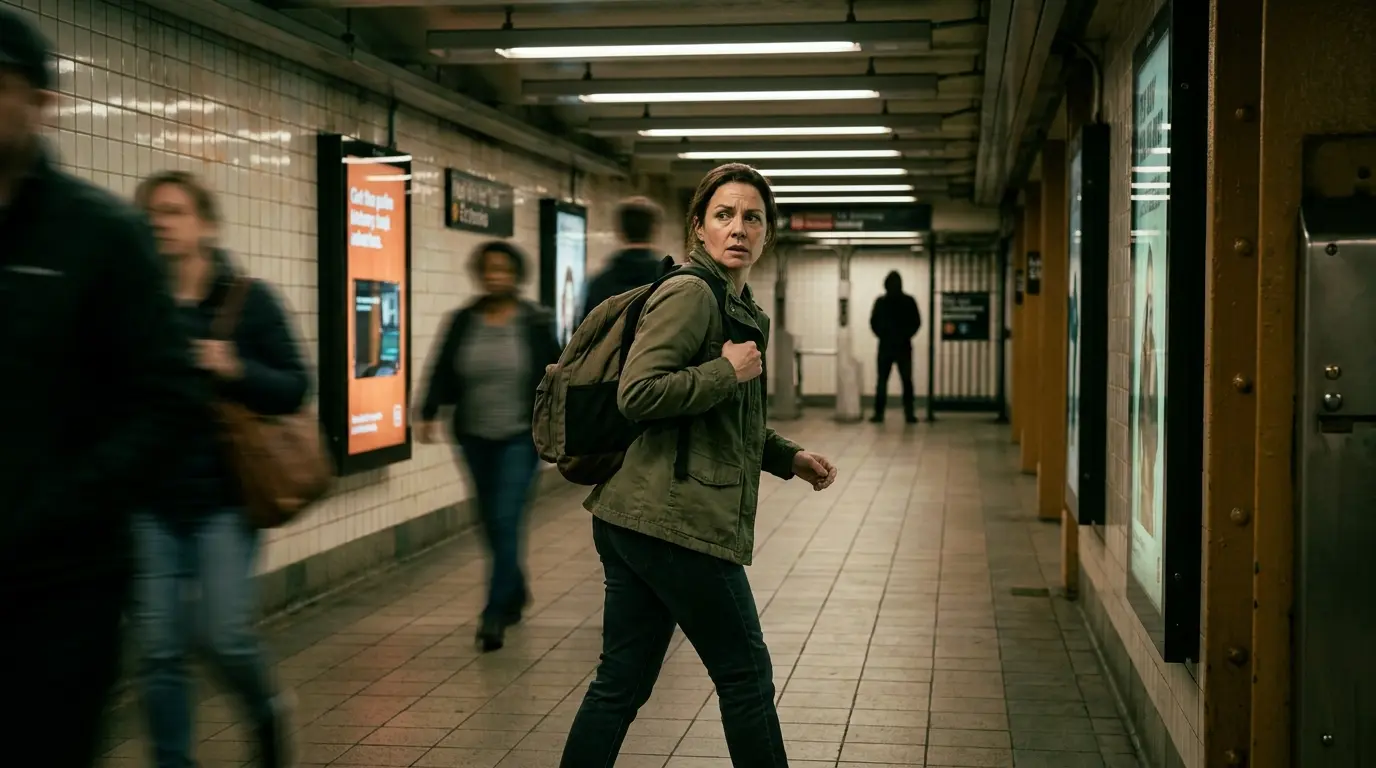
A faceless pursuer — a shadow, a silhouette, an unidentifiable figure — often correlates with diffuse pressure rather than a specific conflict. There is no name to attach the fear to because the fear hasn’t crystallized yet. It is accumulated. Deadlines, vague disappointments, a slow drift in a relationship that hasn’t been spoken aloud. The dream gives it a body so the mind has something to react to.
A pursuer with a recognizable face is the opposite problem. The unconscious has already named the conflict. The boss, the parent, the ex, the old friend who became a stranger. The presence of a specific figure in the chase often points to a specific unresolved interaction, even when the waking mind insists the issue is settled.
If the Setting Is Closed (House, Tunnel) vs. Open (Field, Street)
Closed environments — corridors, basements, narrowing rooms — tend to map onto life areas where the dreamer feels structurally cornered. Not unhappy. Cornered. The walls in the dream are the walls of a job, a contract, a domestic dynamic with no visible exit.
Open environments invert that reading. A field, an empty boulevard, a wide unfamiliar landscape — when paralysis happens in these spaces, it often points not to lack of options but to too many. The dreamer is frozen by directionlessness, not entrapment. This distinction matters because the standard “I feel trapped” interpretation collapses both into the same diagnosis when they are nearly opposite experiences.
If the Paralysis Is Total vs. Slow-Motion
Total paralysis — the body utterly refusing — tends to align with decisive avoidance. There is something the dreamer has decided not to do, and the dream stages the refusal physically. Slow-motion paralysis, where movement happens but feels useless, often reflects a different waking pattern: effort being expended in some area of life without proportional return. Working harder. Getting nowhere. The dream legs match the waking legs.
When the Chaser Is Something You Refuse to Become
What if the pursuer is not a threat at all? Carl Jung proposed that recurring pursuit dreams often dramatize a confrontation with what he called the Shadow — the disowned parts of the self that consciousness has refused to integrate. The chaser, in this reading, is not coming to harm you. It is coming to rejoin you.
This shifts the entire frame of the dream. The instinct to run is the instinct to keep the disowned material disowned. The paralysis becomes psychologically eloquent. Part of the dreamer wants distance. Another part — the part producing the dream — has stopped cooperating with the distance. The body refusing to move is not a malfunction. It is a refusal to keep running.
There’s a useful distinction here that almost no popular dream content makes: the difference between a threat-pursuit and a reintegration-pursuit. A threat-pursuit feels alien, predatory, external — the energy of attack. A reintegration-pursuit feels uncannily personal, almost intimate, even when the figure is monstrous. The fear is different. One feels like prey. The other feels like recognition refused.
Most chase dreams that recur for years, with the same emotional aftertaste, fall into the second category. They are not warnings. They are summons. And the legs that won’t run are the body’s quiet vote to finally listen.
Reading Your Specific Chase Dream Without Forcing a Diagnosis
Dreaming of being chased but can’t run should not be flattened into one fixed meaning.
A similar pressure can appear in a giant spider dream, especially when the creature blocks the only exit.

The variables don’t work in isolation. They cross. A faceless pursuer in a closed corridor with total paralysis carries a different weight than a known figure in an open field with slow-motion legs. Reading your dream means holding the three variables simultaneously and noticing which combination shows up — especially if the dream repeats.
Notice the aftertaste in the first ten seconds of waking. Threat-pursuit dreams leave residual adrenaline that fades within minutes. Reintegration-pursuit dreams leave something heavier and slower — recognition, sometimes sadness, sometimes a strange clarity about a part of life the waking self has been minimizing.
Notice whether the dream appears during phases of life-decision pressure or during phases of life-decision avoidance. They’re different. The first tends to produce closed-space variants. The second tends to produce open-space variants.
And notice whether the paralysis itself feels new or familiar. Familiar paralysis — the kind that shows up identically across multiple dreams — usually points to a long-running pattern that has been living in the body. Sometimes that pattern surfaces as physical pain as emotion before it ever surfaces as a dream, and recognizing the carryover is part of reading the dream honestly.
None of this is a protocol. There are no three steps. The dream is already telling you something specific. The work is to read it specifically.
What Dreaming of Being Chased but Can’t Run Was Never Really About
Reverse the original question. The dream was never asking why you couldn’t run. The dream was asking why you’ve been pretending to run in waking life when nothing was actually moving. The legs in the dream are honest. They refuse the simulation. They will not pantomime forward motion that isn’t happening anywhere else.
That refusal — embarrassing in the dream, inconvenient on waking — is also the most useful information the unconscious gives. The body is showing you the shape of a paralysis you’ve been disguising. The chaser will keep arriving until the disguise stops working. The dream legs will keep refusing until something in the waking life genuinely starts to move.
That is not a failure. That is the dream doing exactly what dreams have always done: telling the truth in the only language the sleeping body still believes.
The interpretations in this piece are reflective and symbolic, not clinical. References to REM atonia describe a documented sleep mechanism, while readings of pursuers, settings, and paralysis are exploratory frameworks drawn from depth psychology and somatic observation. If chase dreams recur frequently or significantly disrupt sleep, that pattern is worth discussing with a qualified sleep or mental-health professional rather than self-diagnosing through dream symbolism alone.




Alex Turner
Alex Turner is the author behind Signs of Universe, a website focused on dreams, spiritual meanings, and symbolic signs. His approach combines research and intuitive interpretation to help readers understand the subtle messages that appear in everyday life.