Finding a White Feather on the Ground in a Dream: Meaning
Most people read this dream the same way they read finding a feather on a sidewalk. Peace. Angels. A message from someone who died. But finding white feather on ground dream imagery is not the same as picking one up on a street corner. The ground is not a detail — it is the entire architecture of what happened.
When you dream of finding a white feather on the ground, the feather did not float to you. It did not land on your shoulder or appear mid-air. It was already there. Still. Waiting. Placed on a surface you had to look down to notice. That downward gaze changes everything about what the image carries — because it means the dream asked you to bend toward something before you could receive it.
The difference between a feather arriving and a feather already resting below you pulls the symbol into territory most interpretations skip entirely. Whether this dream stirred something about grief, peace offered at a strange time, transition you haven’t named yet, or a quiet message you couldn’t decode after waking — the ground beneath the feather holds information the feather alone does not.
Finding White Feather on Ground Dream: Why the Ground Changes Everything
A feather in the air belongs to movement. A feather on the ground belongs to stillness.
That distinction matters more than it seems. In almost every popular interpretation of white feathers, the object is treated as something that comes to you — floating, drifting, arriving. The dream inverts that. The feather was already on the ground before you showed up. It did not seek you out. You found it. And finding something requires a specific kind of attention: the willingness to look where you were not already looking.
In ancient Egypt, the feather of Ma’at — a white ostrich plume — served as the counterweight on the scale of judgment in the afterlife. According to the Book of the Dead, the heart of the deceased was placed on one side, and Ma’at’s feather on the other. If the heart was lighter than the feather, the soul passed into the Field of Reeds. If heavier, it was devoured. The feather was not a gift. It was a measure.
When a dream places a white feather on the ground at your feet, there is an uncomfortable echo of that scene. Not because the dream is judging you — but because it positions the feather as something you must lower yourself toward. The question becomes less about what the feather means and more about whether you were willing to reach for it.
Some people experience this dream during seasons of loss, when grief is still fresh and any sign of peace feels simultaneously needed and suspicious. Others report it during transitions they have not yet committed to — a move, a separation, a decision they keep circling. The feather rests where they haven’t looked yet. That alone may be the first layer of the message: not what the feather symbolizes, but what it took for the dreamer to notice it at all.
A similar tension between waiting for a sign and actually receiving one appears in the timing of signs people ask for — where the gap between request and arrival determines how much weight the sign carries.
Three Dream Scenarios That Mean Different Things
Not every ground carries the same weight. The specific scenario of finding white feather on ground dream imagery shifts depending on the surface beneath the feather. Three common variations appear in these dreams, and each one pulls the symbol in a different direction.
If the Feather Was on Familiar Ground
Your bedroom floor. The hallway of a house you grew up in. A kitchen tile you recognize.
When the white feather appears on ground the dreamer already knows, the message tends to stay domestic. Close. Personal. Something in the dreamer’s immediate life is being offered rest — or has already reached a resolution the dreamer has not consciously accepted. The feather is not announcing something new. It is confirming something that already landed.
People in the middle of family tension, exhaustion from caregiving, or prolonged emotional labor often see the feather on floors they associate with responsibility. The ground is not neutral. It is the exact surface where they have been standing too long.
If the Feather Was on Unknown or Open Ground
A field. A road. A place the dreamer has never visited.
This version tends to signal transition. The dreamer is not in their known territory, and the feather is the first recognizable object in an unfamiliar landscape. It operates almost like an anchor — a single point of orientation in a space the dreamer hasn’t mapped yet.
Dreams with this configuration often coincide with decisions the dreamer keeps postponing. Not out of laziness, but out of uncertainty. The open ground reflects a phase where the next step has not been defined. The feather does not define it either. But it marks the spot where the dreamer paused long enough to look down.
For those experiencing loss during this kind of liminal moment, the appearance of comforting symbols like an angel number after losing someone can mirror the same impulse: the need for a recognizable sign in unfamiliar emotional terrain.
If the Feather Was on Dark or Disturbed Ground
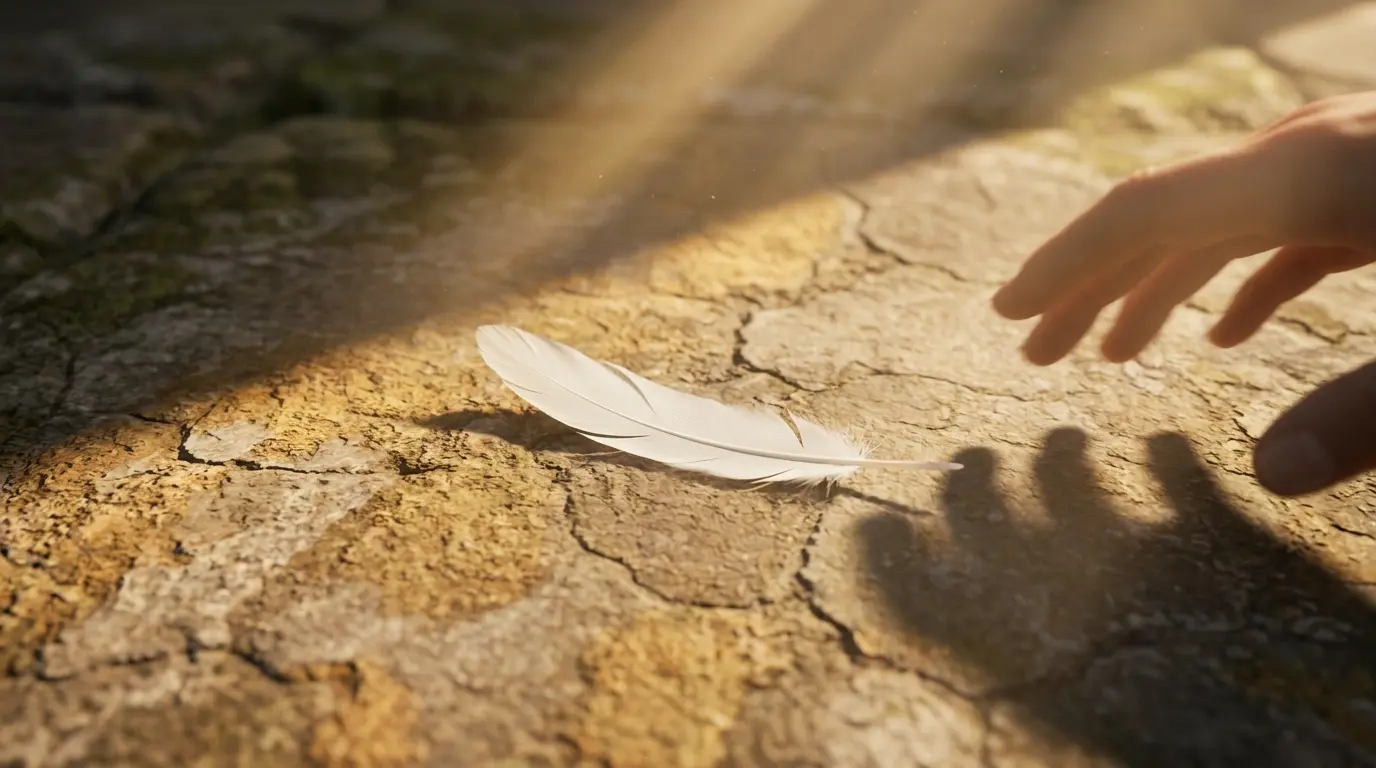
Mud. Wet earth. A cracked surface. A place that felt wrong.
This is the variation that unsettles people most — and the one that carries the most tension. A white feather on dark or dirty ground creates a visual contradiction: purity against discomfort. Peace offered in a context that does not feel peaceful.
Dreamers who report this version are frequently going through something they cannot reconcile emotionally. Grief mixed with relief. Love mixed with resentment. The dream does not resolve the contradiction. It simply presents it — and watches what the dreamer does.
What You Did With the Feather Matters More Than What It Means
Here is where most interpretations stop too early. In any version of the finding white feather on ground dream, analysts define the feather, assign it a category — peace, angel, deceased loved one, new beginning — and move on.
But the dream did not end when the feather appeared. The dream continued — and what happened next is where the real reading lives.
If you picked it up and kept it. This gesture suggests acceptance. Whatever the feather represents — comfort, closure, permission — the dreamer received it. Not passively. Actively. The act of picking something up from the ground requires bending, reaching, choosing. That is not a small motion inside a dream.
If you picked it up and let it go. Ambivalence. The dreamer recognized the message but was not ready to hold it. This sometimes appears when the peace being offered comes too soon — when grief has not finished its work, or when accepting comfort would mean accepting that something is truly over.
If you looked at it but did not touch it. Observation without commitment. The dreamer sees the sign, registers it, but does not engage. This can mean the dreamer is still processing — or it can mean the dreamer does not trust what is being offered. Both readings are valid. The difference usually lives in the feeling that accompanied the hesitation.
If you walked past it or stepped on it without noticing. This is rarer in recall, because dreamers who remember the feather usually remember it because they noticed it. But in dreams where the feather was noticed only in retrospect — recalled after waking, as if the mind flagged it after the fact — the dream may be pointing to something the dreamer is actively overlooking in waking life. Not refusing. Just not seeing yet.
FAQ
Does a white feather in a dream always mean a message from someone who died?
Not necessarily. When finding white feather on ground dream imagery is grief-related, the dreamer usually knows, without explanation, who the feather is “from.” When that recognition is absent, the feather may reflect peace being offered from a different source: the dreamer’s own transition, a decision reaching completion, or simply the nervous system processing a period of tension. The grief connection is real for many, but it is not the only reading available.
What if the feather in the dream was dirty or damaged?
A damaged feather does not cancel the symbol. It complicates it. A white feather with mud, bent quills, or discoloration may reflect peace that has been through something — comfort that arrives imperfect, or a message that took too long to reach the dreamer. Some interpret this as a sign that the source of the message endured difficulty before sending it. Others read it as the dreamer’s own resistance making the symbol harder to receive cleanly.
Is finding a white feather on the ground in a dream different from dreaming of a feather floating in the air?
Yes. A floating feather implies delivery — something arriving, moving toward you, in transit. A feather on the ground implies arrival already completed. It has been there. The question is not whether it will reach you but whether you will reach it. The emotional tone also differs: floating feathers tend to evoke wonder or lightness, while grounded feathers tend to evoke recognition or quiet weight. The ground anchors the symbol in something concrete, which usually makes the reading more personal and less abstract.
The Next Time the Feather Appears on the Ground
One night — maybe weeks from now, maybe sooner — the dream will come back. Not identically. The room may change. The light may shift. But the feather will be there again, white and still, resting on a surface below your line of sight.
This time, you will notice things you missed before. The texture of the ground. Whether the feather was centered or tucked near an edge. Whether your body moved toward it or your eyes arrived first. These are not decorative details. In the grammar of this particular dream, they are the sentence structure.
The feather itself will not have changed. It will still be white. It will still be quiet. It will still carry the same shape it always has — the shape of something that once belonged to flight and now belongs to rest.
What changes is you. What you choose to do with it. Whether you bend down or keep walking. Whether you hold it or just look.
The meaning was never sealed inside the feather. It was always in the gesture — yours — the one the dream has been rehearsing, waiting for you to complete.
Some signs repeat in clusters — seeing 333 on clocks, finding feathers, waking at odd hours — and the pattern often says more than any single occurrence.
If the feather showed up while you were awake rather than dreaming, the reading shifts — finding a white feather in waking life carries its own layered history worth knowing.
This article explores symbolic, cultural, and reflective interpretations of dream imagery. It does not constitute psychological advice, clinical diagnosis, or spiritual prescription. Dreams are deeply personal, and their meaning belongs to the dreamer — not to any single framework of interpretation.




Alex Turner
Alex Turner is the editorial pen name used for articles published on Signs of Universe. The website covers dreams, symbolism, and cultural interpretations for informational and reflective purposes. Alex Turner is not a medical, mental health, scientific, or spiritual authority.