Why Dogs Stare at Empty Corners: Canine Perception or Something Beyond the Physical?
Your dog is not staring at nothing. “Nothing” is a human word for a human limitation.
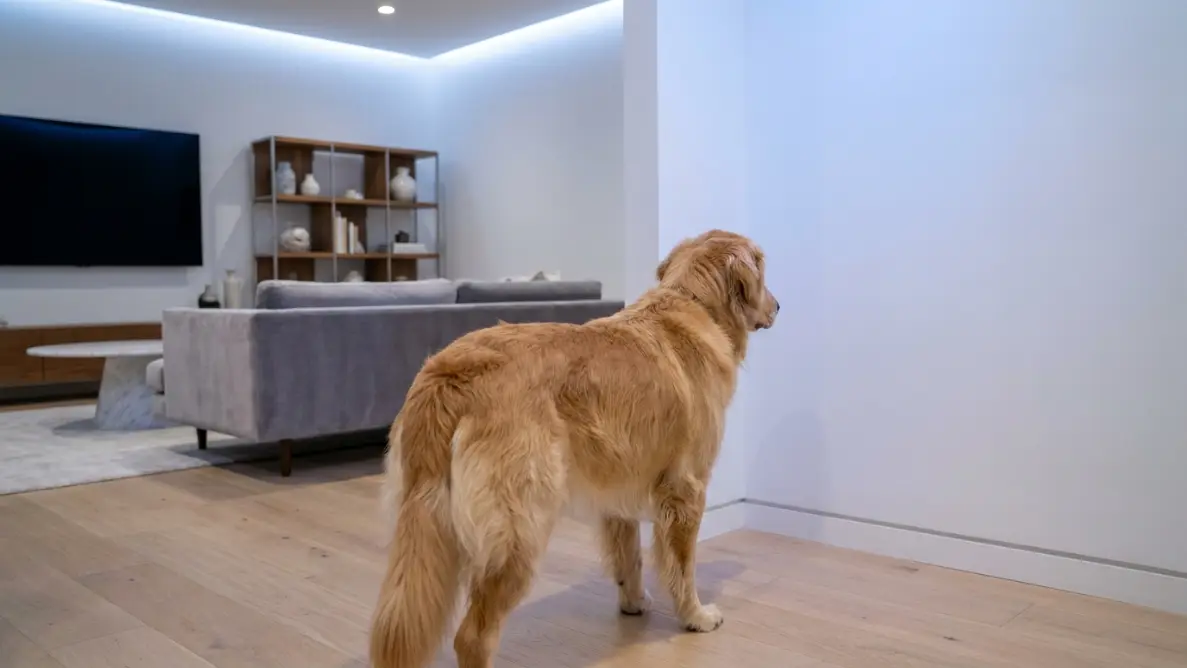
That frozen moment — head low, ears tilted, eyes locked on a corner where you see bare wall and shadow — unsettles you not because your dog is behaving strangely. It unsettles you because somewhere behind your ribs, you suspect your dog is registering something your own senses edited out.
The phrase dogs staring at nothing spiritual meaning pulls thousands of searches every month, but the question behind it is older than search engines. It is the question of a species that built microscopes and telescopes but still cannot see what a sixty-pound Labrador detects in the corner of a living room at 2 AM.
What makes this particular behavior so difficult to dismiss is how specific it is. Not barking. Not pacing. Just stillness, aimed at a fixed point. The behavior sits at a strange intersection — part sensory biology, part unresolved cultural memory, part something that resists easy classification. Whether the answer lives in ultraviolet light, in ancient mythology, or in the emotional weather of the household itself depends less on the dog and more on how honestly you are willing to look at the edges of your own perception.
The Part Where You Watched Your Dog and Felt Something Shift
It probably started as a joke. Your dog was staring at the corner behind the couch, and you said something like who’s there? in a voice that was half playful, half not.
Then the dog didn’t move.
Not the ears. Not the tail. Not the weight shifting between paws. Just a fixed, directional stare at a point in the room where absolutely nothing — by your standards — existed. And in that pause, something in your chest tightened. Not fear exactly. More like the sudden awareness that your perceptual toolkit might be incomplete.
This is the part nobody writes about. Most articles about this behavior rush toward explanations: it’s hearing, it’s smell, it’s cognitive dysfunction in older dogs. And some of those explanations are real, verifiable, important. But what gets skipped is the moment before the explanation — the moment where the human, not the dog, becomes the subject. You are the one who felt something shift. The dog just kept looking.
That reaction is worth noticing. Because the discomfort behind every search for dogs staring at nothing spiritual meaning is not random. It is the friction between two perceptual systems sharing the same room but not the same reality. Unlike a cat that watches you with a gaze that feels evaluative and personal, the dog’s stare isn’t directed at you at all. It is directed past you. At something you cannot audit.
Dogs Staring at Nothing: What They Perceive That You Cannot
Here is where the biology gets strange enough to matter.
In 2014, researchers Ronald H. Douglas and Glen Jeffery published a study in Proceedings of the Royal Society B examining the ocular lenses of dozens of mammalian species. They found that the canine lens transmits a significant amount of ultraviolet light — approximately 61% of UVA reaches the dog’s retina. Human lenses block almost all of it. This means your dog is not just hearing or smelling things you cannot. Your dog is literally seeing a layer of visual information that your eyes are physically incapable of processing.
That sentence deserves a second read.
The wall you see as blank may contain UV-reflective traces — residue, fibers, biological deposits, marks left by insects or other animals — that fluoresce in a spectral range your retina filters out before it ever reaches your conscious awareness. Your dog is not hallucinating. Your dog may be watching something real that exists outside your visible bandwidth.
Layer in audition. The American Kennel Club notes that dogs can detect sound frequencies up to approximately 65,000 Hz. Humans top out around 20,000 Hz, and that ceiling drops with age. Pipes contracting inside walls, electrical wiring carrying faint hum, rodents shifting between insulation layers — all of these produce sounds your dog may triangulate to a specific point on the wall. What looks like a blank stare is spatial targeting.
Then there is olfaction. Estimates place canine smell sensitivity at 10,000 to 100,000 times greater than a human’s. A dog can detect scent in layers — not just what is there, but when it was there and which direction it moved. When your dog stares at a corner, it may be processing a scent trail with a temporal dimension you cannot imagine having.
So before any spiritual interpretation enters the conversation, the baseline reality is this: your dog has access to an entire floor of sensory data that your biology locked behind a door you didn’t know existed.
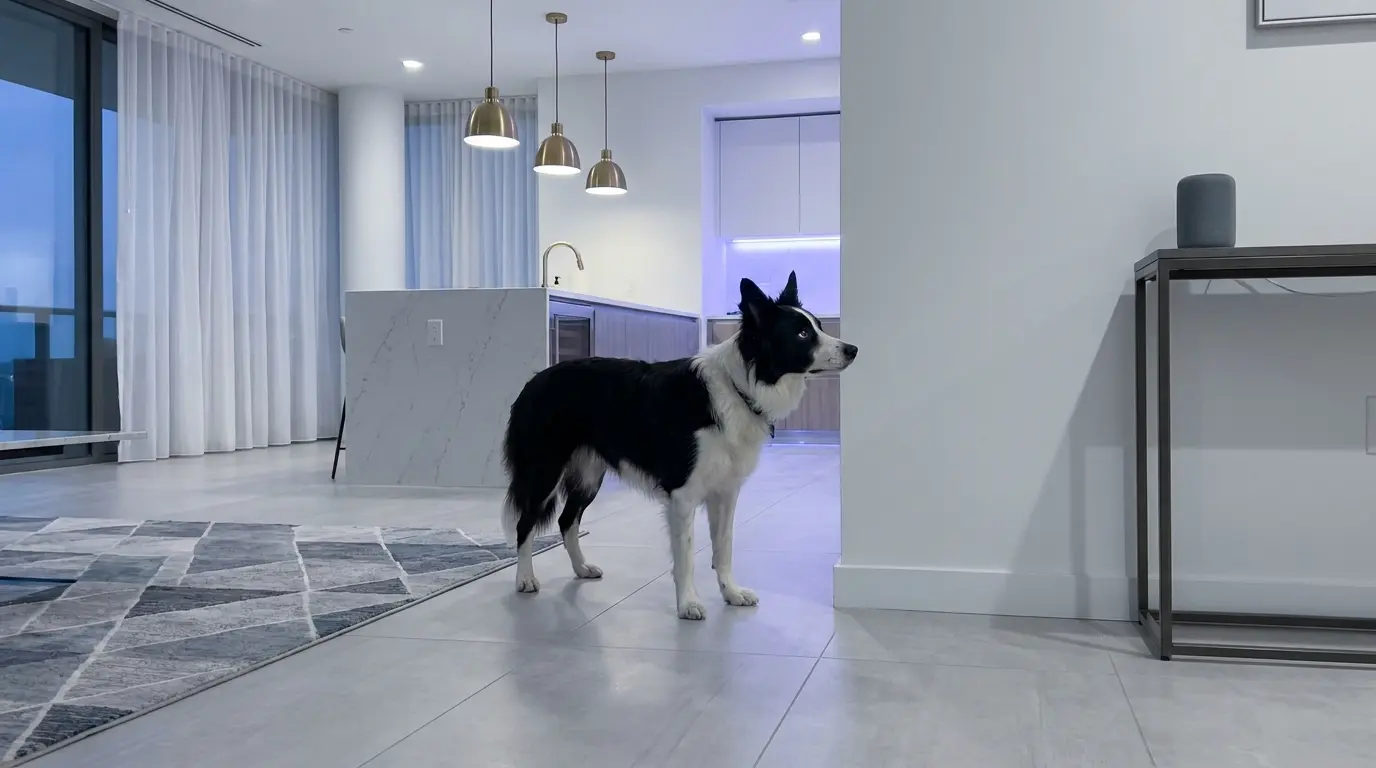
The Dog That Stands Between Worlds
Biology explains what the dog perceives. It does not explain why humans, across millennia and continents, kept assigning the dog a specific mythological role: the animal that watches thresholds.
Not the horse. Not the eagle. Not the cat, which was sacred in its own right but associated with independence and interior knowledge. The dog was given a different assignment. The dog was placed at the boundary — between the living and the dead, between the known world and whatever waited past its edge.
The clearest example is Anubis in ancient Egypt. Most people know Anubis as a jackal-headed god associated with death, but that summary flattens something important. According to the World History Encyclopedia, Anubis functioned as a psychopomp — a guide of souls across the threshold between states of existence. His role in the Book of the Dead was not to judge or punish. It was to accompany. He stood at the scales during the Weighing of the Heart, steadying the plumb bob, ensuring the crossing was witnessed. His image appears on royal tombs from the First Dynasty of Egypt, roughly 3150 BCE — which means humans were already, five thousand years ago, depicting a canine figure standing at the exact boundary between what is visible and what is not.
The Greeks had a parallel. Cerberus, the multi-headed dog guarding the entrance to the underworld, is usually described as a monster. But his function was not attack. His function was observation. He watched what crossed the threshold. He did not prevent the dead from entering. He prevented them from leaving. That distinction matters: the dog at the boundary is not a weapon. It is a witness.
When your dog stares at an empty corner, you may be watching a modern echo of a very old archetype — the animal whose gaze marks the edge of a perceptual frontier. Whether that frontier is biological (UV light, ultrasonic sound) or something less measurable depends on where you stand. But the behavior people describe when searching dogs staring at nothing spiritual meaning — fixed, silent, directional — maps precisely onto the mythological assignment humans gave dogs for thousands of years.
Some people experience something adjacent to this when they sense an unseen presence nearby in their own home. The difference is that the human doubts the feeling. The dog does not.
What the Corner Knows That the Room Doesn’t
Here is where context replaces formula.
Three dogs. Three corners. Three entirely different readings.
The old shepherd mix in the house after the funeral. The family had just lost a grandmother who lived in that home for thirty-one years. The dog — fourteen years old, arthritic, mostly deaf — began sitting in front of the hallway corner near the bedroom that had been hers. Not whimpering. Not agitated. Just sitting, oriented toward a point about three feet above the floor, for periods of twenty to forty minutes. The family had cleaned the room, removed the hospital bed, repainted. The dog kept returning. Some would call this signs during grief — the animal responding to olfactory residue so deep in the walls that no human nose could detect it. Others would call it something that doesn’t have a clinical word yet. Both readings are honest.
The puppy in the apartment the couple just moved into. Eight months old, high energy, no history of fixation behavior. Within the first week, the puppy began staring at the upper corner of the living room near the ceiling vent. Only in the evening. Only when the heating system was running. The most likely explanation: the vent carried sounds — maybe from neighboring units, maybe from ductwork expansion — that the puppy’s ears could localize but the humans could not. Once the couple blocked the vent with a foam panel, the behavior stopped within two days. Not every stare is a signal. Some stares are acoustics.
The adult border collie who only does it at night. No recent death. No new apartment. No vent. The dog is four years old, healthy, high-scoring on every behavioral assessment. But between roughly 11 PM and 1 AM, two or three nights per week, the dog walks to the same corner of the dining room, sits, and stares. The owner has checked for pests, had an electrician inspect the wiring, put a camera on the spot. Nothing visible. Nothing audible to human equipment. The behavior has continued for eighteen months. The owner describes it as “the thing I stopped trying to explain.”
Three dogs, three contexts, three different weights of meaning. What separates them is not the behavior — it is the surrounding architecture of the life in which the behavior appeared.
One important note, though: if your dog stares fixedly at walls or corners with increasing frequency, seems disoriented afterward, shows changes in sleep, appetite, or coordination, or displays signs like unresponsiveness, circling, or subtle seizure-like episodes, this pattern may reflect something that deserves professional attention. Canine Cognitive Dysfunction, partial seizures, vision changes, and compulsive disorders can all produce wall-staring as an early sign. A veterinary evaluation is not an overreaction — it is a reasonable step, especially in senior dogs.
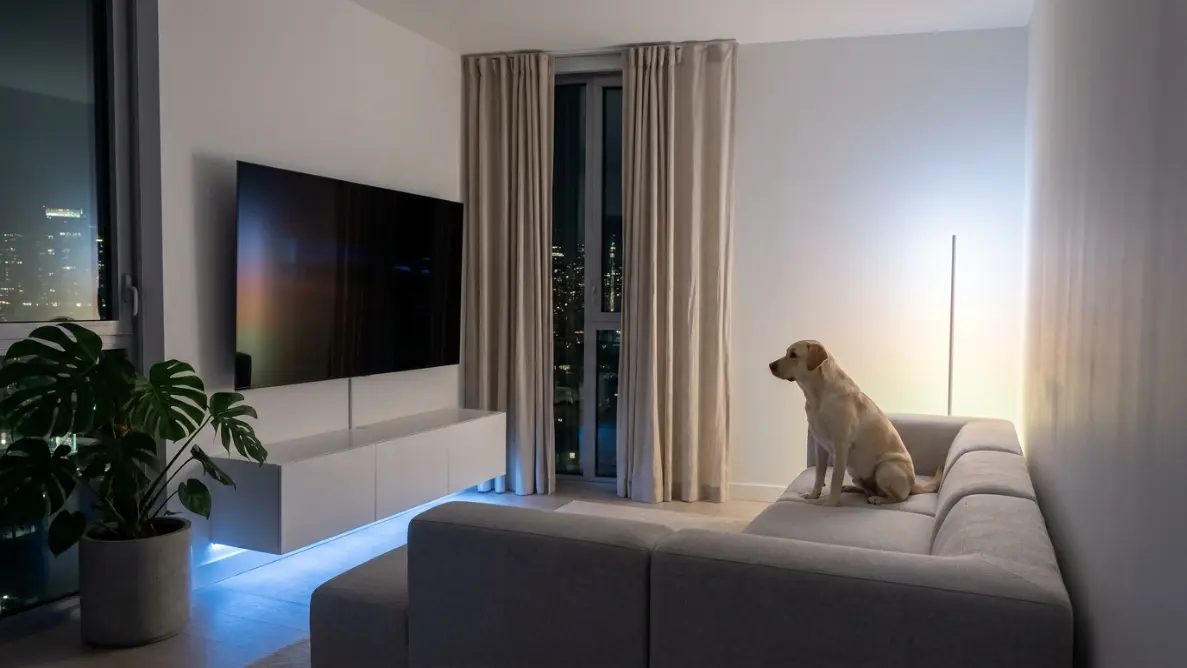
Dogs Staring at Nothing Spiritual Meaning: FAQ
Can dogs see ghosts?
The question at the heart of dogs staring at nothing spiritual meaning has no clinical confirmation or denial. What research has confirmed is that dogs perceive ultraviolet light, ultrasonic frequencies, and scent layers that are entirely invisible to humans. Whether what they detect in those ranges includes something nonphysical is a question science has not answered — not because the answer is no, but because the question falls outside current methodology.
Should I worry if my dog stares at walls?
Occasional staring at a specific spot is usually harmless — your dog may be tracking a sound, scent, or light pattern you cannot detect. But if the behavior becomes frequent, prolonged, or is accompanied by disorientation, changes in routine, loss of appetite, unresponsiveness to your voice, circling, or seizure-like episodes, consider scheduling a veterinary evaluation. In older dogs especially, wall-staring can be an early sign of Canine Cognitive Dysfunction or other neurological conditions that benefit from early attention.
Why does my dog only stare at corners at night?
Corners are where walls create acoustic and olfactory convergence — sounds and scents traveling along surfaces collect where surfaces meet. At night, ambient noise drops, human activity decreases, and your dog’s sensory system operates with less competition. The stare may intensify at night simply because the signal-to-noise ratio improves. Your dog was probably detecting the same thing during the day. You just didn’t notice because neither of you was still enough.
The Next Time Your Dog Freezes and You Hold Your Breath
It will happen again. Maybe tonight, maybe next Tuesday at 1 AM. Your dog will stop mid-step in the hallway, rotate its head toward a corner, and hold.
You will feel that pull in your chest — the same one that made you search dogs staring at nothing spiritual meaning in the first place — the one that says look where the dog is looking. You will glance at the corner and see nothing. The wall. A shadow. Maybe a faint line where the paint caught the roller unevenly.
But here is what you might try, just once. Instead of pulling the dog away, or saying its name, or reaching for your phone to record the moment — look at your own day. What were you carrying when you walked into that room? What conversation had you just ended? What were you avoiding thinking about? Because whether the dog is tracking a UV trace, a subsonic hum, or something without a name in English, the corner it chose is also the corner of your house where you happen to be standing. And sometimes the most useful question is not what does my dog see? It is what was I not looking at before my dog stopped and pointed?
The next time it happens, you might not get an answer. But you will be paying attention. And that, according to five thousand years of mythology about dogs standing at boundaries, is exactly the point.
The interpretations in this article reflect symbolic, cultural, and reflective perspectives — not clinical claims. Canine behavior can carry many layers of meaning, but if your dog’s staring is frequent, sudden, or accompanied by other behavioral changes, a veterinary consultation is always a reasonable first step. No spiritual reading replaces professional observation of your animal’s health.


Alex Turner
Alex Turner is the editorial pen name used for articles published on Signs of Universe. The website covers dreams, symbolism, and cultural interpretations for informational and reflective purposes. Alex Turner is not a medical, mental health, scientific, or spiritual authority.