Clock Stopped at Specific Time Spiritual Meaning: Closure or Coincidence?
A clock stopping at a specific time does not establish a spiritual message. Check its power supply and mechanism first. If the displayed time reminds you of a person, loss, or turning point, you can treat that connection as personal symbolism without using it to predict events.
A stopped clock can be mechanical, electrical, accidental, symbolic, or all of those at once. The real question is not only why it stopped, but why that exact time felt addressed to you. A useful reading begins with the object, moves through memory, and ends without giving the clock authority over your life.
On this page
The Minute the Clock Refused to Move
A Clock Is a Machine Before It Becomes a Message
Why One Frozen Time Feels More Personal Than a Repeating Number
How to Read the Time Without Letting It Decide for You
Small Questions About a Clock That Stopped
What to Do With the Clock Now
The Minute the Clock Refused to Move
The strange part is usually not the clock. It is the match.
A kitchen clock stuck at 6:12 would be forgettable until 6:12 was the time printed on a hospital note, the time a voicemail arrived, or the minute you remember walking out of a room for the last time. The same hands that once moved quietly now point like evidence.
This is where the spiritual meaning of a clock stopped at a specific time begins: not in the clock alone, but in the collision between timekeeping and personal memory. A clock does not have to be mystical to become emotionally charged.
That is why this experience often feels more intimate than seeing a sign hours later. With a sign arriving later, the question is usually about timing and recognition. With a dead clock, the question becomes colder and more physical: when did this object stop, and why does that minute feel selected?
When the Time Matches Something Too Precisely
A meaningful match does not need to prove anything to matter.
The same is true of a wrong turn that lands you somewhere meaningful, where the timing matters more than any proof.
If the stopped time connects to a death, a breakup, a move, a phone call, a dream, or a decision, the clock may function like an emotional timestamp. It gathers the surrounding story into one visible number. That can feel like closure, but it can also feel like pressure.
A stopped clock can invite interpretation without becoming instruction. The hour may reflect what you have already been carrying, not deliver a new command. If 9:18 matters because someone was born on September 18, the meaning lives partly in the calendar, partly in memory, and partly in your reaction when you found it.
The useful question is not “What cosmic message is this?” The better question is: what did this frozen minute bring back before you tried to explain it?
A Clock Is a Machine Before It Becomes a Message
Before a stopped clock becomes symbolic, it is a device that failed to keep moving.
A clock needs a working source of power and a mechanism or electronic system that advances the display. Identifying its type is more useful than assuming that a meaningful number explains the failure. If you are also noticing flickering lights, record them separately: changes in light output raise electrical questions that a stopped time display does not answer.
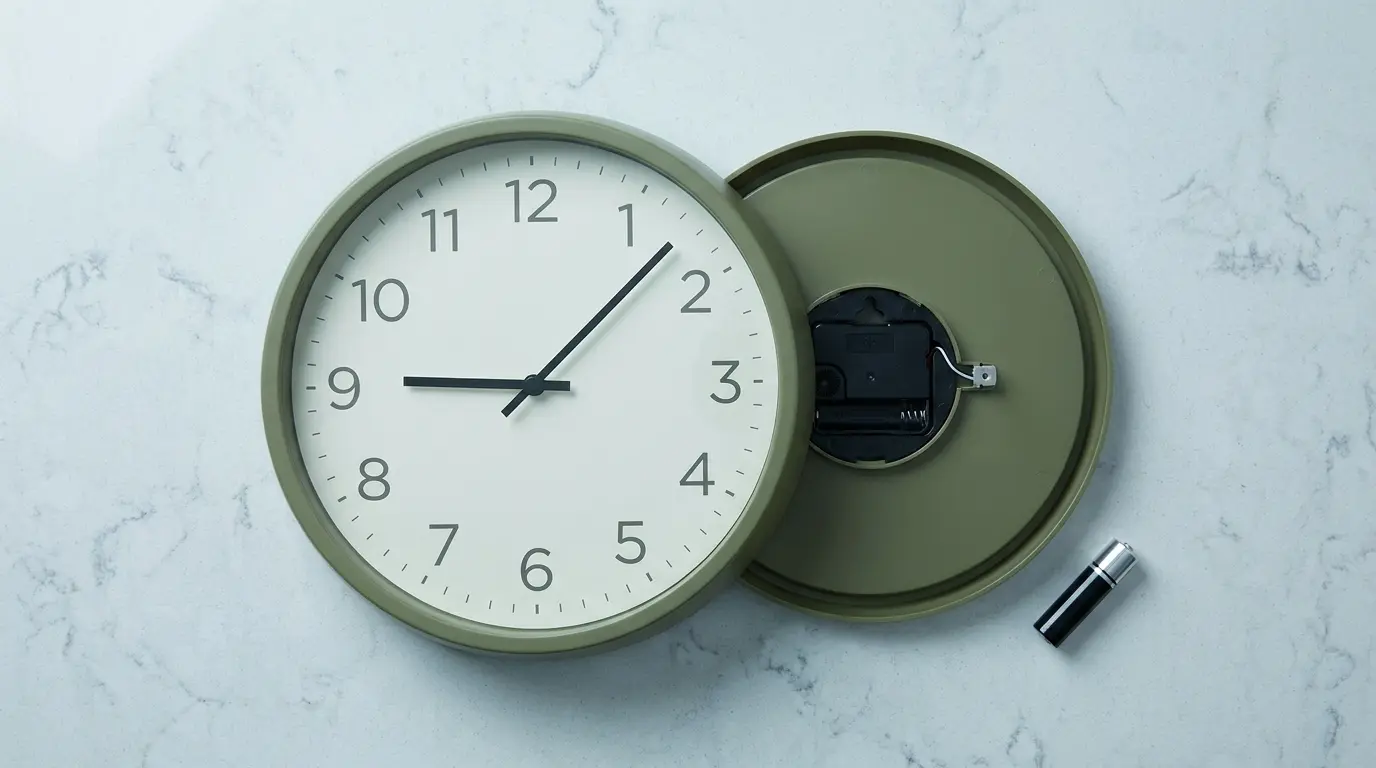
Start with the physical object. For a battery clock, check the battery and the manufacturer’s instructions. For a wind-up clock, check its winding requirements. If there is damage, an electrical concern, or a fault you cannot safely identify, ask an appropriate repairer.
None of that cancels symbolism. It only prevents panic from pretending to be insight.
Battery, Winding, Quartz, and the Last Known Movement
The most grounded reading starts with the last known movement.
Was the clock battery-powered, wind-up, plug-in, digital, or part of an appliance? Did every clock in the room stop, or only one? Was there a power outage? Was the clock recently moved, cleaned, bumped, stored, or exposed to moisture?
Then establish the observation window. If you last saw the clock working at 8:00 and noticed the fault later, that narrows when a problem may have developed. It does not prove the hands show the exact real-world minute of failure: the clock may already have been slow, incorrectly set, or moving intermittently. An analog dial also cannot normally establish AM or PM.
This is the difference between a timestamp and a projection.
The Stopped-Clock Illusion Is Not the Same as a Stopped Clock
There is also a perception issue worth separating from the object itself.
A 2001 study by Kielan Yarrow and colleagues in Nature investigated chronostasis: after moving their eyes toward a ticking clock, observers can perceive the first interval as unusually long. The clock appears briefly stopped even though it continues to run. This is a finding about perception, not a device losing power.
That distinction is useful. Chronostasis is about perception. A dead wall clock is about an object that no longer moves. If the second hand looked frozen for a moment and then continued, you may have witnessed a perceptual oddity. If the same clock stayed stopped for hours or days, you are dealing with mechanical failure plus personal interpretation.
Why One Frozen Time Feels More Personal Than a Repeating Number
A repeating number on a working clock and a time on a stopped clock raise different practical questions. With the first, you are noticing a display as it changes. With the second, you need to determine why it no longer advances.
Seeing 11:11 or 333 on clocks can feel like recurrence, symmetry, or a pattern you keep meeting. A stopped clock removes motion and leaves one time behind like a pin in fabric.
If it is the repeated appearance of a time that concerns you, the related discussion of 11:11 on the clock addresses that experience. Here, the focus is the failed timekeeping device and your association with its display.
A Repeating Number Reappears; A Dead Clock Stays
Repeated numbers often depend on your attention meeting a moving system. The clock continues. The day continues. You catch the number, lose it, and maybe catch it again later.
A dead clock creates a small private monument.
In a heritage article about Victorian funeral customs, Adrian Bean of Foster Hill Road Cemetery describes people deliberately stopping clocks to mark a death, alongside beliefs about the spirit’s passage. This was a human ritual. It does not establish that an unattended clock stopping predicts or detects a death.
The symbol did not come from nowhere.
When Grief Turns a Time Into an Address
Grief often makes time behave differently in memory.
A 2023 Nature Communications study by Mason McClay, Matthew Sachs, and David Clewett examined how changing emotional states shaped memory for sequences of images while participants listened to music. It concerns experimentally structured experiences, not bereavement, spiritual signs, or clocks stopping.
The study does not demonstrate why a particular clock feels meaningful during grief. That connection is better described as a personal association: the displayed time may bring a final conversation, a date, or someone you miss to mind.
That is also why signs during grief should be handled gently. A clock stopped at the time someone died may feel comforting to one person and frightening to another. Neither reaction needs to become a universal rule.
Meaning is not proof. It is a relationship between an event, an object, and the person who notices.
How to Read the Time Without Letting It Decide for You
Keep the interpretation proportional to what you actually know.
Do not begin with the most dramatic interpretation. Begin with the clock. Then look at the time. Then look at the connection. Then look at what changed after you found it. This sequence allows symbolism without handing the clock your decision.
Use a simple reconstruction:
- Identify the exact stopped time, including AM or PM only if the clock makes that clear.
- Check the type of clock and the likely reason it stopped.
- Establish the last moment someone saw it working.
- Name the first memory, person, date, or event the time brought to mind.
- Notice whether the meaning creates calm, fear, pressure, tenderness, or closure.
- Compare the emotional reaction with the actual evidence.
If the time reminds you of a loss, the guide to 444 after losing someone offers ways to use a number as an optional reminder without treating it as verified contact.
If the clock stopped at 10:22 and October 22 is important to you, the connection may be symbolically meaningful. If you had to search through many possible dates until one fit, the match is weaker. A responsible interpretation does not force the minute to carry more weight than it can hold.
Match the Time to the Event, Not the Fear
Fear is fast. Meaning is slower.
If the first thought is “something bad is coming,” test that thought against the actual context. Did the clock stop after a power outage? Was it old? Did it fall? Was the battery already weak? Did the time match something painful, or did the fear arrive first and begin hunting for a reason?
A stopped clock can mark closure rather than danger. It may represent an ending already lived, not a warning about something ahead. It may also be nothing more than a failed object that happened to stop on a charged number.
The difference is not always obvious. That is why the reading should stay modest.
Ask What Changed After You Found It
A meaningful sign usually changes attention before it changes circumstances.
After finding the clock, did you remember someone? Did you finally accept that a chapter ended? Did you repair an object you had ignored? Did you decide to keep the clock stopped as a memorial, or did you feel better after replacing the battery?
These responses reveal the real function of the moment.
Your response can reveal what you associate with the time; it cannot establish what caused the mechanism to stop.
If the stopped time helped you honor a memory, the symbol may have served closure. If it made you feel trapped, watched, or afraid, the healthier response may be to return the clock to ordinary function. Fix it. Move it. Replace the battery. Let the object become a clock again.
That is not disrespectful. Sometimes restoring movement is the symbolic act.
If an object breaking unexpectedly raised the same question for you, compare broken mirror symbolism. A stopped clock draws attention to a displayed time; a broken mirror draws attention to a reflection. Neither object establishes a prediction.
Small Questions About a Clock That Stopped
Is a stopped clock a sign someone died?
A stopped clock does not prove that someone died. Some mourning traditions did stop clocks after a death, but that was a human ritual, not evidence that every frozen clock carries the same meaning.
If the stopped time matches a death or a moment of grief, it may feel symbolically powerful. Hold that meaning carefully, without turning it into a rule for other people or a prediction about the future.
What if the clock stopped at 3:33 or 11:11?
If a clock stopped at 3:33, 11:11, or another repeating number, the number may be part of why the moment feels charged. Still, the object matters first. A moving clock showing 11:11 is different from a dead clock frozen there for days.
Read the number and the mechanism together. The spiritual meaning may be less about the number alone and more about why this particular clock stopped carrying time forward.
Should you fix a clock that stopped at a meaningful time?
You can fix it. You can also preserve it, if doing so brings calm rather than distress.
A clock stopped at a specific time does not need to remain frozen to keep its meaning. Taking a photo, remembering the context, and restoring the clock may be enough. If keeping it stopped makes the room feel heavier, letting it move again may be the cleaner symbolic choice.
What to Do With the Clock Now
A stopped clock is not proof that fate reached into the room.
It is a machine that failed at a minute your mind may refuse to treat as random. Sometimes the explanation is battery, dust, wiring, gravity, or age. Sometimes the meaning is grief, closure, memory, or the strange human need to see one moment held still long enough to understand it.
A frozen time can become a personal reminder of a person, loss, decision, or ending. That meaning is something you associate with the object, rather than a message whose sender has been established.
Before you decide what it means, reconstruct the last minute the clock can honestly give you. Check the mechanism. Check the timeline. Check the memory that answered first. Then choose what the object should become now: repaired clock, quiet memorial, or ordinary thing returned to the wall.
Interpretive note
This article is symbolic, reflective, and informational. A stopped clock does not prove death, destiny, a spiritual warning, or an absolute supernatural message.
If the stopped time is connected to grief, anxiety, intrusive fear, or recurring distress, seek appropriate human or professional support. Symbolic interpretation can offer language for meaning, but it should not replace care, conversation, or grounded help.

Alex Turner
Alex Turner is the editorial pen name used for articles published on Signs of Universe. The website covers dreams, symbolism, and cultural interpretations for informational and reflective purposes. Alex Turner is not a medical, mental health, scientific, or spiritual authority.