

Are you using spiritual affirmations at night? It’s 3 a.m. You’re wide awake — and it doesn’t feel like an accident.
Something pulled you out of sleep. Maybe it was a thought you couldn’t shake, a question that’s been following you for weeks, or just a strange, quiet feeling that the universe was listening right now, more than it ever does in the middle of a busy afternoon.
If you’ve ever found yourself awake in the deep hours of the night wondering whether this is more than a coincidence, you’re not alone. Many people report that the period between midnight and 4 a.m. feels distinctly different — spiritually charged, almost like a door left slightly open.
This is exactly the kind of moment where spiritual affirmations can become something more than positive self-talk. When used intentionally in the stillness of the night, they may act as a bridge between your conscious desires and the deeper signals the universe seems to offer.
In this guide, we’ll explore why the nighttime holds such symbolic weight, how to craft affirmations that feel aligned and sincere, and what to look for in the days that follow as potential answers.
Quick Summary
- The middle of the night is widely considered a spiritually sensitive time in many traditions
- Spiritual affirmations at night work differently than daytime affirmations — the mind is more open and less defended
- Effective night affirmations are specific, emotionally resonant, and framed as openness rather than demands
- Signs and answers from the universe may arrive subtly — through dreams, synchronicities, or unexpected conversations
- Consistency matters: a nightly affirmation practice can gradually shift your awareness to receive more guidance
Why the Middle of the Night Feels Spiritually Different
You may have wondered why waking up at 3 a.m. feels so significant, or why certain thoughts feel louder in the dark. Across different spiritual traditions, the late-night hours — especially between midnight and 4 a.m. — are described as a threshold time.
In some folk traditions, this window is called the “witching hour” or the “hour of the veil,” a period when the boundary between the physical world and subtler planes of existence is thought to be thinner. In many Indigenous and Eastern traditions, deep night is associated with receptivity, the unconscious, and the realm of dreams — all of which are believed to connect directly to higher guidance.
From a more symbolic perspective, nighttime represents stillness, surrender, and the unknown — three qualities that many spiritual practitioners consider essential for receiving rather than doing. When we stop striving, stop planning, and stop performing, we may become more available to what the universe is trying to communicate.
This doesn’t mean you need to believe in any specific doctrine. Even from a purely personal standpoint, the stillness of the night makes it easier to hear your own inner voice — which many traditions simply call the universe speaking through you.

Scientific and Logical Perspective
Before diving deeper into spiritual interpretations, it’s worth acknowledging what science and psychology say about nighttime awareness.
Sleep cycles and waking windows: During a full night of sleep, humans cycle through different stages of REM and non-REM sleep. Waking naturally between 2–4 a.m. often coincides with the end of a REM cycle, when the brain is in a lighter, more alert state. During and after REM sleep, the brain is highly active, emotionally processing the day’s events.
The hypnagogic and hypnopompic states: The moments just before falling asleep (hypnagogic) and just after waking (hypnopompic) are known to be states where the brain is uniquely open to suggestion, imagery, and creative or intuitive thinking. Many inventors, artists, and thinkers have reported breakthrough ideas arriving in these in-between states.
Reduced mental noise: During the day, the prefrontal cortex — the brain’s analytical, critical center — is highly active. At night, especially after waking from a deep sleep, this activity is lower, which means your inner critic is quieter. Affirmations spoken or thought in this state face less internal resistance.
So whether you interpret this scientifically or spiritually, the conclusion is similar: the night is a uniquely powerful time to plant intentions in your own mind.
What Are Spiritual Affirmations, Exactly?
Many people report that the word “affirmation” carries some baggage — it can feel like forced positivity or wishful thinking. But spiritual affirmations are different in their intent.
Rather than simply repeating “I am rich” or “I am happy,” spiritual affirmations in the context of manifestation are more like sincere, open-hearted requests or declarations of alignment. They signal to yourself — and, symbolically, to the universe — what you’re seeking, what you’re open to receiving, and where you’re placing your focus.
Think of them less as demands and more as conversations with something larger than yourself.
Some spiritual traditions interpret this practice as literally communicating with spirit guides, angels, or a higher power. Others see it purely as a psychological tool for tuning your subconscious mind toward specific outcomes. Either way, the core mechanism is the same: you are actively shaping your inner state, and your inner state shapes what you notice in the world.
How to Use Spiritual Affirmations at Night: A Step-by-Step Guide
1. Create a Simple Ritual to Signal Intention
Before you speak your affirmations, your mind and body need a signal that something intentional is about to happen. This doesn’t need to be elaborate. It could be:
- Lighting a candle
- Taking three slow, deep breaths
- Sitting up in bed and placing both feet on the floor
- Holding a meaningful object (a crystal, a photograph, a small stone)
The ritual itself isn’t magic — the ritual is a permission slip you give yourself to enter a more receptive state.
2. Choose Affirmations That Feel True Enough to Believe
One of the most common mistakes with affirmations is choosing statements so far from your current reality that your mind immediately rejects them. For nighttime spiritual affirmations, aim for language that is open and seeking rather than declarative and demanding.
Examples of affirmations oriented toward receiving answers:
- “I am open to receiving clear guidance about [specific situation].”
- “The universe is already sending me signs. I trust that I will recognize them.”
- “I release the need to control the outcome. I am ready to receive direction.”
- “My path is becoming clearer with each day. I welcome the next sign.”
- “I am aligned with what is meant for me. I trust the timing of my life.”
Notice that these affirmations are phrased as trust and openness, not as certainties you don’t yet feel.
3. Speak Them Aloud — or Write Them Down
Whispering or softly speaking your affirmations activates different neural pathways than just thinking them. If speaking out loud feels strange at night, writing them in a small journal kept by your bed works beautifully.
Some people report that writing affirmations by hand — especially by candlelight or dim lamp — feels especially meaningful. There’s something about the physical act of forming each word that makes the intention feel more real.

4. End With a Statement of Surrender
This step is often overlooked but may be the most important. After stating your affirmations, add a closing line that releases the outcome. Something like:
- “I offer this intention to the universe and trust that what is meant for me will find me.”
- “I let go of how this arrives, and I remain open to any form this answer may take.”
Surrender doesn’t mean giving up. It means releasing the anxious grip of control so that guidance has room to appear in unexpected ways.
5. Pay Attention in the Days That Follow
The answer to your nighttime affirmations rarely arrives in a dramatic flash. More often, spiritual practitioners report noticing:
- A recurring word, phrase, or symbol appearing in unexpected places
- A dream that feels unusually vivid or meaningful
- An unprompted conversation that addresses exactly what you were seeking
- A sudden shift in how you feel about a decision — a quiet clarity
- A “coincidence” that feels too specific to be random
These are what many traditions call synchronicities — meaningful coincidences that arrive as a form of communication.
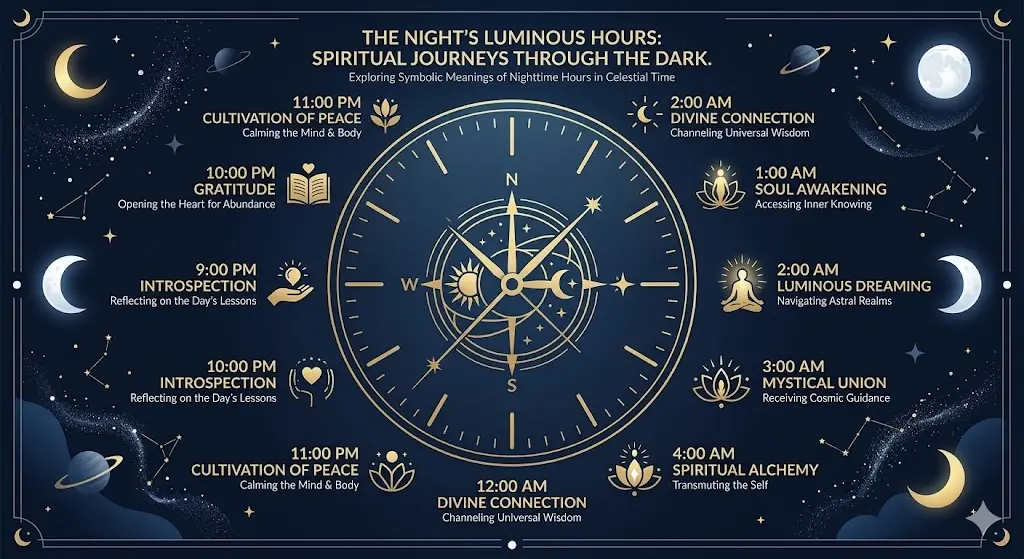
Symbolic Meanings: What Different Times of Night May Represent
| Time | Symbolic Association | Possible Spiritual Meaning |
|---|---|---|
| 12:00 AM (Midnight) | Threshold, new cycle | Beginnings, reset, major life transitions |
| 1:00–2:00 AM | Deep silence | Subconscious messages, inner truth surfacing |
| 3:00 AM | “Witching hour,” liminal space | Heightened spiritual sensitivity, messages from guides |
| 4:00 AM | Pre-dawn, emerging light | Clarity approaching, end of a difficult phase |
| 5:00 AM | First light, awakening | New perspectives, opportunities beginning to form |
Common Mistakes That Can Block Nighttime Manifestation
Even people with genuine spiritual intentions sometimes unknowingly undermine their practice. Here are a few patterns worth noticing:
Affirmations made from fear, not trust. If your nighttime practice is driven by panic — “Please make this work, I’m desperate” — the emotional vibration behind the words may not align with the openness needed to receive guidance. Try to approach affirmations from a place of genuine curiosity and trust rather than urgency.
Expecting a specific format for the answer. The universe rarely delivers guidance the way we expect it. If you’re waiting for a sign that looks exactly a certain way, you may miss the real signal entirely.
Performing the ritual while distracted. Scrolling through your phone, having background noise, or rushing through your affirmations defeats the purpose. The point is genuine stillness and presence.
Giving up after a few nights. Some answers arrive quickly. Others develop slowly over weeks. Consistency is more valuable than intensity.
FAQ
Q: Do I need to believe in God or a higher power to use spiritual affirmations at night? A: Not necessarily. Many people use spiritual affirmations as a psychological and mindfulness tool rather than a religious practice. The core function — directing your attention, relaxing mental defenses, and planting clear intentions — works regardless of your beliefs. What matters is that you approach the practice with sincerity.
Q: What if I fall asleep while saying my affirmations? A: Many practitioners actually consider this a good sign. Falling asleep while in a relaxed, intentional state allows your subconscious mind to continue processing those affirmations throughout your sleep. Don’t worry about “doing it wrong” — the intention has already been set.
Q: How long does it take to receive an answer from the universe after nighttime affirmations? A: There’s no fixed timeline. Some people notice meaningful synchronicities within a day or two; others report shifts that unfold over several weeks. The important thing is to remain observant and open in your daily life rather than waiting with expectation.
Q: Can I use affirmations to ask the universe specific yes-or-no questions? A: You can, though many spiritual practitioners suggest framing questions as an openness to clarity rather than demanding a binary answer. For example, instead of “Universe, should I take this job?” try “I am open to receiving clear inner guidance about this decision.” This keeps you receptive to nuanced answers, which are more likely to be accurate.
Q: Is there a “wrong” type of affirmation to use at night? A: In symbolic interpretations, affirmations driven by envy, harm, or control over others are generally considered misaligned — not because the universe will “punish” you, but because these intentions tend to keep your own mindset in a low-trust, fearful state. The most effective nighttime affirmations are rooted in clarity, gratitude, and sincere openness.
Conclusion
The middle of the night has always held a special place in human spirituality — not because it’s magical in a theatrical sense, but because the silence it offers is genuinely rare.
When the world quiets down and the mental noise fades, there’s a space for something more honest to surface. Spiritual affirmations spoken or written in that space aren’t just words. They’re a declaration of where you’re placing your attention, what you’re opening yourself to, and how willing you are to listen.
You don’t need elaborate rituals or a perfectly designed practice. A candle, a quiet moment, a few sincere words — and then the patience to watch how the universe responds in the days that follow.
If you wake up at 3 a.m. and the room feels still and oddly full, perhaps it’s an invitation. Not to worry, not to plan — but to speak, and then to listen.
The content of this article is intended for reflective and informational purposes only. The spiritual interpretations presented here are drawn from various traditions and symbolic frameworks and do not constitute religious, psychological, or medical advice. We encourage you to approach these ideas with curiosity and use your own discernment.