Why Finding an Old Key in the Street During Times of Uncertainty May Be a Sign from the Universe
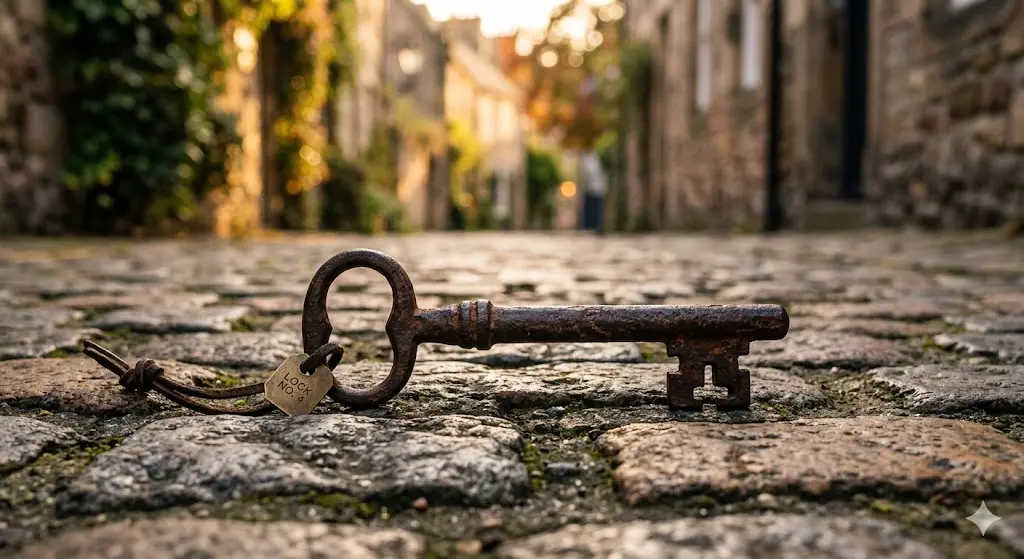
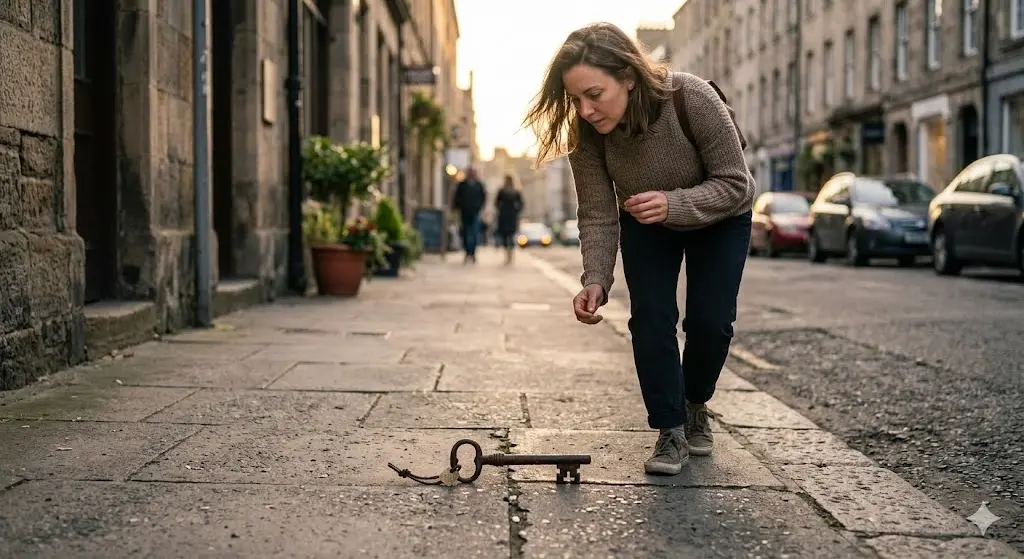
You’re walking down the street, your mind tangled in questions you can’t quite answer. Maybe you’ve been weighing a major career decision, wondering whether a relationship is still the right path, or simply feeling like your life needs to move in a different direction — but you don’t know which one. And then, almost out of nowhere, something small catches your eye on the pavement. An old key.
Not a shiny modern house key. Something older. Maybe rusted, a little worn, with an unusual shape that makes it look like it belongs to a different era entirely.
Why a Key, of All Things
Keys are among the most consistent symbols in human history, and the reason is structural rather than mystical: a key is the only common object whose entire purpose is to control access. It doesn’t do anything on its own. It exists solely to open what is otherwise closed. The same function-first method is useful with ring symbolism, where a shared circular form can carry very different meanings depending on what the ring was made to do.
That function helps explain why keys recur in symbolic art, but the traditions are not identical. The British Museum notes Janus as the Roman god of doors and shows later art with him holding a key. Christian art depicts Peter with the “keys of the kingdom”; The Metropolitan Museum of Art documents a Byzantine example tied to Matthew 16:19. The Egyptian ankh means “life,” according to British Museum teaching material; calling it a literal key is a later visual nickname, not evidence that these cultures shared one key doctrine.
The Egyptian ankh means “life,” according to British Museum teaching material; our guide to ankh meaning examines that interpretation through dated museum objects. Calling it a literal key is a later visual nickname, not evidence that these cultures shared one key doctrine.
Why an Old Key Reads Differently Than a New One
This is the detail that changes the interpretation most, and it’s worth being precise about why.
A modern key almost certainly has a lock that still exists — someone lost it this week, and somewhere there’s a door it still opens. An old, rusted, unusually shaped key very likely does not. The lock it was cut for is probably gone: a demolished building, a replaced door, a piece of furniture that no longer exists.
So an old key is a functional object that has outlived its function. That’s a considerably stranger thing to find than a lost house key, and it’s the source of most of the symbolic weight people feel. It’s an object built entirely around access, still intact, with nothing left to open.
The Readings People Reach For
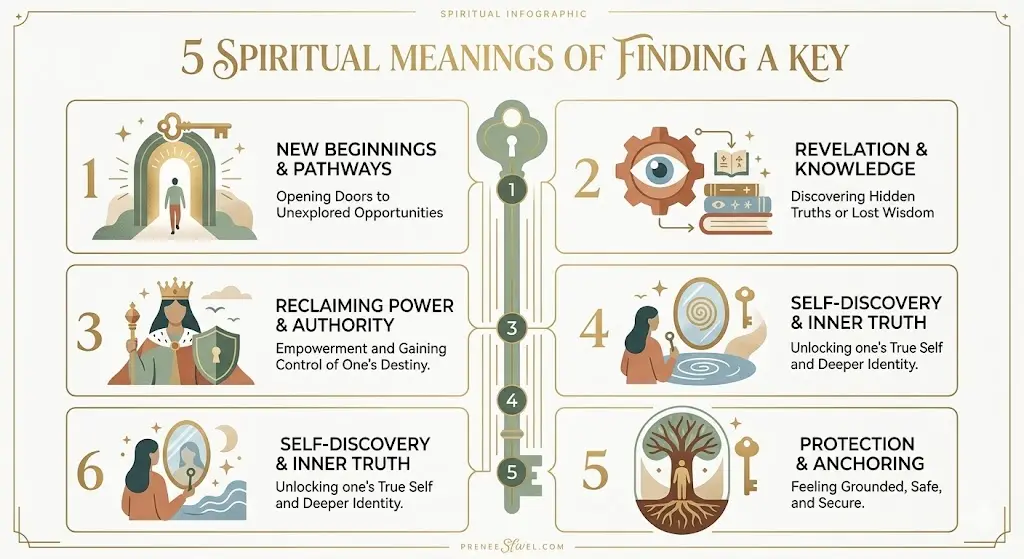
Most interpretations of a found key fall into two directions, and which one fits depends less on the key than on what’s happening in your life when you find it.
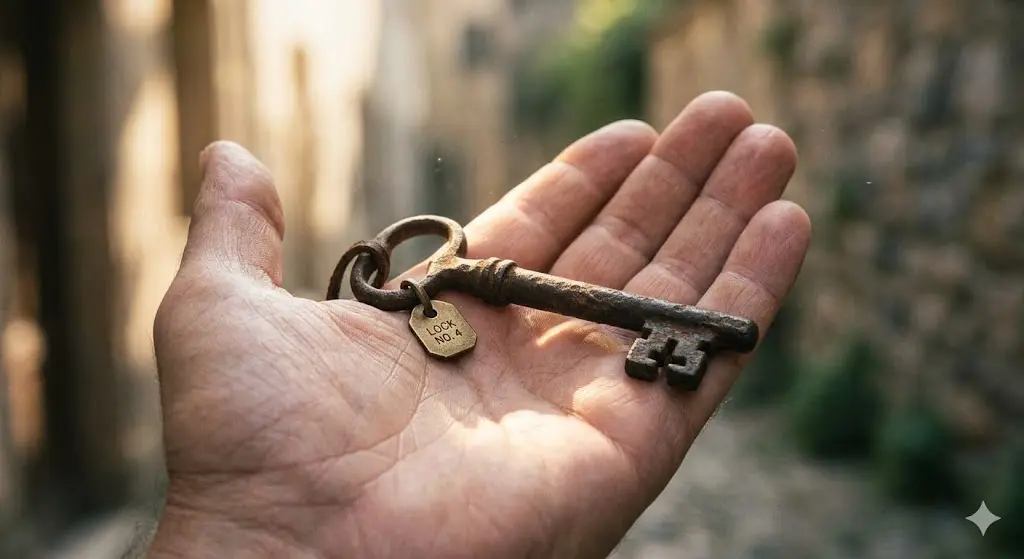
The forward-facing reading treats it as an opportunity approaching — a door opening whether or not you feel ready for it. There’s a specific version of this worth noting: you found the key rather than being handed it, and in symbolic terms that difference matters. Something discovered by your own attention reads differently from something given to you.
The backward-facing reading takes the dead lock seriously instead of ignoring it. A key that no longer fits anything can point at something in your own life that has quietly stopped fitting — a belief, a role, a plan you’re still carrying because it once worked, not because it still does. In this reading the key isn’t announcing a new door. It’s asking why you’re still holding one that opens nothing.
Neither reading is more legitimate than the other. The useful question is which one made your stomach drop slightly when you read it.
Does the Condition of the Key Matter?
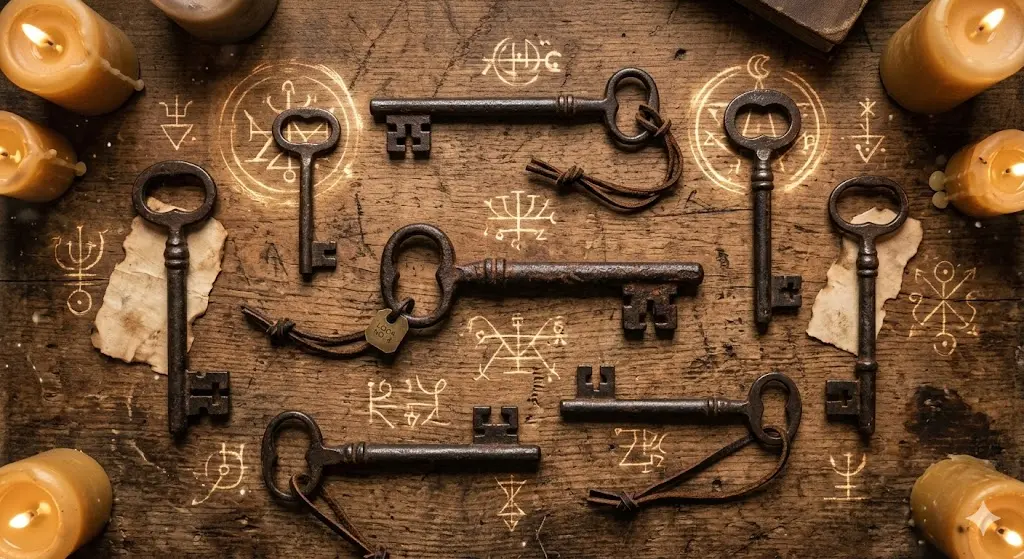
Somewhat, though less than the timing. A heavily rusted key emphasizes duration — something that has sat unused for a long time. An ornate or decorative key suggests it belonged to something that mattered enough to be made beautiful, which tends to be read as a rarer opportunity rather than an everyday one. A broken key is the most pointed version: not just a lock that’s gone, but a tool that couldn’t open it even if the lock remained. Finding several keys at once shifts the reading toward choice rather than access — more than one direction available, and the pressure that comes with that.
A golden or brass-colored key carries its own separate line of interpretation, closer to what shows up in dreams about golden keys, where the material matters as much as the object.
The Ordinary Explanation
Keys fall out of pockets constantly. Old ones get cleared out of drawers, dropped during moves, discarded when a house changes hands. Finding one on a sidewalk is genuinely common, and in most cases it’s exactly what it appears to be.
What makes it feel otherwise has a name: apophenia, the tendency to perceive meaningful patterns in unrelated events. When you’re already turning a question over in your mind, your attention is primed to catch anything that looks like an answer — and a key, of all objects, looks exactly like one.
That explanation doesn’t cancel the moment out. It just relocates where the meaning lives: not in the key arriving, but in what you were already carrying when you noticed it.
What to Do With It
Before walking on, notice what you were thinking about in the moment just before you spotted it. That question — not the key — is the thing worth writing down. If the key felt significant enough to pick up, keeping it as a marker of that moment is a perfectly reasonable thing to do, and so is setting it back down once you’ve registered what it prompted. There’s no tradition that requires one over the other.
The Question the Key Actually Asks
Strip away the traditions and one observation remains: you were carrying a question and noticed an object built to control access. You may receive that as a spiritual symbol, an attention effect, or coincidence. None of those options can decide the question for you. The useful prompt is narrower: what currently feels closed, what evidence would show that it can open, and are you still investing in a “key” that no longer fits?
What in your life is currently locked — and are you still carrying a key that stopped fitting it a while ago?
The interpretations here draw on documented symbolic and cultural traditions. They’re offered as reflective possibilities, not as fact, prediction, or a substitute for your own judgment about what a moment meant to you.
Related reading: Finding a White Feather on the Ground in a Dream.



Alex Turner
Alex Turner is the editorial pen name used for articles published on Signs of Universe. The website covers dreams, symbolism, and cultural interpretations for informational and reflective purposes. Alex Turner is not a medical, mental health, scientific, or spiritual authority.