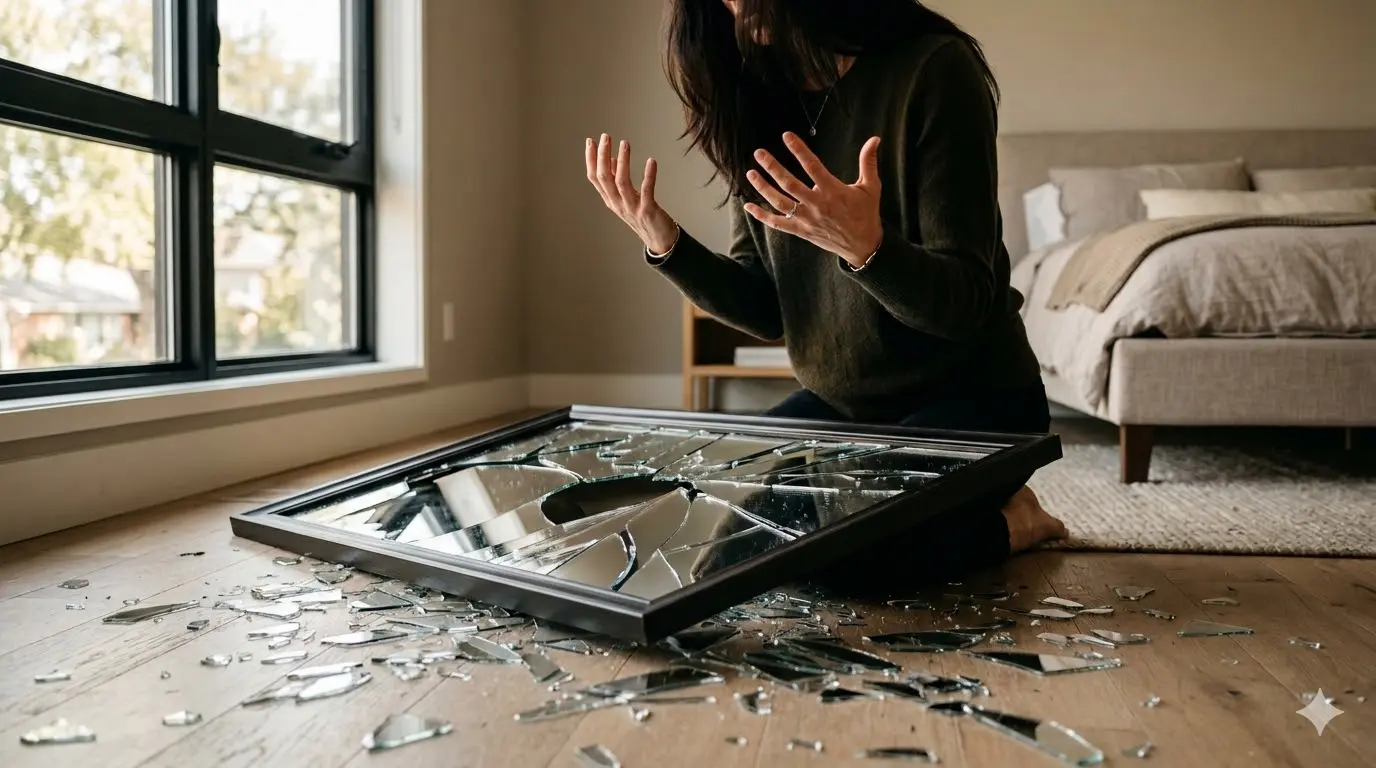

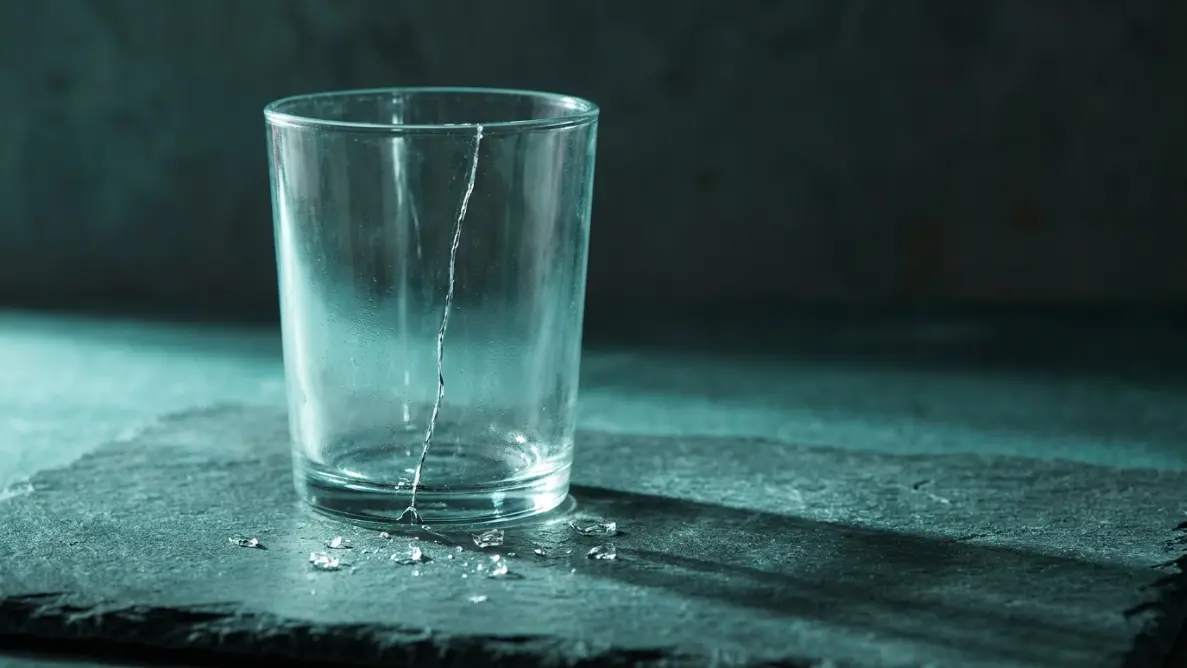
I watched a glass crack on a shelf three years ago. No earthquake, no temperature shift, no one near it. Just a clean split down the side while I sat across the room rereading an old lease I was about to break. I didn’t tell anyone for weeks — partly because it felt absurd, partly because the timing was so specific that saying it out loud would force me to take it seriously.
The phrase glass breaking by itself spiritual meaning gets searched thousands of times every month, and the reason isn’t curiosity about physics. Something about the moment — the sound, the mess, the sharpness — lands differently when it has no visible cause.
Whether the breakage happened during an argument you replayed in your head, a week where your identity felt like it was shifting underneath you, or a stretch of silence you can’t quite explain, the event tends to carry a weight that outlasts the cleanup. That weight is what this piece is actually about — not what made the glass fall, but why you’re still thinking about it.
The Surface Explanation: Thermal Shock and the Stories We Tell Ourselves
Nobody starts with the spiritual interpretation. That’s not how it works.
The first thing most people do after a glass breaks without being touched is reconstruct the physics. Temperature differential. A micro-fracture from the dishwasher. When someone searches glass breaking by itself spiritual meaning, they’ve already moved past the physics.
Nickel sulfide inclusions — a phenomenon first documented in Japanese tempered glass panels in the 1960s, where tiny impurities inside the glass expand over time and cause spontaneous shattering years after manufacture.
That explanation is real. It’s also beside the point for most people searching this phrase.
Why the Rational Answer Doesn’t Quiet the Question
Here’s what’s worth noticing. The person who watches a glass break and immediately Googles the physics usually closes the tab within thirty seconds. Satisfied. Done. The person who keeps searching — who adds the word “spiritual” or “meaning” to the query — is experiencing something the physics didn’t touch.
That gap between explanation and resolution matters. The glass breaking by itself spiritual meaning, for most people, lives inside that gap — not in the answer, but in the question that won’t go away.
It suggests the event activated something that has nothing to do with silica or thermal expansion. The breakage became a marker. A punctuation mark in a sentence that was already being written inside the person’s life.
And that’s where the surface layer ends. Not because it’s wrong, but because it answered a question nobody was really asking.
What Fragility Practitioners and Grief Therapists Observe in Breakage Patterns
Which glass broke?
That question changes everything. A random glass from a cabinet of twelve triggers a different internal response than the mug your mother used every morning before she died. Or the wine glass from a dinner that was the last normal night before a relationship collapsed.
Object attachment theory — studied extensively in bereavement contexts — suggests that humans don’t just assign memory to objects. They assign ongoing relationship. The object becomes a stand-in for a bond that still feels alive internally, even when the external connection has ended.
This is where the glass breaking by itself spiritual meaning starts to shift from curiosity into something personal.
When that object breaks, the loss re-activates. Not as memory. As sensation.
Some grief therapists have noted that clients describe the breakage of a loaded object as feeling like a second death — not of the person, but of the last physical thread connecting them. Others describe it as relief they couldn’t consciously allow themselves to feel.
The glass breaking by itself spiritual meaning, in this layer, isn’t about the universe sending a coded message. It’s about the emotional charge stored inside the object finally exceeding what the object — or the person — could hold.
❓ FAQ — Glass Breaking by Itself Spiritual Meaning
Is it bad luck when a glass breaks by itself? The idea that broken glass equals bad luck traces back to Roman-era superstition, where mirrors — not drinking glasses — were believed to reflect the soul, and breaking one meant seven years of fractured fortune. Drinking glasses weren’t part of that tradition. Most contemporary interpretations frame spontaneous breakage as a neutral event whose meaning depends entirely on what was happening emotionally when it occurred.
Can a glass really break on its own without being touched? Yes. Tempered and annealed glass can fracture from residual internal stress, nickel sulfide inclusions, or sudden ambient temperature changes. This is a documented material science phenomenon, not a paranormal claim.
What does it mean spiritually when glass breaks during an argument or emotional moment? Some traditions — particularly those rooted in Mediterranean and Middle Eastern protective symbolism — interpret this as the object absorbing tension that would otherwise remain in the body or the relational field. There’s no empirical proof of this, but the consistency of the reported timing is worth noting.
Does the type of glass matter? In folk traditions, yes. A mirror carries different symbolic weight than a window, which carries different weight than a cup. The common thread across interpretations is that the function of the object shapes its symbolic reading — a container that breaks may suggest something that could no longer be held; a mirror, something that could no longer be reflected honestly.
Should I be worried if glasses keep breaking in my house? Repeated breakage likely has a material cause — a shelf that vibrates when the furnace runs, inconsistent water temperatures during washing, or stacking pressure. If you’ve ruled those out and the pattern persists during a specific emotional period, some somatic practitioners might frame it as an environmental echo of internal pressure — though this remains interpretive, not diagnostic.
The Oldest Layer: Glass as a Mirror of Invisible Pressure
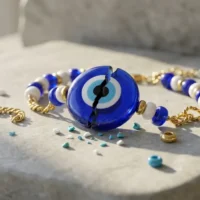
My grandmother in Istanbul kept a blue glass eye above every door. When one fell and shattered, she didn’t sweep it up immediately. She stood over it and said “Görevini yaptı” — it did its job.
The nazar boncuğu tradition is older than most people realize. Glass evil eye amulets have been excavated from sites in Mesopotamia dating to roughly 3300 BCE. But the logic underneath the tradition is more interesting than the history. The premise isn’t that glass is magical. The premise is that glass is absorbent — that it takes in what the human body cannot safely process.
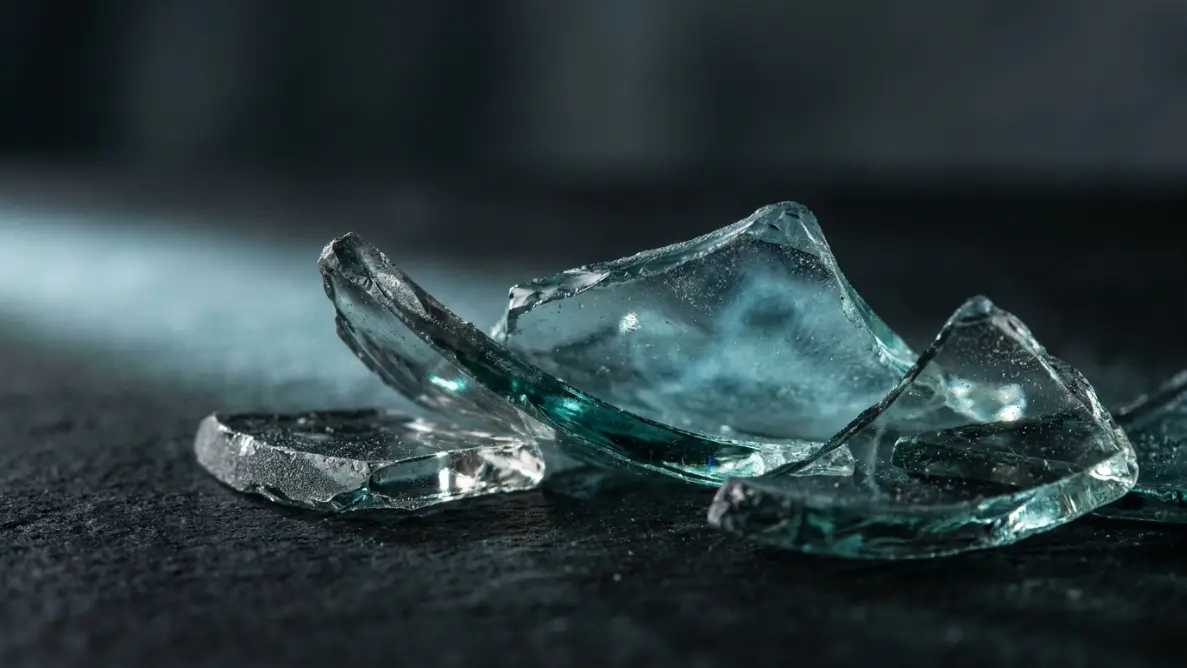
In this framework, glass breaking by itself doesn’t signal danger. It signals completion. And this is perhaps the oldest layer of the glass breaking by itself spiritual meaning — not warning, but release. The object reached its capacity. It held something — envy, grief, unresolved pressure from another person — and when the weight exceeded what the material could contain, it released.
This isn’t a belief you need to adopt. But as a structural metaphor, it’s remarkably consistent with how people actually describe the experience. Almost no one says “a glass broke and I felt scared.” What they say, more often, is: “a glass broke and I felt seen.“
That distinction — between fear and recognition — is the fingerprint of meaning.
Three Contexts That Change Everything About What the Glass Meant
Not all breakage carries the same charge. The moment surrounding the event shapes the interpretation far more than the event itself.
When it happens during relational tension. A couple arguing in the kitchen. A phone call with a parent that went wrong. The glass shatters and both people stop talking — not because of the sound, but because the breakage says what neither of them could. In this context, some somatic-informed therapists suggest the environment may be responding to accumulated cortisol-level arousal — though not as a mystical act, but as a reminder that physical space registers what we try to suppress. The glass isn’t the message. The silence after it is.
When it happens during a period of transition. Moving cities. Ending a career. Leaving a faith tradition. The glass that breaks in this window tends to be one the person has owned for a long time — a holdover from the life they’re exiting. In symbolic interpretation, this reads less like a warning and more like a timestamp. The object belonged to a version of you that no longer exists. Its structural failure mirrors yours — not as collapse, but as reorganization.
When it happens in total stillness. No argument. No stress. Just a quiet room. This is the context people find hardest to explain, and the one most likely to send them searching. The absence of a trigger is itself the trigger. When a glass breaks in silence, the question isn’t what caused it — it’s what were you thinking about in the three seconds before it happened? That thought, whatever it was, is usually the actual subject of the search.
The glass breaking by itself spiritual meaning doesn’t live in the glass. It lives in the pause that follows.
What Stays After the Sound Fades
I never replaced that glass from three years ago. Not out of reverence. Not because I thought it was sacred. I just noticed that the shelf looked different without it — more honest, somehow. Like a sentence that finally had the unnecessary word removed.
The spiritual meaning of glass breaking by itself isn’t a fixed code. It doesn’t translate into one clean message you can write down and move on from. What it does, consistently, is mark a moment. It draws a line in time and says: something was already shifting before this happened.
Understanding the glass breaking by itself spiritual meaning isn’t about decoding a message — it’s about noticing what was already in motion.
If you’re reading this because a glass broke in your house and you can’t shake the feeling that it meant something — pay attention to what you were carrying the moment it happened. Not what you were doing. What you were carrying. The answer to why you’re still thinking about it is probably there.
The interpretations explored in this piece — from object attachment theory to the nazar tradition to somatic observation — are reflective and symbolic in nature. They’re meant to open questions, not close them with certainty. If breakage is recurring and accompanied by structural concerns in your home, a material explanation deserves priority over a metaphysical one.
The glass isn’t the only thing that cracks when internal pressure builds:
- Explore why the objects tied to someone who’s gone carry a weight your nervous system still tracks in Evil Eye Bracelet Broke: Does It Mean It Fulfilled Its Protection Mission?
- Trace the line between what the body stores and what finally surfaces without permission in The Emotional Meaning of Physical Pain: What Your Body Might Be Reflecting
- Follow what happens when the mirror — not the glass — is the one that shatters in Broken Mirror Spiritual Meaning: Is the Universe Trying to Warn You?