Bright Blue Light in Your Bedroom at Night: Spiritual Meaning or Perception?
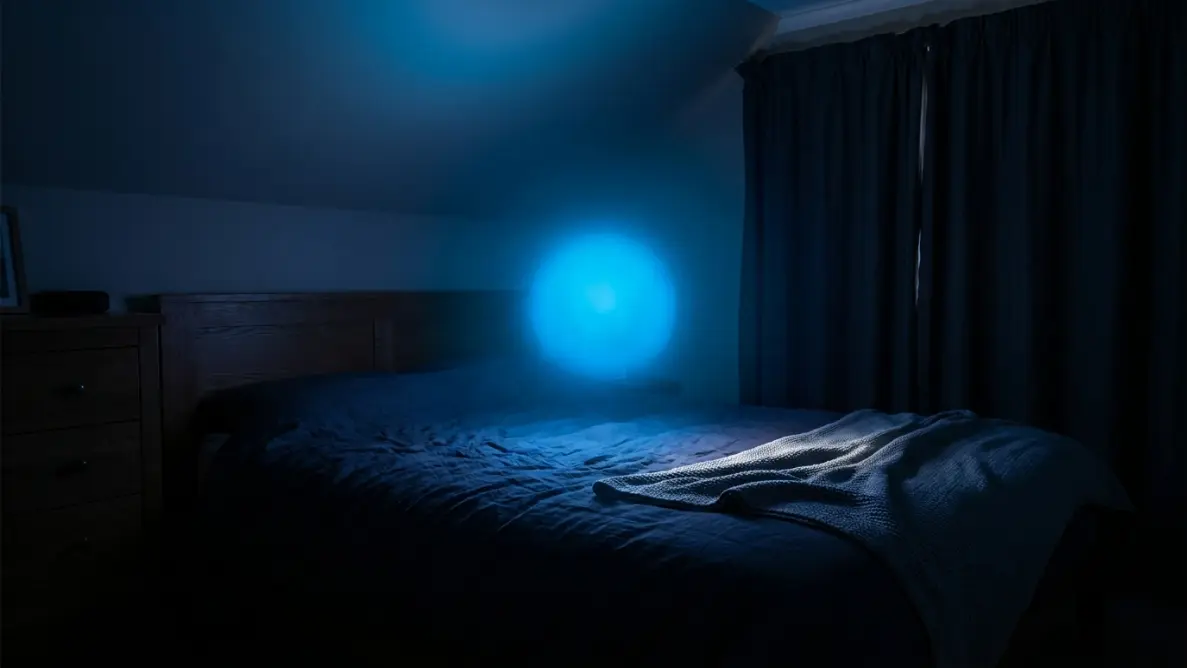
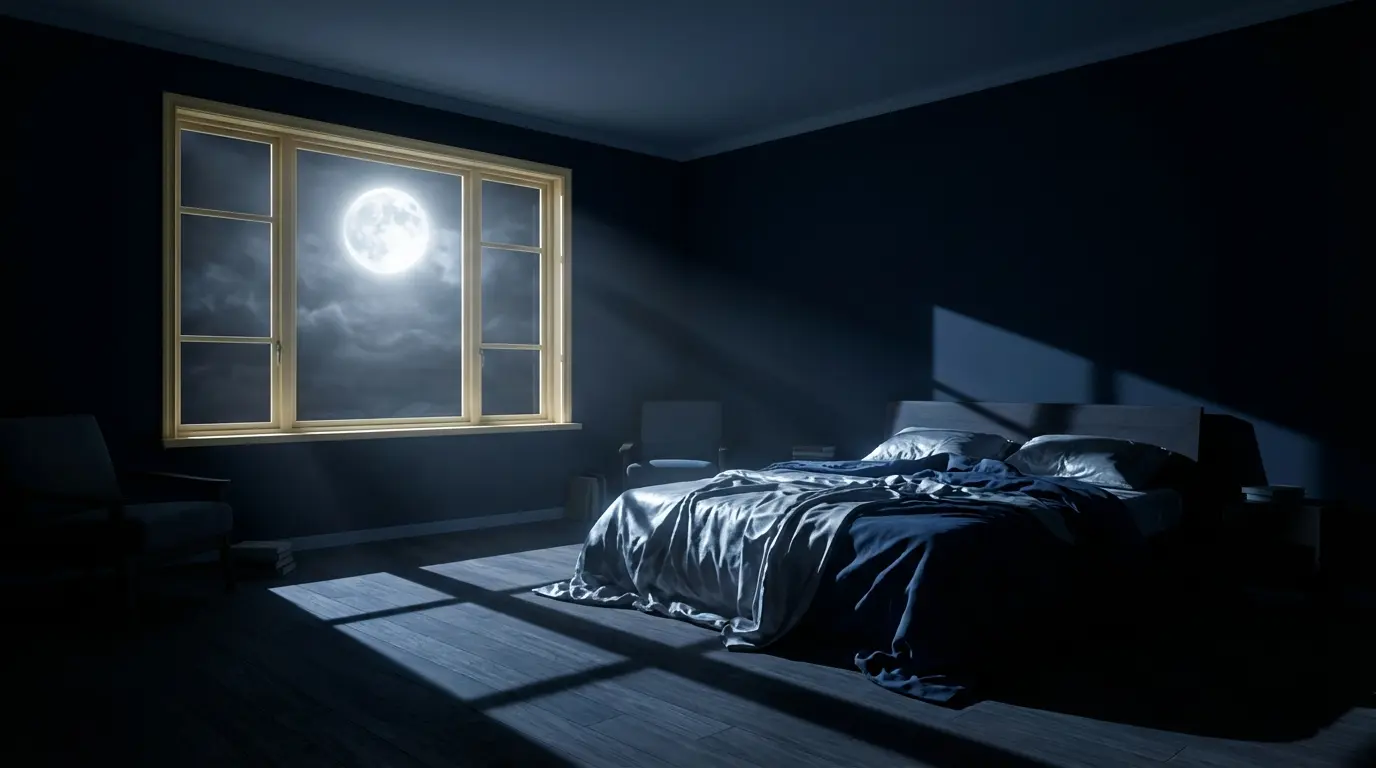
The first time it happened, I assumed the phone had glitched. A faint blue glow near the foot of the bed, steady for two or three seconds, then gone. No screen was on. No car passed outside. The room was sealed, curtains drawn, and the light had no origin I could trace. I lay still and waited for it to return. It didn’t.
That bright blue light in your bedroom at night probably started the same way for you — not with curiosity, but with a physical jolt.
What makes this particular experience hard to file away is that blue doesn’t behave like other colors in the dark. It gets louder. And the reasons for that stretch from 19th-century physiology labs to 6,000-year-old Egyptian mines to a yogic tradition that considers the blue point between your eyebrows the last image before samadhi.
The space between those explanations is where this article lives — not to choose one for you, but to lay them next to each other and let the contrast do the work.
The Color That Had to Be Invented Before It Could Be Seen
In 1858, William Gladstone — before he became Britain’s Prime Minister — published a dense philological study on Homer. He noticed something strange. Homer described the sea as “wine-dark.” Honey as “green.” Iron as “violet.” But across the entire Ilíada and Odyssey, he never once used a word for blue.
Gladstone wasn’t the last to notice. Linguist Guy Deutscher later expanded the research and found the same gap in ancient Hebrew, Chinese, Japanese, and Icelandic texts. The pattern was consistent: blue was the last color to receive a name in nearly every recorded language. The only ancient civilization that had a word for it was Egypt — and they were also the only ones manufacturing a blue pigment, Egyptian Blue, as early as 2200 BCE.
This isn’t trivia. It’s a lens.
If you see a bright blue light in your bedroom at night and your first instinct is confusion — not fear, not peace, just an inability to classify — you’re echoing something very old. The difficulty isn’t emotional. It’s categorical. Blue resists easy filing. It always has.
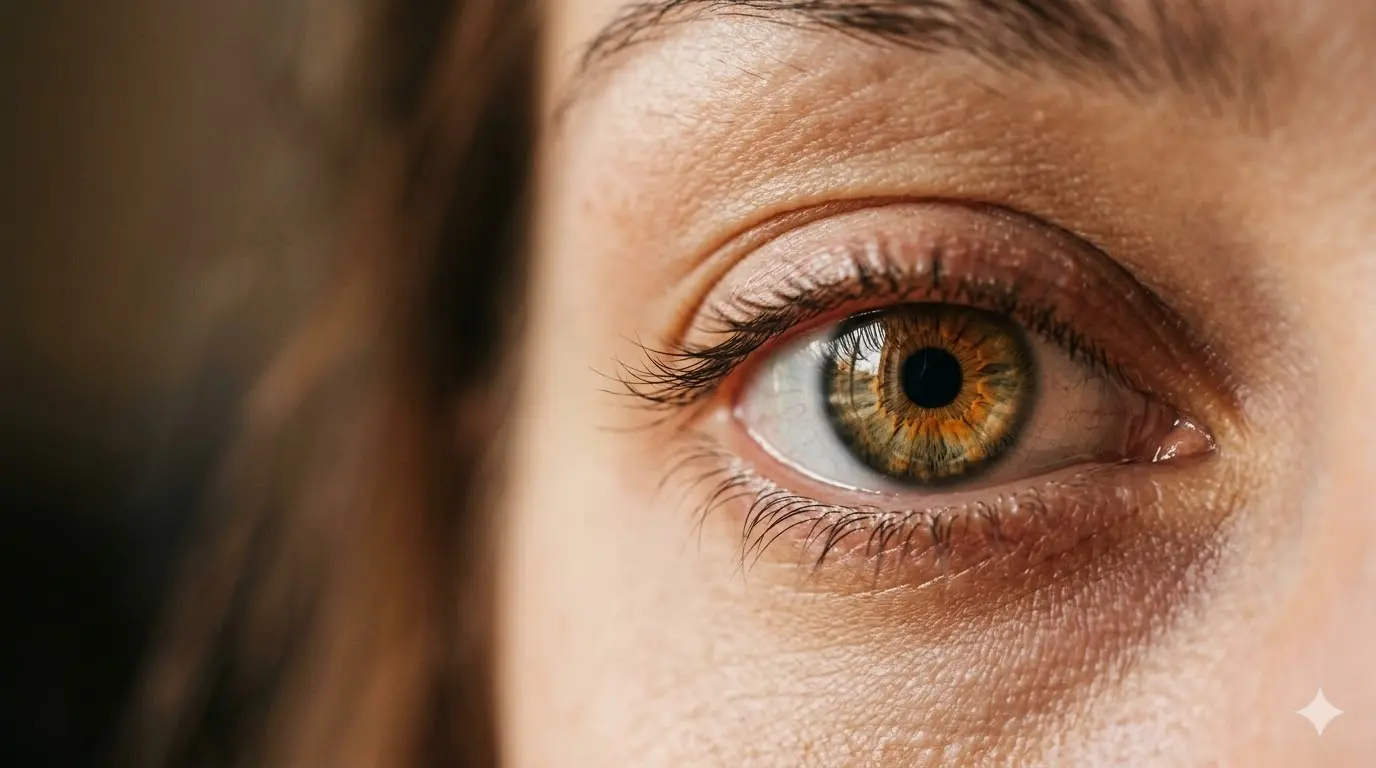
There’s also a measurable reason why blue appears brighter in the dark. Czech physiologist Jan Evangelista Purkyně documented this in the 1820s: in low-light conditions, human vision shifts sensitivity toward the blue end of the spectrum. Reds dim. Blues intensify. The phenomenon — now called the Purkinje effect — means that a faint blue stimulus in a dark room registers as disproportionately vivid. Your eyes are doing exactly what they’re designed to do. The question is whether the stimulus was external.
People who experience disrupted sleep at odd hours may notice that the visual landscape of the bedroom shifts during those waking moments — shadows gain texture, small lights look larger, and blue tones dominate the field.
What Happens Between Waking and Sleeping — and Why Blue Appears There
The moment right before sleep has a name. Hypnagogia. It’s the transitional state between full waking consciousness and sleep onset, and it comes with a specific set of perceptual artifacts that most people never learn about unless they actively research them.
During hypnagogia, the visual cortex doesn’t shut off cleanly. It produces spontaneous images — shapes, colors, faces, geometric patterns — without external input. These are called phosphenes when they’re simple (dots, lines, waves) and hypnagogic hallucinations when they’re complex (scenes, figures, landscapes). They are not dreams. They occur before REM sleep begins.
Blue and violet are among the most frequently reported colors in phosphene research. One reason may be structural: the short-wavelength cones in the retina (S-cones, responsible for blue perception) have a different activation threshold than their red and green counterparts. In near-darkness, with minimal competing input, faint S-cone firing can produce the subjective experience of a blue flash or glow that has no external source at all.
So if you saw the blue light while lying down, eyes closed or half-open, body heavy but mind still partly active — the timing matters more than the color. You weren’t fully asleep. You weren’t fully awake. And in that gap, the visual system generates content on its own.
That doesn’t close the door on meaning. But it opens a specific one: the blue light you saw may have been generated internally, by a brain in transition. What you did with the experience after — what it meant to you, how it changed the night — belongs to a different layer of interpretation entirely.
The Yogic Eye, the Throat, and the Frequency of Stillness
In Paramahansa Yogananda’s “Autobiography of a Yogi,” first published in 1946, there’s a description that matches what thousands of people report in bedrooms, not ashrams. Yogananda describes a blue sphere visible at the point between the eyebrows during deep concentration — the Kutastha Chaitanya, often translated as the “spiritual eye.” He calls it the gateway to Christ Consciousness in Western language, and to Brahman in Vedantic terms.
What makes this reference worth noting isn’t authority. It’s specificity. The color is blue. The location is internal. The experience happens in stillness, often in the dark, often when the body is immobile and the mind has stopped performing its usual tasks. Sound familiar?
The yogic tradition doesn’t claim the blue light is a message. It claims the blue light is a destination — a visual marker that the practitioner is approaching a certain depth of inner withdrawal. The blue point isn’t sent to you. You arrive at it.
Separately, the throat chakra (Vishuddha) carries the color blue in Hindu and Buddhist tantric systems. Its association isn’t with speech in the casual sense. It’s with the capacity to articulate what hasn’t been said — the thing that sits right below consciousness, pressing upward but not yet formed into words. Some practitioners interpret seeing blue light spontaneously as a signal that something is ready to be expressed but hasn’t been.
These are interpretive frameworks, not clinical claims. They belong to contemplative traditions with internal coherence, not peer-reviewed trials. But they describe something that aligns with the experience: a blue presence that appears in darkness, in stillness, in the body’s most receptive posture.
For those noticing other shifts alongside the blue light — disrupted sleep, emotional sensitivity, heightened perception — some interpret these as spiritual awakening signs rather than isolated events.
How to Tell Which Blue Light You Actually Saw
The most useful question isn’t “what does it mean?” — it’s “what kind of blue light was it?”
Different origins leave different fingerprints. A reflected LED from a smoke detector, router, or standby indicator produces a fixed point. It doesn’t move. It doesn’t pulse. And when you turn your head, it stays where it is. If the blue light in your room has a fixed position and remains visible when you shift your gaze, it’s almost certainly environmental. Check small electronics, power strips, and exterior light sources filtering through curtains.
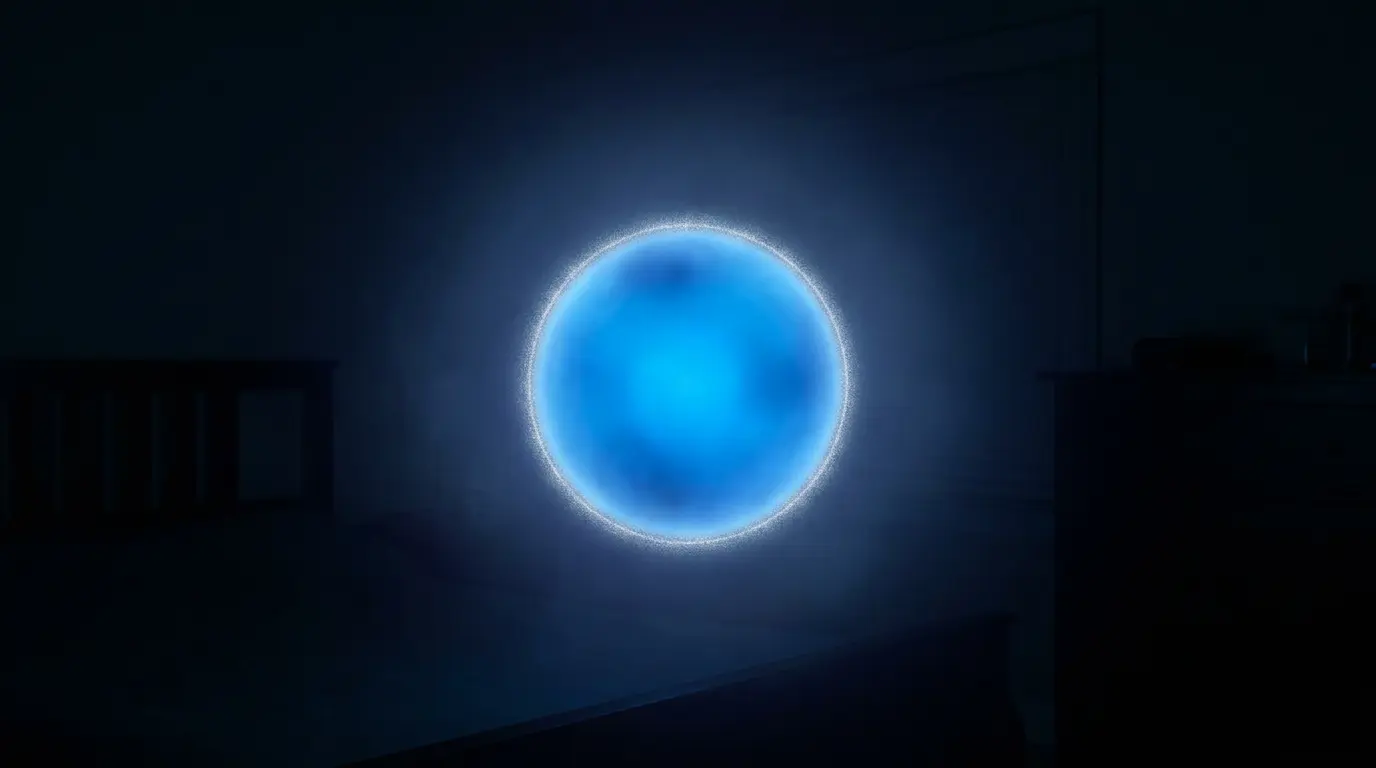
A phosphene or hypnagogic image behaves differently. It moves when your eyes move. It may pulse, expand, or dissolve. And it typically disappears the moment you become fully alert. If the blue light vanished the instant you sat up or turned on a lamp — and you can’t find an electronic source — the timing points toward an internally generated perception.
Then there’s the third category: the one that doesn’t resolve neatly into either column. You were awake. The room was dark. The light appeared, held steady for a few seconds, and faded — but it didn’t track with your eye movement, and there was no electronic source. This is where the perceptual and the symbolic occupy the same moment, and no single framework can claim the full explanation.
The critical thing is proportion. If it happened once and carried no emotional charge, it may simply be a visual artifact your brain produced during a state transition. If it happened during a period of intense emotional processing, grief, or life change — and it felt directed, personal, almost communicative — the experience carries a different weight, regardless of its optical origin.
That same ambiguity between perception and presence shows up in phantom presence experiences, where the body registers something the environment doesn’t explain.
Frequently Asked Questions
Can blue light in a bedroom be caused by something medical?
In rare cases, persistent visual phenomena like flashes or colored spots can indicate retinal issues such as posterior vitreous detachment. If you’re seeing blue flashes frequently, especially accompanied by floaters or a dark curtain in your peripheral vision, an eye exam is the appropriate first step. A single, brief blue glow without those accompanying symptoms is far less likely to point to anything clinical.
Why do some people feel calm when they see the blue light instead of scared?
Blue sits at the low-energy end of the visible spectrum, and research on color psychology has consistently associated it with reduced arousal and increased feelings of safety. Culturally, blue is tied to sky, water, and openness. It’s possible that the neurological response to blue — even internally generated blue — triggers a calming rather than alarming reaction, which is why many people report curiosity rather than fear.
Does seeing blue light mean a spirit is present?
Multiple spiritual traditions — Hindu, Christian mystical, and certain Indigenous frameworks — associate blue light with protective or transitional presences. These interpretations carry meaning within their respective systems. From a perceptual standpoint, the experience can also be explained by phosphenes, the Purkinje effect, or hypnagogic imagery. This article doesn’t claim one explanation overrides the other. What matters is whether the experience changed something in you, and what you do with that change.
The Light That Disappears When You Name It
The bright blue light in your bedroom at night sits in a strange category. It has plausible optical explanations — the Purkinje effect, hypnagogic phosphenes, reflected LEDs. It has deep symbolic lineage — Yogananda’s spiritual eye, the throat chakra, the Egyptian invention of blue as a visible concept. And it has a phenomenological quality that neither side fully captures: the fact that it appeared to you, specifically, in a room where you felt safe enough to notice it.
The blue doesn’t need to be spiritual to matter. It doesn’t need to be optical to be real. What makes it worth examining is the gap between the two — the few seconds where the light existed and you hadn’t yet decided what it was. That gap is the actual experience. Everything after is interpretation.
If it changed the texture of your night, it did its work. Whether it came from a retina or a tradition older than the word for its own color is a question you get to leave open.
The interpretations in this article reflect symbolic, contemplative, and perceptual perspectives on the experience of seeing a blue light at night. They are not medical assessments, clinical diagnoses, or guarantees of spiritual contact. If visual phenomena persist or cause concern, consulting an eye care professional is a reasonable and responsible step.


Alex Turner
Alex Turner is the author behind Signs of Universe, a website focused on dreams, spiritual meanings, and symbolic signs. His approach combines research and intuitive interpretation to help readers understand the subtle messages that appear in everyday life.