Dreaming of a Black Snake in Bed: Spiritual Meaning and Hidden Fear
The bed is the only place where your body is already paralyzed when the dream begins. During REM sleep, voluntary muscles go still — a state researchers call atonia. So when a black snake appears in that exact space, it doesn’t need to trap you. You’re already trapped. That detail changes everything about how this dream should be read, and almost no one reads it that way.
Most interpretations of dreaming of a black snake in bed skip straight to betrayal, sexual tension, or generic transformation. But the bed is not a random backdrop. It’s the most unguarded space a person occupies — where armor dissolves, where the body surrenders control, where whatever was buried during the day finally has room to surface.
The fact that the snake chose THAT location, and not a road, a forest, or a river, carries weight that a list of spiritual meanings can’t capture. Whether the snake coiled silently on the sheets or pressed against your skin, the real question isn’t what it represents — it’s what the bed allowed you to finally see.
The Myth That Every Black Snake in Bed Means Betrayal
The most common interpretation online is fast and confident: a black snake in your bed means someone close to you is being dishonest. Usually a romantic partner.
That reading relies on a single shortcut — bed equals intimacy, intimacy equals relationship, relationship plus snake equals betrayal. It sounds logical. But it collapses the bed into one function and the snake into one role, ignoring everything else both symbols carry.
A bed is where people grieve alone at 2 AM. Where fevers break. Where the body processes a day it couldn’t digest while standing. The bed is where your social mask doesn’t exist because no one is watching. Reducing it to “romantic intimacy” erases most of what the bed actually does in a person’s inner life. The snake might not be pointing at a partner. It might be pointing at whatever you can only feel when every distraction is gone and the room is dark.
A common observation, in body-focused approaches to stress, is that tension people carry all day tends to sit in the shoulders, the lower back, the jaw — and that it doesn’t release until they finally lie down. The bed is where that letting-go happens, and sometimes what comes with it is imagery the waking mind never authorized. A black snake appearing in that vulnerable window may reflect something closer to the freeze of being unable to move than to relational deceit — a confrontation with what surfaces only when defenses are completely down.
The betrayal reading isn’t necessarily wrong. But treating it as the default interpretation is like assuming every locked door means someone is hiding something. Sometimes the snake in the bed has nothing to do with another person. Sometimes it has everything to do with you.
Why the Bed Changes Everything About This Dream
What would be different if the same black snake appeared in a field?
In an open space, the snake is an obstacle. Something you can walk around, observe from a distance, decide whether to approach. But in a bed, distance doesn’t exist. The snake is already inside your most private perimeter. There’s no buffer zone. No room to assess.
That’s why this dream hits harder than other snake dreams. The location strips away the one thing the dreaming mind usually provides: the illusion of choice. In a bed, you’re horizontal, tangled in fabric, eyes closed. The snake didn’t break through a door. It was already there when you arrived — or when you woke up inside the dream and realized it had been there the whole time.
Researchers in sleep medicine have documented that during REM sleep, the brain paralyzes voluntary muscles to prevent the body from acting out dreams. This is a protective mechanism, not a spiritual event. But the experience of being unable to move while perceiving a threat creates a specific emotional texture that the dreaming mind often incorporates into the dream itself. Some people who report dreaming of a black snake in bed describe not just seeing the snake but feeling unable to pull their legs away — a sensation that may overlap with the body’s actual immobility during that sleep phase.
What the Bed Exposes That Daylight Protects
During the day, a person can outrun discomfort. Work, noise, screens, conversation — all of it functions as insulation. The bed removes every layer.
The idea that solitude has its own distinct quality — and its own effects on a person — is old enough to have filled entire books. The Swiss physician Johann Georg Zimmermann devoted a widely read 18th-century work, Über die Einsamkeit (On Solitude), to exactly that subject, treating time alone as something with real weight rather than simply an absence of company. The bed is where most people meet that quality in its most concentrated form: no company, no task, no distraction, nothing to perform for.
A black snake appearing in that confessional space may not be delivering a message from outside. It may be the shape your mind gives to something that was always inside but could only be perceived when every wall came down.
The Emotion You Couldn’t Name Before the Snake Arrived
Here’s what happens in the first ten seconds after waking from this dream: the body responds before the mind does. Heart rate elevated. Sheets gripped. Legs pulled inward. The emotional charge is already in the body before any interpretation begins.
That sequence matters more than the dream dictionary entry.
The popular reading says the black snake “represents fear.” But that’s backwards. Fear is what you feel AFTER seeing the snake. The question is what existed BEFORE the snake — what emotional state was already present in the bed, unnamed, when the dreaming mind decided to give it a shape.
Some people report this dream during periods that don’t look dramatic from outside: no breakup, no job loss, no crisis. Just a slow accumulation of something they couldn’t articulate. Guilt about a decision they keep defending. Desire they haven’t admitted. Grief for something that didn’t die but changed shape. The snake doesn’t represent the emotion. The snake IS the moment the emotion finally became visible.
This is what separates a giant spider dream from a black snake in the bed. The spider often fills a room — it overwhelms by scale. The snake doesn’t overwhelm. It infiltrates. It arrives where you were already lying, already still, already exposed. The spider makes the space feel invaded. The snake makes the space feel honest.
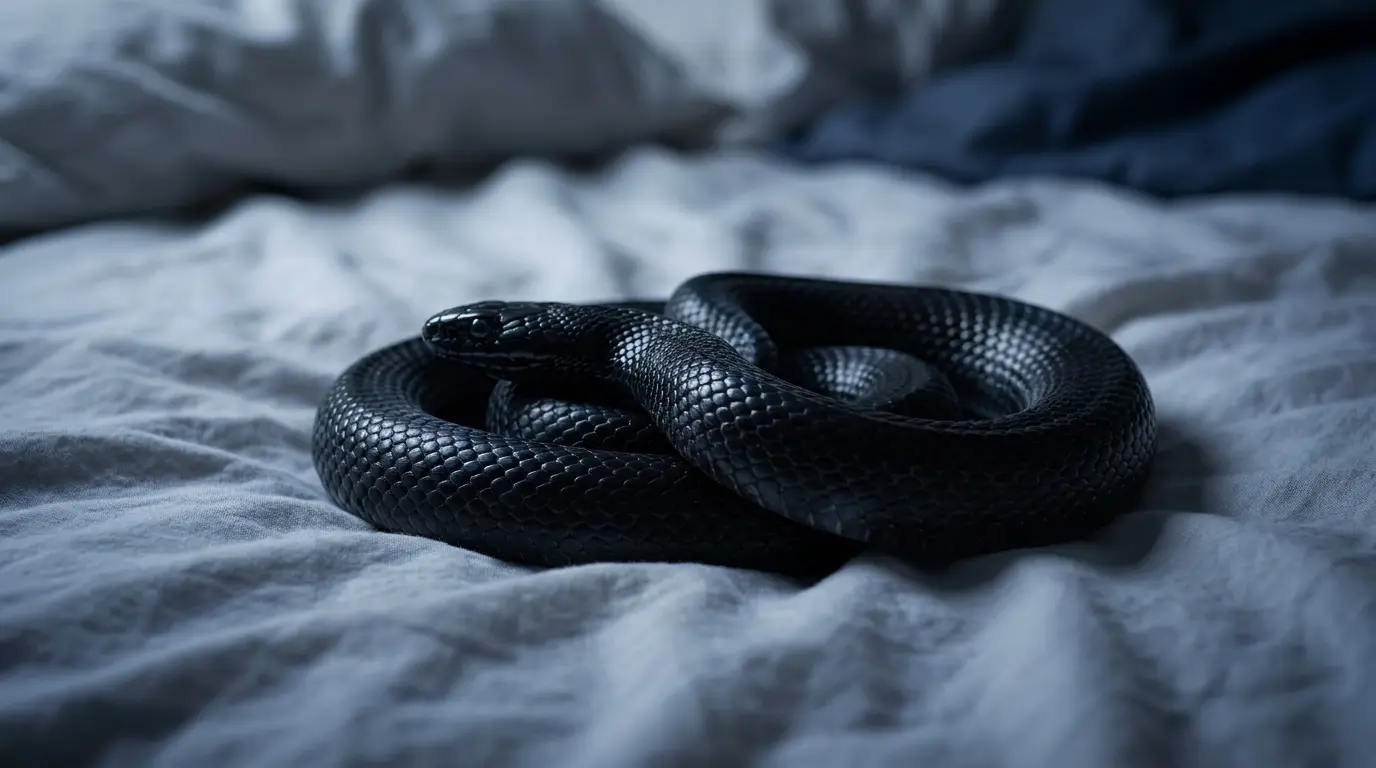
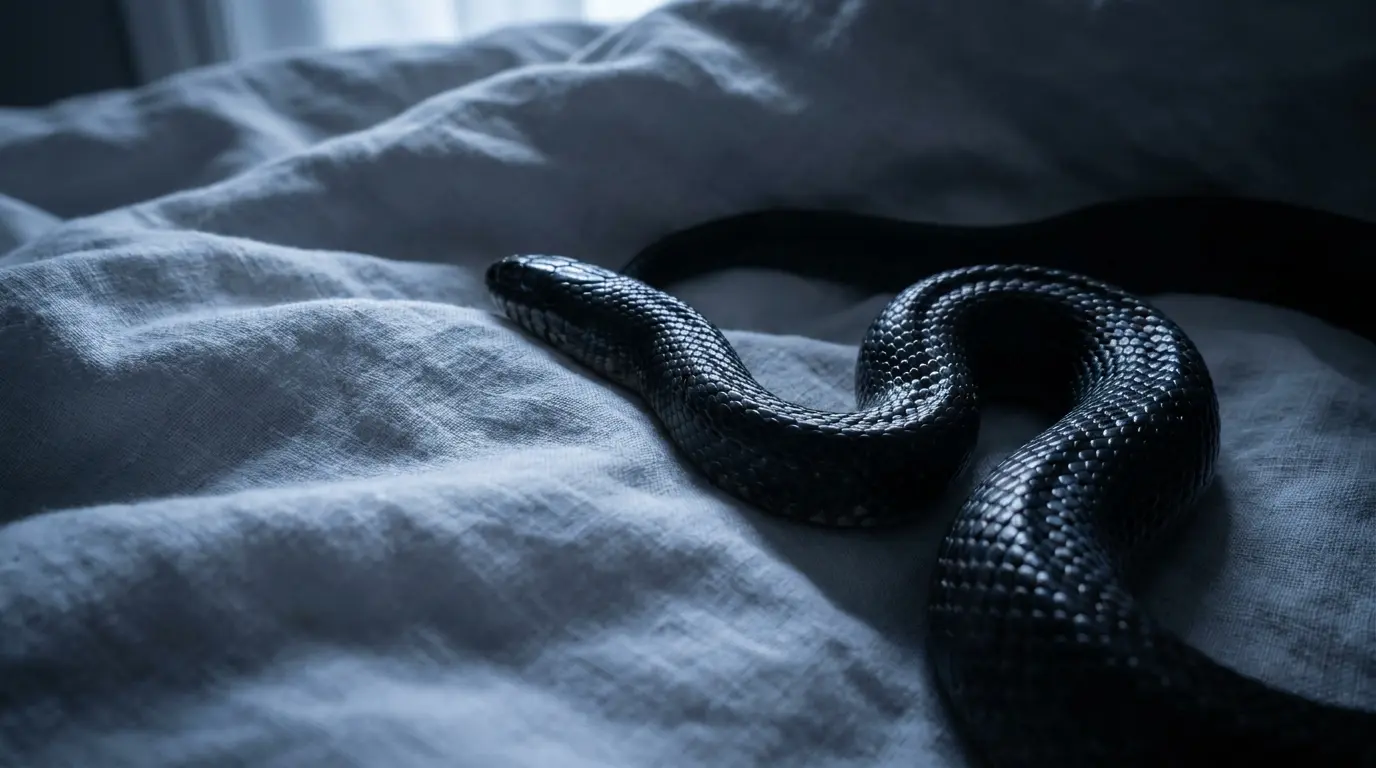
A black snake in bed rarely announces itself with drama. People describe it as already being there — under the pillow, beside the leg, coiled at the foot of the mattress. Not attacking. Not fleeing. Present. As if it had been waiting for the dreamer to notice.
What You Do in the Dream Matters More Than What the Snake Does
A woman finds the snake at the foot of her bed. She doesn’t scream. She watches it. She pulls her feet back slowly and waits.
Another dreamer sees the same snake in the same position. He tries to grab it. It bites.
Same snake. Same bed. Two completely different dreams.
Most online interpretations focus obsessively on the snake’s behavior — did it bite, did it hiss, did it move. But the variable that actually shifts the entire reading is the dreamer’s response. Freezing in place tells a different story than running. Watching with curiosity tells a different story than screaming. Trying to kill the snake tells a different story than letting it stay.
The freeze response, specifically, deserves attention here. In dreams where the black snake is on the bed and the dreamer cannot move, the experience mirrors what some people describe when asked about dreaming of being chased — except there’s no chase. The threat is static. Proximity without motion. That combination — danger plus stillness plus bed — creates a dream texture that often correlates with situations where the dreamer feels trapped not by external force but by their own inability to act. A relationship they won’t leave. A truth they won’t speak. A boundary they won’t enforce.
If you reached for the snake, that’s not the same dream as watching the snake from the other end of the mattress. If you tried to push it off the bed, you’re working with something different than if you lay perfectly still and let it coil closer.
The snake’s behavior is a mirror. Your behavior is the message.
Frequently Asked Questions
Is dreaming of a black snake in bed always a bad sign?
Not necessarily. The emotional charge of the dream — what you felt during and immediately after — carries more interpretive weight than the image itself. Some people report this dream during periods of internal clarity, not crisis. The snake’s presence in the bed may signal that something hidden has finally surfaced, which can be uncomfortable without being harmful.
Does the size of the snake change the meaning?
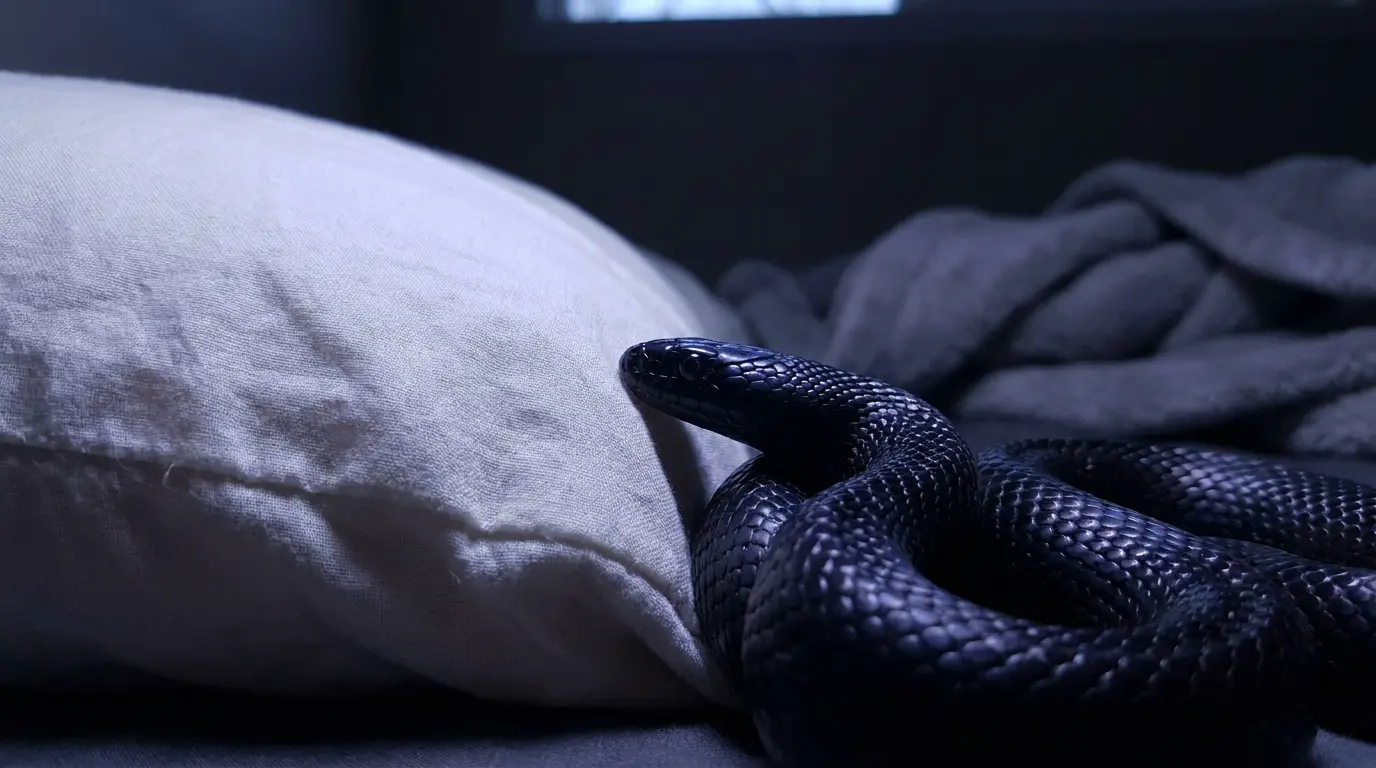
It can shift the emphasis. A small snake near the pillow may point to something subtle and personal — an unspoken thought, a minor guilt. A large snake covering most of the mattress tends to correlate with situations the dreamer perceives as overwhelming or consuming. But size alone doesn’t determine whether the dream is “positive” or “negative.”
What if the snake was under the covers?
That detail intensifies the intimacy of the symbol. Under the covers means the snake occupied the exact space the body occupies — not beside the bed, not on top of it, but INSIDE the sleeper’s zone. Some traditions interpret this as a sign that whatever the snake represents has been with the dreamer for a long time, hidden by proximity rather than distance. It was too close to see.
The interpretations in this article reflect symbolic, reflective, and observational perspectives on dream imagery. They do not constitute psychological diagnosis, medical advice, or spiritual prescription. A black snake coiled on your sheets at 3 AM inside a dream is not a clinical event — it’s a private image your sleeping mind assembled from materials only you carry. Read it as you would read a question addressed specifically to you, not as a verdict delivered by anyone else.
The Bed Was Never the Safe Place You Thought It Was
Every layer of interpretation — betrayal, transformation, repressed emotion, unnamed desire — leads back to the same structural fact: the bed is where you can’t hide. Not from a partner, not from a memory, not from the version of yourself that only exists when no one is watching.
The snake didn’t break in. The bed let it through.
Maybe the more uncomfortable question isn’t what the snake means. Maybe it’s why you assumed the bed was safe in the first place.


Alex Turner
Alex Turner is the editorial pen name used for articles published on Signs of Universe. The website covers dreams, symbolism, and cultural interpretations for informational and reflective purposes. Alex Turner is not a medical, mental health, scientific, or spiritual authority.