

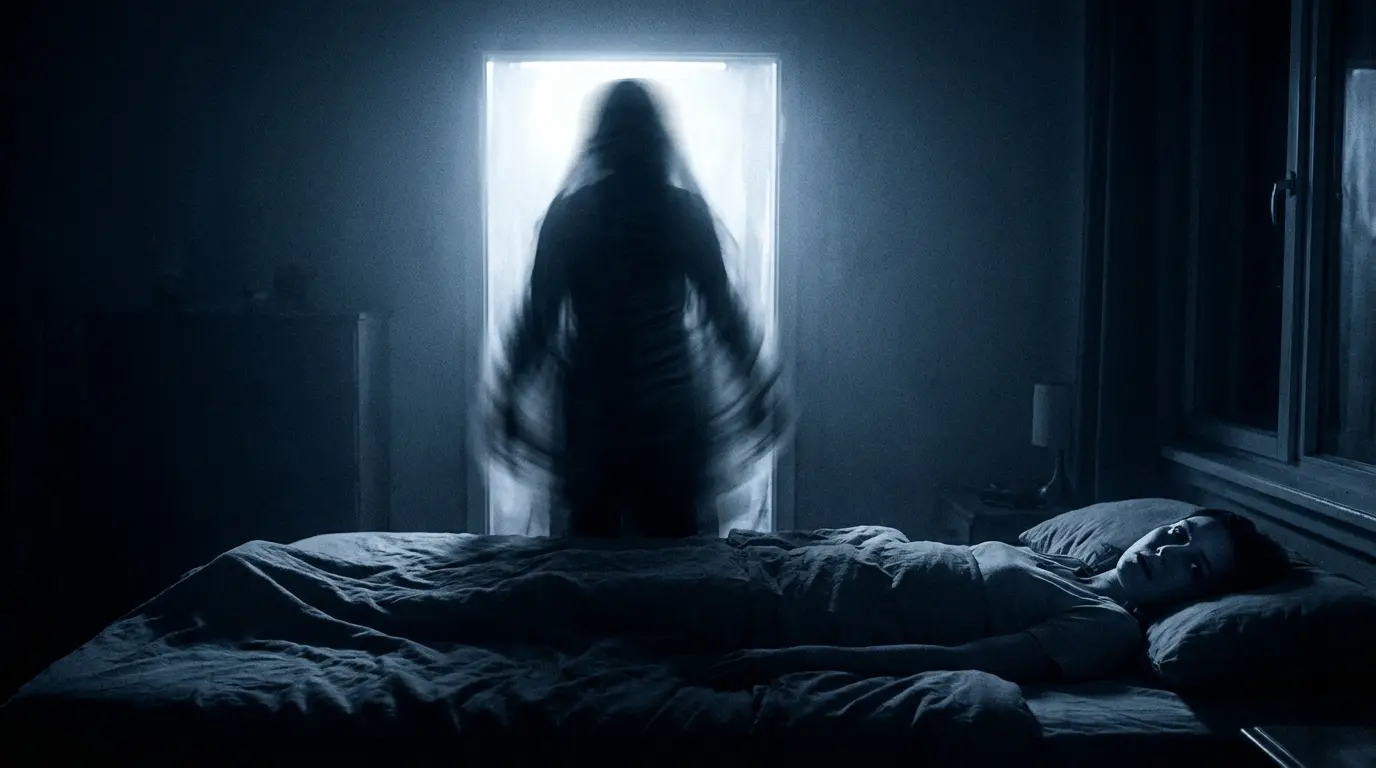
What exactly does your brainstem think it’s protecting you from when it locks every voluntary muscle in your body — but leaves your eyes open?
That question matters more than any debate about demons. Because the paralysis isn’t random. It’s engineered. Your own nervous system built it. And the thing standing in the corner of your room? Your visual cortex rendered it in real time, using raw material you probably didn’t know you were carrying.
Sleep paralysis demons sit at the exact collision point between neuroscience and something older, something the body seems to know before the mind catches up. The weight on the chest, the shadow that doesn’t move like a shadow should, the unmistakable sense that whatever is in the room with you has intent — these details repeat across thousands of independent reports with an accuracy that makes both skeptics and believers uncomfortable.
What’s actually happening inside the brain during those seconds, why the “entity” seems to know your specific fears, and whether the experience carries usable biological information — that’s the territory ahead.
The Case for Demons: Why Thousands of People Report the Same Entity
Here’s what makes the spiritual interpretation hard to dismiss outright: the reports are too consistent.
Not vaguely consistent. Specifically consistent. Across language barriers, across centuries, across people who have never read each other’s accounts.
The figure is dark. It has mass. It presses down. And it does not speak — but it communicates something. Dread. Ownership. A kind of predatory patience that no random neurological glitch should be able to produce.
The Shadow That Sits on Your Chest
The most reported element isn’t the visual. It’s the pressure.
A weight on the sternum. Sometimes described as a hand. Sometimes as an entire body. The lungs feel compressed. Breathing becomes shallow — not because the airways are blocked, but because the intercostal muscles won’t respond.
This is the detail that feeds the spiritual interpretation: the pressure feels intentional. Not mechanical. Not like a cramp. Like something is applying force with purpose.
People who have experienced this once rarely forget the sensation. People who experience it repeatedly begin to recognize the “entity” — same position, same weight distribution, same emotional signature. That level of specificity is what makes the experience feel personal. Targeted. Not random.
When the Terror Feels Too Intelligent to Be Random
The second feature that reinforces the demonic interpretation: the entity seems to know things.
Not facts. Not words. But it knows where your fear lives. It finds the exact emotional frequency that makes you freeze harder. The terror escalates in a pattern that feels responsive, not automated — as if the presence is calibrating itself to your specific threshold.
Readers who remember a creature in the room may also want to compare that feeling with giant spider dream meaning.
This is the part that rational explanations struggle with most. Not the image. Not the paralysis. The apparent intelligence behind the experience.
If it were random neural noise, it should feel chaotic. Fragmented. Instead, it feels organized. Curated. Like a predator that already mapped the room before you opened your eyes.
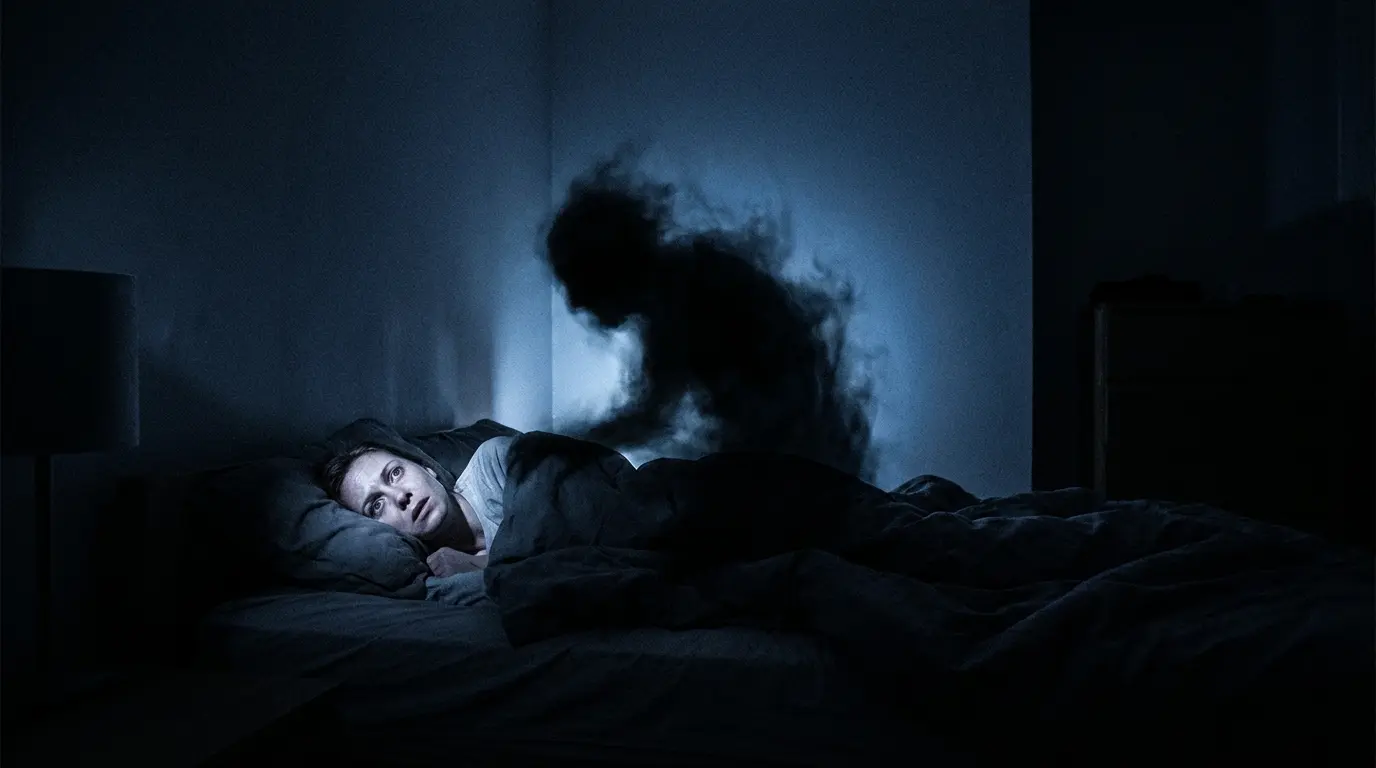
The Case for Hallucination: What Your Brainstem Is Actually Doing
The neurological explanation doesn’t start with “it’s just your imagination.” It starts with a mechanical failure in the wake-up sequence.
Your brain exits sleep in stages. Motor control comes back last. Consciousness comes back first. And in the gap between those two events — sometimes only seconds, sometimes minutes — your perceptual system is fully operational but still receiving feed from the dream engine.
That gap is where the demon lives.
REM Atonia: The Paralysis Your Brain Creates on Purpose
During REM sleep, your brainstem actively paralyzes your skeletal muscles. This is called atonia. It exists to prevent you from physically acting out your dreams — a safety mechanism so effective that it shuts down everything except your diaphragm and your eye muscles.
The system works. Until it doesn’t disengage cleanly. fully alert awakening at the same hour every night, carrying a tone that feels more like a summons than a glitch.
When consciousness returns before the atonia releases, you experience the paralysis as something being done to you. Not a process. An event. Your proprioceptive system reports that your body is locked, and your cortex — now awake — needs an explanation.
The brain doesn’t tolerate unexplained physical sensations. It narrates them. It assigns cause. And because the emotional system wakes up before the rational system, that narrative defaults to threat.
The Threat Detector That Has No Off Switch
The amygdala during sleep paralysis is operating without its usual cortical filter.
In normal waking states, the prefrontal cortex modulates fear. It contextualizes. It says: “that shadow is a coat rack.” During sleep paralysis, the prefrontal cortex is still booting up. The amygdala has no brakes.
So it does what it does best: it constructs a threat.
Not an abstract one. A specific, embodied, spatially located threat. The visual cortex — still partially in REM mode — renders the threat as a figure. The somatosensory system translates the atonia as external pressure. And the emotional system floods the entire experience with a grade of terror that waking life almost never produces.
The “intelligence” behind the entity? That’s your own threat-detection system working at full resolution with zero rational oversight. It feels smart because your amygdala is smart. It knows your fear history. It has access to every unprocessed emotional file you’ve been avoiding.
The demon is rendered from your own archive.
The Third Position: What If Both Sides Are Describing the Same Thing?
Strip the labels away — “demon” and “hallucination” — and you’re left with an identical event.
The body is locked. A presence appears. It carries emotional weight that feels too specific to be generic. And it targets the exact psychological material the person has been avoiding.
The spiritual framework says: something external found your vulnerability. The neurological framework says: something internal used your vulnerability as raw material. But both agree on the mechanism. Both agree that the experience is constructed from unprocessed emotional content. Both agree that the “entity” has a relationship to the host’s psychological state.
This is where somatics offers a third reading.
The shadow figure isn’t attacking you. It’s also not “nothing.” It’s your nervous system rendering a piece of emotional data that has no other outlet. Trauma stored in the body. Grief that was never discharged. Fear that was suppressed so long that it calcified into something dense enough to be perceived as a separate being.
The “demon” is a delivery system. The content it delivers — the specific flavor of terror, the specific location of pressure, the specific emotional tone — is the actual message. Not the figure. What the figure carries.
People who experience recurring sleep paralysis demons often report that the entity changes subtly over time. It gets smaller. Or less aggressive. Or it shifts position. These changes correlate with periods of emotional processing in waking life. The demon doesn’t shrink because you defeated it. It shrinks because you processed some of the material it was built from.
Less raw material. Smaller avatar.
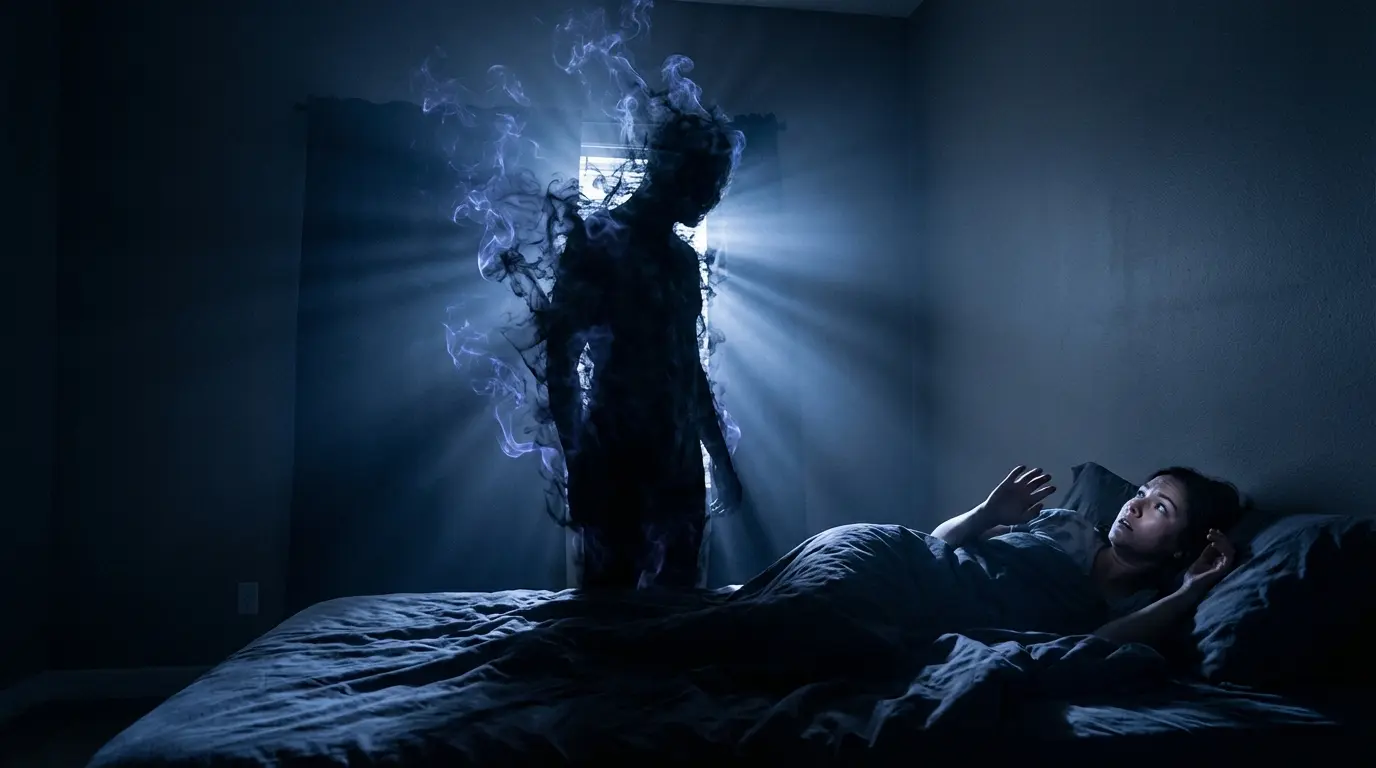
How to Break the Loop During the Episode
The worst advice for sleep paralysis is “try to relax.” Your amygdala is running a threat simulation at maximum intensity. Relaxation isn’t available. What is available: micro-motor recruitment.
The Distal Override — Toes First. During atonia, the extremities regain motor control before the core. Your toes are the first muscles to come back online. Focus every ounce of conscious effort on curling your smallest toe. Not your leg. Not your arm. The toe. One repetitive micro-contraction is enough to signal the brainstem that the wake-up sequence needs to complete. Most people report that full motor return follows within 10 to 30 seconds of the first successful toe movement.
The Ocular Redirect. Your eye muscles are exempt from REM atonia. They never stopped working. During the episode, deliberately shift your gaze away from wherever the entity appears. Look at the ceiling. Look at a wall corner. The visual cortex is rendering the figure in your peripheral field — moving your focal point forces a recalculation that often destabilizes the hallucination.
The Diaphragmatic Override. Your diaphragm also bypasses atonia. You can breathe. The trick: change the pattern. If your breathing is shallow and rapid (which it will be), force a single slow exhale through pursed lips. Not a “calming” breath. A mechanical override. The vagus nerve responds to extended exhalation by downregulating sympathetic activation, which loosens the atonia faster.
Post-Episode Decoding (within 60 seconds of regaining movement). Before the content fades — and it fades fast, like dream material — identify two things: where on your body the pressure was heaviest, and what emotion the entity carried. Not “fear.” More specific. Was it shame? Abandonment? Rage? Helplessness? That specific emotional flavor is the data your system was trying to surface. The location on the body tells you where you’re holding it somatically. Chest = grief or loss. Throat = suppressed expression. Stomach = unresolved threat to safety.
The entity is a courier. You don’t need to fight it. You need to read the message before it dissolves.
FAQ — Sleep Paralysis Demons
Are sleep paralysis demons real entities or just hallucinations? They are neurologically generated experiences — the visual cortex renders a figure using emotional content while the amygdala operates without cortical regulation. Whether that process also involves something beyond neurology depends on your framework, but the physiological mechanism is well-documented. The experience is real. The source is debated.
Can sleep paralysis demons hurt you physically? No. The paralysis is caused by normal REM atonia that hasn’t disengaged, not by external force. The pressure on the chest is a somatosensory misinterpretation of the atonia, not actual compression. No physical harm has ever been documented from a sleep paralysis episode itself.
Why do I always see the same figure during sleep paralysis? Because your threat-detection system reuses templates. The amygdala stores emotional threat profiles and reconstructs them under similar conditions. If you experienced a particular quality of fear during a formative event, the visual cortex will render a figure that matches that emotional signature. Same unprocessed material, same avatar.
How do I stop sleep paralysis from happening? Irregular sleep schedules, sleeping supine (on your back), and high stress levels are the three strongest correlates. Shifting to a lateral sleep position reduces episode frequency significantly. Addressing the underlying emotional content that feeds the entity — the specific fear or trauma being rendered — is what reduces both frequency and intensity over time.
Is sleep paralysis connected to spiritual awakening? Some traditions interpret recurring paralysis as a threshold experience — the nervous system encountering material that the waking mind refuses to process. Whether you frame that as spiritual or psychological, the functional pattern is the same: the episodes tend to intensify during periods of emotional suppression and decrease during periods of genuine internal confrontation.
The Demon That Wears Your Own Face
Every sleep paralysis entity is custom-built. Not by something outside of you. By the most primitive, honest, uneditable part of your own nervous system — the part that catalogues every fear you refused to feel and every grief you swallowed instead of expressed.
The question was never “is it a demon or a hallucination?” Both frameworks are pointing at the same locked door.
The question that actually changes something: the next time the shadow pins you down and you recognize — even for half a second — the exact emotional weight it brought into the room, will you read what it’s carrying? Or will you wait for it to come back heavier?
The content in this article reflects a somatic and neurobiological interpretation of sleep paralysis phenomena. It is not a substitute for clinical evaluation from a sleep specialist or mental health professional. If your episodes are frequent, escalating, or accompanied by significant distress, a polysomnography evaluation or consultation with a neurologist can rule out underlying sleep disorders such as narcolepsy. The “entity” your body builds tells a story — but a trained clinician can help you distinguish signal from noise in ways that no article can replicate.
Continue navigating the unseen forces that impact your reality:
- Discover the hidden mechanics behind your manifestation blocks in The Law of Repulsion: Why You Might Be Accidentally Pushing Away What You Want
- Find out if your intense bodily reactions are spiritual or physical by reading Spiritual Awakening or Nervous System Dysregulation? How to Tell the Difference