
Seeing a Red Cardinal After a Loss: Comforting Symbol or Grief Pattern?
The word “cardinal” doesn’t come from the color red. It comes from the Latin cardo — a hinge. An axis. The fixed point around which a door swings open or shut. Centuries before anyone associated the bird with heaven or messages from the dead, the word already described something that holds two sides together without belonging entirely to either one.
That etymology rarely shows up in the articles people find when they search for the red cardinal after death meaning. What shows up instead is a gentler version: the bird as messenger, as angel proxy, as proof that someone who died is still watching. And for a person sitting in the first weeks of loss — scanning the yard, the windowsill, the parking lot — that gentler version may be exactly what they need to hear.
But the hinge matters. Because what makes the cardinal such a durable symbol of grief isn’t its color or its song or its willingness to stay through winter. It’s the fact that the bird seems to sit right at the joint between what was and what is now — between the person you lost and the morning you’re still standing in.
The comfort people report, the tears that come without warning when the bird lands close, the strange certainty that the timing can’t be random — all of it traces back to the question of what the hinge actually connects: a real presence, a memory strong enough to reshape perception, or something no single explanation can close.
Why the Red Cardinal Became the Bird of the Grieving
Not every red bird carries this weight. The scarlet tanager is just as vivid. The vermilion flycatcher arguably more dramatic. But neither of them became the default symbol of after-death communication in American culture. The cardinal did — and the reasons are more practical than mystical.
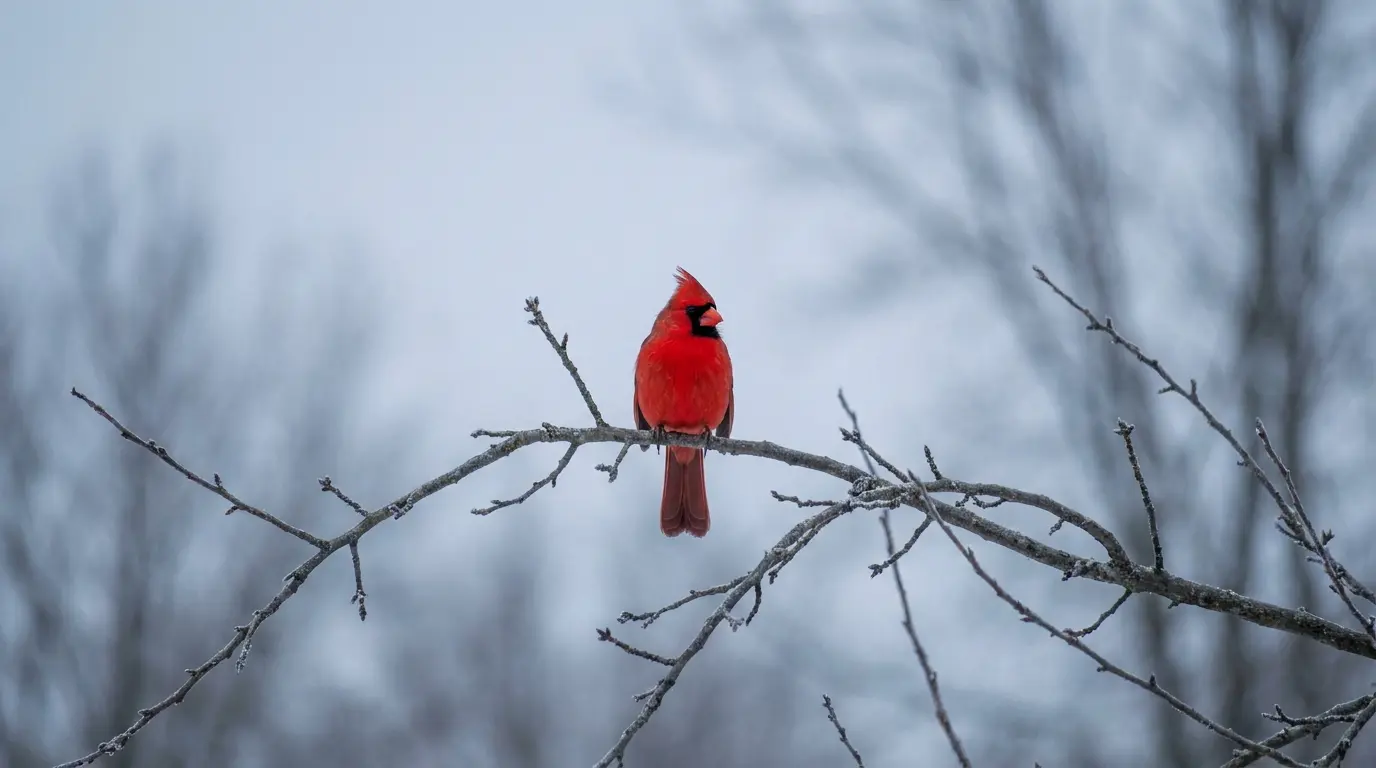
Northern Cardinals don’t migrate. They stay through December, through January, through the months when grief tends to hit hardest because holidays force the absence into the room. Most songbirds vanish when the temperature drops. The cardinal remains. It sits on the feeder in the snow. It sings from the same branch at dawn when the house is quiet and the person who used to make coffee isn’t there to make it anymore.
That persistence is the first layer. The second is chromatic: the male cardinal’s red registers as almost aggressively saturated against gray sky, white snow, bare wood. In a visual field drained of color — which is both literally what winter looks like and metaphorically how grief often feels — the bird becomes impossible to miss. It doesn’t blend. It interrupts.
The third layer is etymological, and almost nobody mentions it. Cardo, the Latin root, referred to the hinge of a door — the fixed pin that allows rotation. Roman city planning used cardo for the main north-south axis of a town, the line everything else organized around. When the Catholic Church adopted the word for its highest bishops, the idea was the same: these were the pivots on which the institution turned. The bird inherited the name because of its crest and color, but the structural meaning lingered underneath. A cardinal is, by etymology, a hinge-point. And for someone in grief who keeps noticing signs during loss, the bird lands at what feels like the exact joint between before and after.
That convergence — persistence through winter, chromatic interruption, etymological weight — is not something anyone designed. It accumulated. And it may explain why the cardinal carries emotional authority that no amount of debunking ever fully dissolves.
What the Red Cardinal After Death Meaning Reveals About Grief and Perception
When did you start noticing them? Before the loss, cardinals were probably background. A flash of red in peripheral vision. A bird at the feeder that didn’t require identification because it was always there, common as sparrows.
Something shifted after.
Grief researchers have a term for what happens to attention during bereavement: the bereaved person’s perceptual field narrows and sharpens simultaneously. Irrelevant information drops away. Emotionally loaded stimuli amplify. Dennis Klass, a psychologist at Webster University in St. Louis, spent decades studying what he called “continuing bonds” — the observation that healthy grief doesn’t require severing the relationship with the deceased. The bond continues, but it needs anchors. Objects, places, sensory experiences that hold the connection in place while the griever reorganizes everything else.
For some people that anchor isn’t visual at all but a scent tied to grief, like catching cigarette smoke in a room where no one is smoking.
The cardinal fits that anchor role almost too well. A high-saturation red object appearing unpredictably in the visual field — during a walk, through a kitchen window, in a cemetery parking lot — creates a micro-interruption. The griever’s attention, already tuned to emotional salience, locks onto it. And because the cultural narrative is already loaded (“when cardinals appear, loved ones are near”), the interpretation follows the attention almost instantly. The bird lands. The meaning arrives before the thought does.
This is not the same as saying the experience is “just” pattern recognition. Klass’s work suggests that the comfort itself is functionally real regardless of its source. If the cardinal anchors a continuing bond, and the continuing bond supports healthier grieving, then the mechanism matters less than the outcome. The question shifts from “is this a real sign?” to “is this actually helping me stay connected to someone I lost?”
That second question tends to be more useful. And harder.
Three Sightings, Three Different Readings
The moment the cardinal appears changes everything about what it seems to mean.
The Window Visit, Four Days After
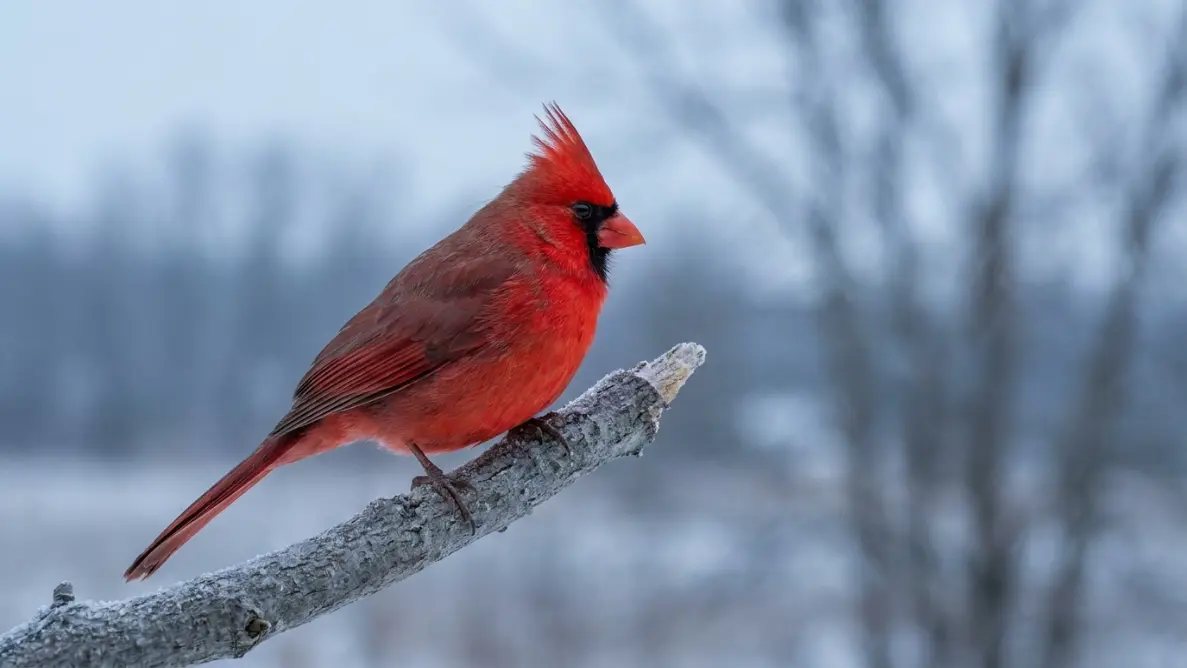
The dishes aren’t done. The sympathy cards are still on the table. The bird lands on the sill and stays longer than it should. In this context, the reading is almost always one of visitation — the person interprets the bird as the deceased arriving, checking in, proving that something survived the body. The emotional charge is enormous because the loss is still raw and the need for reassurance is at its peak. The timing feels impossible. The bird feels chosen.
From a naturalist perspective, a territorial male cardinal visiting a window it has always visited doesn’t know a funeral happened inside. The bird’s routine didn’t change. The griever’s attention did. But pointing that out to someone four days into loss doesn’t help anyone — and Klass’s research suggests it doesn’t need to. The comfort is doing real work whether the bird intended it or not.
The Garden Song, Seven Months Later
The acute phase has passed. The griever has returned to something resembling routine, but certain mornings still land wrong. The bird’s song becomes less about visitation and more about continuity — the deceased isn’t arriving, but hasn’t fully gone either. This is where the hinge metaphor holds best: the cardinal doesn’t bring the person back, but it holds the door open between the life that included them and the life that now continues without them. Some people who’ve reported comforting signs after loss describe a similar shift — the sign stops feeling urgent and starts feeling like company.
The Parking Lot Crossing, Fourteen Months Later
The griever is about to accept a job, sign a lease, start a relationship. The bird flies past — maybe close, maybe not. The reading here tends to be confirmation: the deceased would approve, the direction is right, the sign is permission. This is the most interpretively loaded scenario because the griever is projecting forward, not backward. The cardinal becomes less about who died and more about who the griever is becoming.
None of these readings is wrong. None is provable. The difference between them is entirely a function of where the griever stands in time — and that’s worth noticing, because it means the cardinal’s “meaning” isn’t fixed in the bird. It’s fixed in the person looking at it.
The Hinge That Doesn’t Need to Prove Anything
Proof is a strange thing to demand from a bird.
If the cardinal is a literal messenger from the dead, no controlled study will ever confirm it. If the cardinal is a perceptual artifact of grief-sharpened attention, no grieving person scanning the yard at 7 AM needs that explained to them while they’re crying. Both frames coexist, and demanding that one cancel the other usually serves neither the skeptic nor the mourner.
What can be observed — without requiring anyone to choose a side — is this: the cardinal’s appearance creates a moment of contact. Not necessarily contact with the deceased. Contact with the feeling of them. The memory gets pulled forward into the present tense for a few seconds. The person standing at the window isn’t remembering the dead — they’re briefly in the same emotional room again. That moment may last five seconds or five minutes, and then the bird flies away and the ordinary day resumes.
The actions that actually matter here are specific to this particular symbol and this particular experience. They aren’t transferable to a generic spiritual article.
Notice what you were thinking before you saw the bird — not after. The pre-sighting thought is usually the one that carries the actual emotional information. The cardinal just made it visible.
Notice whether the comfort lasts after the bird leaves. If the feeling dissolves immediately, the encounter may be operating as a brief emotional hit — real but thin. If something stays — a decision feels clearer, a weight lifts for the rest of the morning, a conversation you’ve been avoiding suddenly seems possible — the encounter is functioning as a hinge. It moved something.
Stop asking whether the cardinal “was” your person. Ask instead what opened when the bird arrived. A memory. A permission. A grief that needed to surface that morning and found its cue. The answer to “what opened” is almost always more useful than the answer to “who sent it.”
And if you live in a region where Northern Cardinals are common, and you see them constantly, and you’re worried that frequency dilutes the meaning — it doesn’t. The question was never about rarity. A door hinge works every time you push the door. The fact that it’s always there is the point.
The Bird That Stayed All Winter
I’ll be honest about something. I don’t know what cardinals are. I don’t mean taxonomically — Cardinalis cardinalis, Cardinalidae family, year-round resident of the eastern United States and parts of Mexico. I mean I don’t know what they are when they show up at the exact wrong moment and turn it into something bearable.
I’ve read the grief research. I understand continuing bonds. I can explain attentional bias under emotional load and I can cite the etymological chain from cardo to cardinal bishop to the bird with the crest. None of that fully accounts for the weight of the experience people describe — the sudden tears, the certainty, the way the bird seems to wait.
Maybe that’s the point. Maybe a hinge doesn’t need to explain itself. It just needs to hold two things together long enough for whoever is standing in the doorway to decide which direction they’re walking.
The red cardinal after death meaning isn’t a fixed answer. It’s a fixed question — asked differently every time the bird lands, depending on who you’ve lost, how long ago you lost them, and what part of yourself is still standing at the window waiting.
The bird doesn’t migrate. It stays through the season when everything else goes quiet. That might be biology. That might be something else. It is, at minimum, enough.
The reflections in this article draw on symbolic interpretation, cultural folklore, and published grief research. They are not intended as clinical guidance or spiritual doctrine. The experience of loss is deeply personal, and a red cardinal perching on a winter branch — whatever it means — belongs to the person who sees it, not to anyone interpreting it from a distance.



Alex Turner
Alex Turner is the author behind Signs of Universe, a website focused on dreams, spiritual meanings, and symbolic signs. His approach combines research and intuitive interpretation to help readers understand the subtle messages that appear in everyday life.