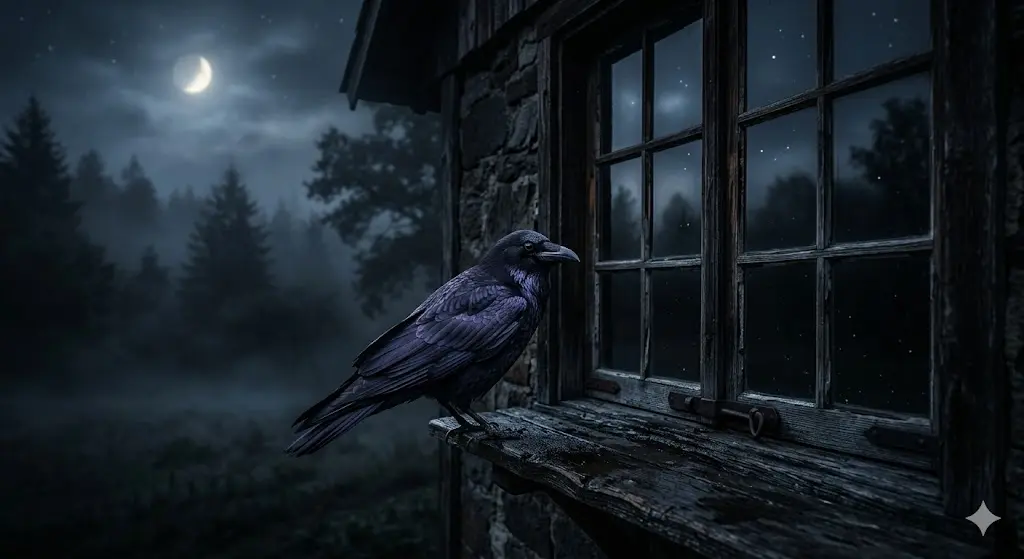
Black Crow at Your Window at Night: The Spiritual Meaning When It Lands Repeatedly
A black crow at your window at night can feel directed toward you because both the place and the hour are unusual. A window creates close eye-level contact with a wild bird, and darkness makes every movement more noticeable. Before interpreting the visit as a warning or message, identify what the bird is actually doing and whether the glass, light, food, shelter, or nearby roost could explain its presence.
The spiritual meaning of the encounter is not fixed. A crow can become a personal symbol of observation, memory, caution, adaptability, or a boundary between home and the outside world. Those are reflective associations, not proof that the bird predicts death, carries a message from another person, or knows what will happen.
First Confirm That It Is a Crow
Crows and ravens are related but different birds, and they are often confused in low light. Size, voice, tail shape in flight, location, and behavior can help with identification. Because spiritual websites frequently combine crow and raven traditions, confirming the bird prevents one animal’s stories from being automatically assigned to another.
If the room is dark and the bird is visible only as a silhouette, certainty may not be possible. It is more accurate to say “a dark corvid-like bird” than to build an elaborate meaning on an identification you could not verify.
Why the Window Matters Practically
Glass reflects sky, vegetation, lights, and the bird itself. A crow may approach because it sees a reflection, notices activity inside, has found food nearby, or uses a ledge as a temporary perch. If the bird repeatedly pecks or strikes the same area, territorial behavior toward its own reflection is one possible explanation.
The National Audubon Society guidance on birds attacking windows and mirrors explains that birds can react to a reflected image as if it were another bird. Audubon recommends reducing the reflection from the outside of the glass. This is different from a high-speed collision, which can seriously injure a bird.
Why a Crow Might Be Active After Dark
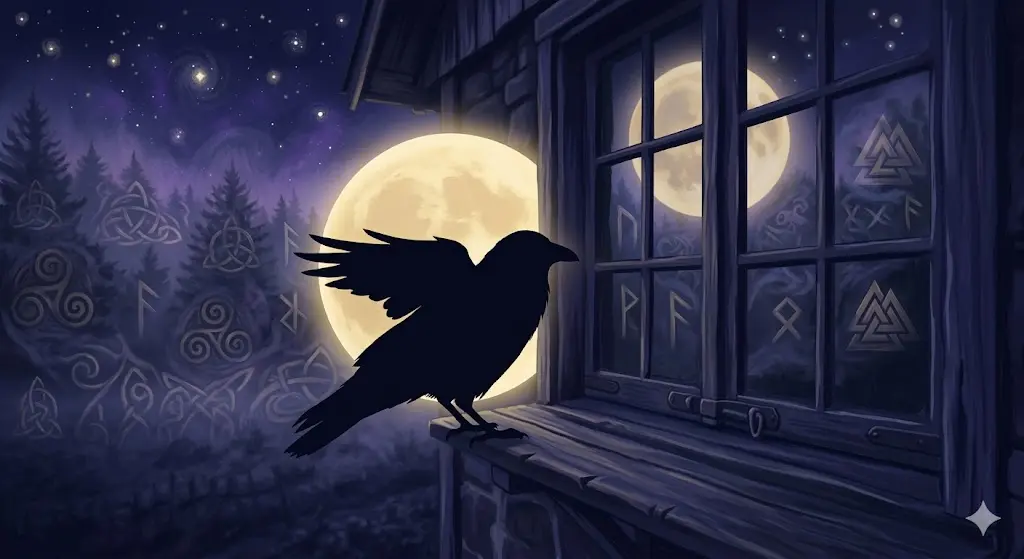
Crows are generally associated with daytime activity and communal nighttime roosts, but “at night” can describe several situations. The bird may be arriving at or leaving a roost around twilight, disturbed by noise, predators, weather, or artificial light, or resting in a location that happens to be visible from your window.
Do not assume that a nighttime appearance is impossible or supernatural simply because it is uncommon in your experience. Record the time, light conditions, season, weather, and whether other crows are nearby. These details are more useful than the hour alone.
If the Crow Looks Through the Glass
A crow facing the window may be looking at movement, light, a possible food source, or its reflection. Human observers naturally experience eye contact as personal, but the bird’s line of sight does not reveal its intention. Watch the head movements, calls, pecking, distance from the glass, and what happens when indoor lights change.
As a symbolic moment, being watched can raise questions about privacy, attention, or something you have been avoiding. Keep the wording personal: “The encounter made me think about…” is more honest than “The crow came to expose a secret.”
If It Taps or Pecks Repeatedly
Repeated tapping is a behavior problem to address before it becomes an omen story. Temporarily covering the outside of the reflective area or applying an appropriate external pattern can interrupt the reflected image. A single small decal may not be enough if the rest of the pane continues to reflect sky or vegetation.
Avoid harming, trapping, or feeding the bird in a way that encourages conflict. If it appears injured, unable to fly, or repeatedly collides with the window, contact a licensed wildlife rehabilitator or local bird-conservation organization for guidance.
If the Same Crow Keeps Returning
American Crows are intelligent, social, and adaptable. The Cornell Lab of Ornithology species account describes their varied diet, social behavior, and ability to live around people. A bird may revisit a location because the site previously offered food, a safe perch, a reflection, or another useful feature.
Repetition makes a pattern worth observing, but it does not automatically make it a spiritual message. Note whether the visit occurs at the same time, whether lights or curtains are in the same position, and whether food or trash is accessible nearby. Changing one condition at a time can help reveal the practical cause.
If you still find the pattern spiritually meaningful, let repetition suggest sustained attention rather than a specific prediction. Ask what issue has repeatedly occupied your own mind during the same period. The answer may be useful even if the bird’s reason remains ordinary.
Does a Black Crow Mean Death or Bad Luck?
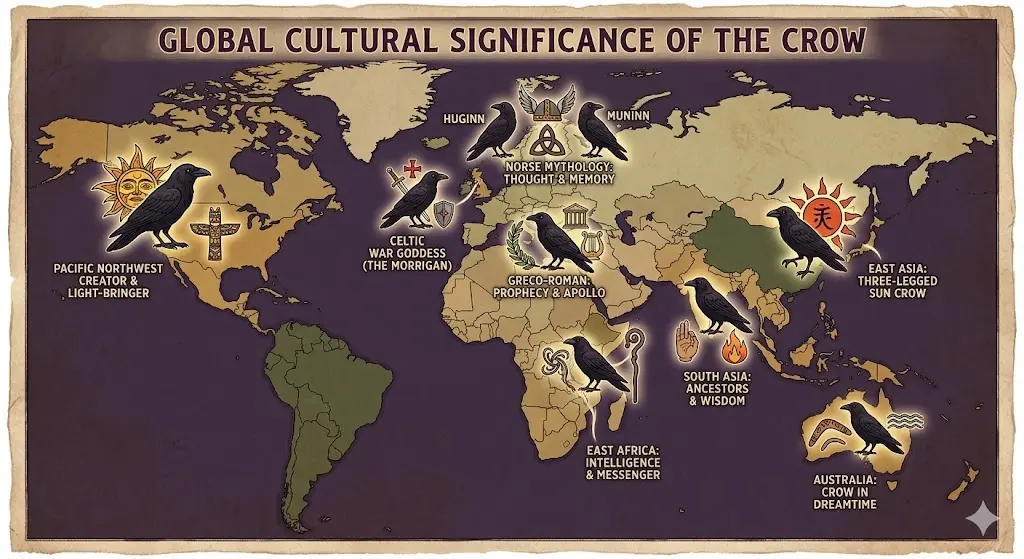
No sighting can establish that a death, accident, or misfortune will occur. Dark birds have been associated with ominous stories in some settings, while other stories emphasize intelligence, protection, ancestors, or guidance. These interpretations vary across cultures and are often mixed together online without reliable sourcing.
If the encounter frightened you, respond to the fear without validating a prediction. Check the window, confirm the bird is safe, and notice whether a real concern was already on your mind. Do not contact loved ones with a claim that the crow foretold harm, and do not make a high-stakes decision because of the sighting.
A Context-First Spiritual Interpretation
Use the encounter as a prompt built from its actual features:
- The crow: observation, intelligence, adaptability, or caution as personal associations.
- The window: a boundary between private space and the outside environment.
- The night: limited information, uncertainty, rest, or heightened attention.
- The repetition: a reason to observe patterns rather than assume a message.
- Your emotion: fear, comfort, curiosity, or vigilance determines which reflection fits.
These themes create a specific interpretation without claiming the bird intended one. For comparison, a domestic animal holding eye contact has a different behavioral context; see the spiritual meaning of a cat staring at you. A hovering insect near water points toward another set of real characteristics, discussed in the spiritual meaning of a dragonfly. You can also compare this encounter with the documented history and modern interpretations of owl symbolism.
What to Do Tonight
- Observe without approaching or frightening the bird.
- Turn off unnecessary indoor lights and check whether the reflection changes.
- Remove accessible food or waste that may attract wildlife.
- If tapping continues, reduce the reflection on the outside of the glass using bird-safe guidance.
- Write down the event and your reaction separately from any interpretation.
A black crow at your window can be memorable without being a threat. Its most responsible spiritual meaning is an invitation to observe carefully: first the bird and its environment, then the thoughts the encounter brought into focus.
This article separates documented bird behavior from symbolic reflection. Spiritual interpretations are presented as possibilities, not facts or predictions. They do not replace wildlife, medical, mental-health, financial, relationship, or safety guidance.

Alex Turner
Alex Turner is the editorial pen name used for articles published on Signs of Universe. The website covers dreams, symbolism, and cultural interpretations for informational and reflective purposes. Alex Turner is not a medical, mental health, scientific, or spiritual authority.