
Losing Everything at Once Spiritual Meaning: Destruction or the Universe Clearing the Path for Something You Didn’t Expect?
What would you do if your job, your relationship, and your savings all disappeared in the same month?
Not as a thought experiment. As your actual life.
When several major losses arrive close together, searching for a spiritual meaning can be an attempt to make an unmanageable situation coherent. The safest answer begins with reality: loss may involve housing, income, health, bereavement, a relationship, or legal and caregiving pressures, and each part may require different help.
The ground drops out. Everything that made your daily routine recognizable vanishes. And the scariest part isn’t even the loss itself — it’s the speed. One hit after another, stacked so close together that you barely finish processing the first before the next one lands.
There is no evidence that clustered losses almost never happen randomly or that they form a universal spiritual pattern. Practical causes often interact: illness can affect work, income can affect housing, and relationship strain can intensify under stress. A spiritual framework may support reflection, but it should not overwrite those causes.
The overwhelming guilt and the narrative that you are being punished usually have a psychological origin that can be entirely dismantled. What feels like absolute destruction is often just the removal of structures that were already crumbling right beneath the surface.
Some people later find growth or a different direction; others remain harmed for a long time. Neither outcome is guaranteed. Concrete action during crisis matters more than promising that the loss will eventually become something a person would not trade.
What Does “Losing Everything at Once” Actually Look Like?
Before the spiritual meaning, the reality. Because naming what’s happening is half the battle.
“Losing everything at once” isn’t a poetic exaggeration for most people who search for it. It’s a literal description of a compressed period — usually weeks or a few months — where multiple foundational structures collapse simultaneously.
The Pattern Most People Don’t Recognize
The losses tend to cluster around a few specific areas:
- A relationship ends — not always dramatically, sometimes just finally
- Financial stability disappears — a job loss, a debt that catches up, an investment that fails
- Health takes a hit — physical, mental, or both, sometimes as a deep tiredness that has no obvious cause
- A living situation becomes untenable — eviction, relocation, loss of a home
- A social circle dissolves — friends distance, family dynamics shift
What makes this experience so disorienting isn’t any single loss. It’s the stacking. Each one removes a piece of the scaffolding that held your identity in place. And when enough pieces go at once, the whole structure folds.
Some losses are connected, but it is not fair to assume the “cracks were already there” in every case. A job loss may trigger housing pressure, illness may alter finances, and bereavement may affect concentration and relationships. Other events can simply coincide. Mapping the actual links is more useful than assigning intention.
Smaller signs can do the same on a household scale, the way dead flies in the house can reveal something that already ended but still lingers in the room.
Why It Rarely Happens in Isolation
There’s a reason life doesn’t tend to fall apart one piece at a time during these periods.
When one major structure fails, the energy and attention you were using to maintain everything else gets disrupted. The relationship you were barely holding together needed the emotional bandwidth that the job stress just consumed. The finances that were “fine” only worked because both incomes were there.
These things are load-bearing walls. Pull one, and the others feel the shift immediately.
Practical explanation and spiritual reflection answer different questions. Practical analysis asks what happened and what needs attention now. Spiritual reflection asks which values, beliefs, or sources of meaning can help a person respond. The second is not automatically deeper or more accurate.

🔮 Losing Everything at Once Spiritual Meaning: The Core Interpretation
Here’s where the frame shifts — from “what happened to me” to “what is happening through me.”
Across some spiritual writing, simultaneous loss is described as “clearing.” That metaphor can help someone imagine rebuilding, but it cannot establish that the universe, God, a higher self, or any unseen force removed people, health, money, or security on purpose.
That’s not a comfortable idea. But it’s a consistent one.
The “Spiritual Demolition” Metaphor—and Its Limits
There’s a critical difference between chaos and demolition.
Chaos is random. A tornado that hits one house and skips the next. No pattern. No direction. Just damage.
The “spiritual demolition” metaphor can be reframed without blaming the person: after a collapse, they may decide which former structures were unsustainable and which were genuinely valuable. That judgment should be made with evidence and time, not assumed from the fact that something was lost.
Random events and systemic problems can also leave opportunities for rebuilding, while purposeful choices can still produce harm. A later benefit does not prove that the original destruction had a hidden blueprint.
There is no reliable test that separates “spiritual demolition” from random or interconnected loss. Knowing that a relationship or job had problems may explain part of an ending, but it does not prove cosmic precision.
The Concept of Forced Surrender
Most people don’t surrender voluntarily. That’s not a character flaw — it’s human.
We hold on. To relationships that stopped growing years ago. To careers that slowly corroded our sense of self. To financial arrangements that looked like security but felt like a trap. We hold on because letting go requires a kind of trust that the rational mind can’t produce.
“Forced surrender” is best treated as a metaphor for reaching the limits of control. It should not imply that the universe removed a person’s choices, that a deadline for change expired, or that the losses were delivered for their benefit.
Some ancient symbols encode this exact tension — the hamsa hand’s two directions literally switch between a gesture of shielding and a gesture of receiving, as if the choice between holding on and opening up was always built into the design.
Different traditions discuss attachment, suffering, providence, acceptance, and uncertainty in different ways. They do not share one identical mechanism in which resistance causes possessions or relationships to be taken away.
The pain of that moment is real. Nobody is pretending otherwise. But the question spiritual frameworks ask is specific: were you actually happy holding all of it? Or were you just afraid to let go?
Why Loss Should Not Be Treated as Proof of Cosmic Intervention
Think about it practically for a second.
If you’d been given the choice — a clean, calm, rational choice — to leave that relationship, quit that job, and start over financially, would you have taken it?
Most people answer honestly: no.
Not because they loved those things. But because the fear of the unknown was louder than the dissatisfaction of the known. The devil you know. The comfort zone that stopped being comfortable years ago but still felt safer than open air.
A non-punitive spiritual interpretation may be helpful, but it should not replace one unsupported claim with another. We cannot know that the universe intervened out of respect for someone’s growth. What can be chosen is a response based on compassion, safety, and values.
A reframe can reduce shame for some readers, but meaning does not have to be found immediately. It is also valid to call an event unfair, tragic, preventable, or unresolved.
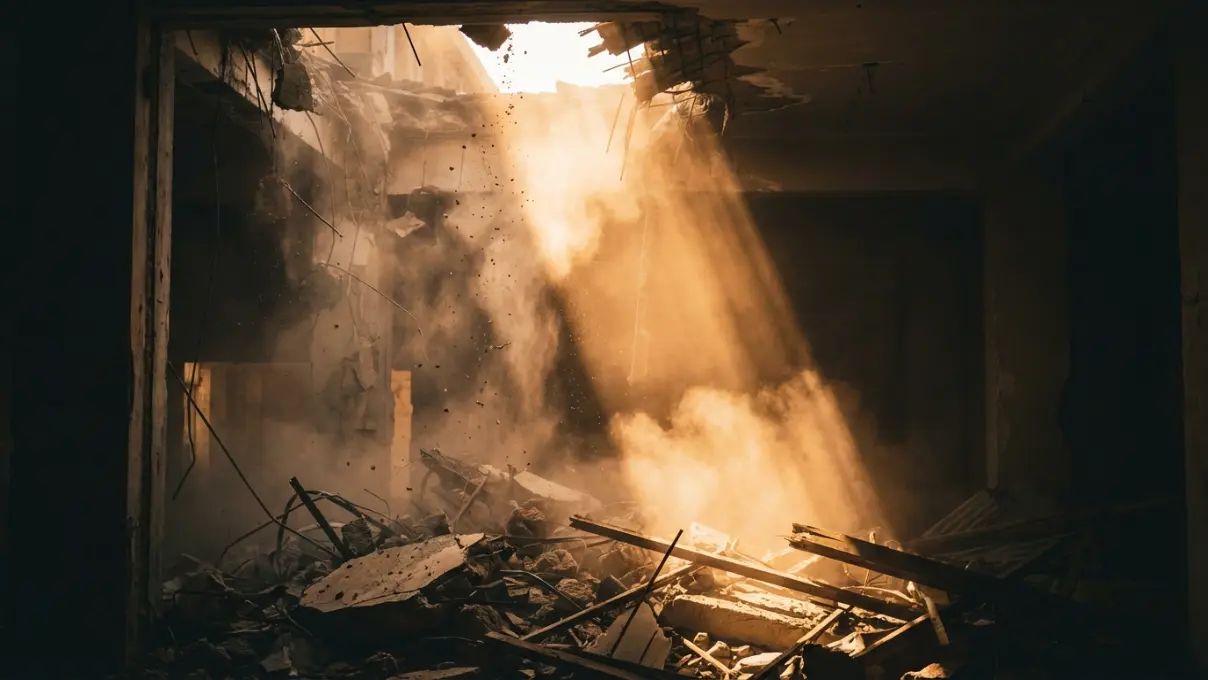
The “Dark Night of the Soul” — And Why This Might Be Yours
“Dark night of the soul” is often used loosely online. In its historical Christian context, it refers to spiritual purification and the felt absence of consolation; it is not a medical label and should not be used to diagnose trauma, depression, or every period of multiple loss.
What This Term Really Means (Beyond the Cliché)
“Dark Night of the Soul” comes from a 16th-century poem by Saint John of the Cross, a Spanish mystic and Carmelite friar. It wasn’t a metaphor for having a bad week.
John described a specific spiritual process: a period where everything that connected a person to their old identity — their comforts, their certainties, their sense of control — gets stripped away. Not partially. Completely.
The purpose, in his framework, was purgation. The soul needed to be emptied of attachments so it could be filled with something greater. The darkness wasn’t God’s absence. It was the space created after everything false had been removed.
Multiple external losses can resemble the language of emptiness or uncertainty used in mystical writing. The resemblance does not mean that every crisis is a divinely arranged spiritual process.
How Simultaneous Loss Changes Identity and Coping
When life takes one thing at a time, you can compensate. Lose the job? Lean on the relationship. Lose the relationship? Bury yourself in work. Lose financial stability? Distract with social life.
Simultaneous loss can remove several coping resources at once. It may also leave overlooked supports: a person, service, document, skill, routine, legal right, community, or emergency resource. The immediate task is to find and strengthen what remains.
The question “Who am I without these roles?” can support reflection, but crisis can also impair sleep, concentration, and decision-making. Profound transformation is not required. Stabilization and recovery are worthwhile outcomes on their own.
It’s brutal. And it works.

What Different Spiritual Traditions Say About Total Loss
Older traditions do discuss suffering and impermanence, but their teachings differ and should not be collapsed into one universal claim that total loss has a consistent spiritual purpose.
Buddhism: Impermanence as the Foundation
Buddhist teachings include impermanence (anicca) as a characteristic of conditioned existence. Applying that concept to a personal crisis is a philosophical interpretation; it does not mean health, relationships, or security were “designed” to disappear in a particular way.
Buddhist discussions of suffering and attachment are more nuanced than saying “the problem was never the loss.” Material loss, violence, illness, and bereavement can cause real harm. Reflection on impermanence should deepen compassion, not minimize that harm.
The Zen teacher Shunryu Suzuki captured it: “Renunciation is not giving up the things of this world, but accepting that they go away.”
From a Buddhist perspective, impermanence may invite attention to change and reduce rigid clinging. It should not be presented as the universe delivering a direct lesson through someone’s crisis.
Christianity: The Story of Job
The Book of Job is arguably the oldest and most direct scriptural exploration of losing everything at once. Job loses his wealth, his children, his health, and his social standing — all in rapid succession, through no fault of his own.
The theological debate within the book is exactly the one most people have internally during total loss: is this punishment? Did I do something wrong?
Job’s friends insist he must have sinned. That the loss is deserved. Job pushes back — not with denial, but with honest anguish. And the eventual resolution isn’t a neat explanation. It’s a confrontation with mystery itself. God speaks from the whirlwind — essentially saying: the architecture of reality is larger than your ability to judge it.
For Christians navigating total loss, Job offers something more useful than comfort. It offers permission to be angry, confused, and faithful simultaneously — without pretending the pain is fair.
Stoic Philosophy: Amor Fati
Marcus Aurelius, the Roman emperor and Stoic philosopher, practiced a concept called amor fati — love of fate. Not tolerance. Not acceptance. Love.
Stoic philosophy emphasizes distinguishing what is within one’s control from what is not and choosing one’s response. It does not require calling every loss good, deserved, or cosmically assigned.
A careful Stoic reading acknowledges pain while focusing on the next controllable action. Describing simultaneous loss as the universe’s “masterclass” risks romanticizing suffering and blaming people who do not emerge stronger.
Amor fati doesn’t ask you to be grateful while you’re bleeding. It asks you to eventually look at the scar and recognize what it built in you.

⚠️ Is the Universe Punishing You? Dismantling the Guilt
Calling a crisis a “spiritual clearing” may not help when shame and self-blame are already present. The more urgent distinction is between responsibility for a specific decision and global blame for everything that happened.
Why the “Punishment” Narrative Is So Seductive
When everything falls apart simultaneously, the human brain does something predictable and cruel: it searches for a cause that puts you at the center.
You must have done something wrong. You attracted this. Your energy was off. God is teaching you a lesson. Karma caught up.
Self-blame can create an illusion of control: if every loss was caused by a personal defect, it may feel as though future pain can be prevented by becoming perfect. A more accurate review separates known causes, unknowns, systemic factors, other people’s choices, and the limited area where one’s own action is possible.
That’s why the punishment story sticks so hard. Not because it’s true. But because it gives the mind something to grip during freefall.
What Karma Actually Means (Not What You Think)
Western pop culture turned karma into a cosmic vending machine: put in good actions, get good results; put in bad actions, get punished. That’s not what karma means in any tradition that actually uses the concept.
In Hindu and Buddhist philosophy, karma is action and consequence across vast scales of time and existence. It’s not a reward-and-punishment system — it’s a description of how energy moves through interconnected systems.
Losing everything is not evidence of “bad karma.” It is also not evidence of karmic graduation or the completion of an invisible cycle. Those are religious or philosophical interpretations, not conclusions that can be drawn from the event.
Understanding this distinction can physically loosen the grip of guilt. You didn’t fail a cosmic test. A cycle completed. That’s structurally different — and it matters.
Separating Self-Blame From Spiritual Meaning
A practical filter is to ask what an interpretation does. If it increases shame, fear, risky decisions, passivity, or dependence on a spiritual authority, step back. If it supports self-compassion and a safe, concrete action, it may be useful as personal meaning—but still not as proof of cause.
Helpful meaning does not have to say the loss “was supposed to” happen. It can say: “This happened, some causes are known and some are not, and I can choose what values guide my next step.”
Self-blame asks whether everything reflects a personal failure. Responsible reflection asks narrower questions: What was under my control? What was not? What can I repair, document, learn, or request now? Spiritual meaning, if used, should not erase those distinctions.
Both are stories about the same events. Only one of them helps you get up.

💡 What Comes After the Collapse: Patterns of Rebuilding
Meaning after loss is not only about why it happened. It may emerge through rebuilding, relationships, advocacy, faith, work, or acceptance—and it may remain incomplete.
The Lag Between Destruction and Clarity
Nobody gets clarity during the collapse. That’s not how this works.
There’s a gap — sometimes weeks, sometimes months — between the loss and the moment where meaning starts to crystallize. During that gap, nothing makes sense. The spiritual frameworks feel hollow. The pain is just pain.
A delay before clarity is common, but it is not a required spiritual stage and an “old identity” does not have to dissolve. Pushing for a lesson too early can add pressure to a person who needs stabilization.
The clarity tends to arrive quietly. Not as a dramatic revelation, but as a slow recognition: the things you lost were things you’d already outgrown. You just couldn’t see it while you were standing inside them.
Why Recovery Stories Are Possibilities, Not Promises
A 34-year-old software engineer lost his job, his apartment, and his fiancée within six weeks. He moved back to his parents’ house with two suitcases. Eighteen months later, he’d launched an independent consulting practice that earned more than his corporate salary and met his current wife at a client workshop he never would have attended in his old life.
Dramatic recovery stories are compelling, but an anonymous example without a verifiable source should not be treated as evidence. Public narratives also overrepresent people whose later success gives the story a satisfying ending.
These stories may illustrate possibilities, not a consistent pattern. Survivorship bias can hide people whose losses led to long-term hardship or whose rebuilding was slow, partial, and dependent on substantial support.
How to Know If the Shift Has Already Started
Sometimes the rebuilding begins before you realize it. Look for these quiet signals:
- You stopped trying to recreate what was lost and started noticing what’s possible
- Decisions you’ve been avoiding for years suddenly feel obvious
- People and opportunities that match your actual values start appearing — not because of manifesting, but because you’re no longer too busy maintaining the old structure to notice them
- The grief shifts from “I lost everything” to “I lost things that weren’t really mine”
That last shift is the turning point. Not everyone reaches it on the same timeline. But when it arrives, it tends to be permanent.

What to Do When You’re in the Middle of Losing Everything
A spiritual framework may help some people, but in the middle of a crisis the priority is stabilization: safety, shelter, food, medicine, communication, deadlines, documentation, and support.
The following actions are designed for overlapping losses. They are triage steps, not a promise that every problem can be solved quickly.
Name Each Loss Separately — Out Loud
When everything collapses at once, the brain merges it all into one massive, undifferentiated catastrophe. That makes it feel unsurvivable.
Break it apart. Say each loss individually, out loud if possible: “I lost my job at [company name]. I lost my relationship with [their name]. I lost [specific amount] in savings.”
Naming each loss separately can make the situation easier to organize. It does not eliminate panic or replace professional assessment, but it can reveal which problem has the nearest deadline or greatest safety impact.
Identify Which Loss Is Actually Hurting the Most
Here’s what surprises most people: it’s usually not the one they’d expect.
Do not assume one loss causes a fixed percentage of the distress. Rank each issue twice: first by urgency and safety, then by emotional weight. The most painful issue may not be the one with the nearest deadline.
Or the reverse — the financial loss creates a survival-level anxiety that makes everything else feel worse than it is.
Identifying the primary wound changes your recovery strategy entirely. Stop trying to fix all five things simultaneously. Find the one that’s generating the most distress and give it focused attention first.
Create One Fixed Point in Your Daily Life
When everything external has collapsed, your nervous system needs one predictable anchor. Just one.
It could be making coffee at the same time every morning. Walking the same route. Eating dinner at the same hour. The content doesn’t matter — the consistency does.
Overlapping loss often disrupts routine. One repeatable action—taking essential medication, eating at a set time, checking one benefits application, or speaking with one trusted person—can provide a small point of predictability without pretending the whole situation is safe.
Tell One Person the Full Truth
Not the sanitized version. Not the “I’m going through some stuff” version. The actual, complete, ugly truth of what happened.
Simultaneous loss creates isolation because the story feels too overwhelming to share. People default to vague summaries because they don’t want to seem like a disaster.
Choose one trustworthy person and explain the situation as clearly as you can. If sharing everything feels unsafe or overwhelming, start with the most urgent fact and a specific request: a ride, a call, a place to store documents, help making an appointment, or simply company.
A 24-Hour Triage for Multiple Losses
1. Protect immediate safety. Identify where you will sleep, whether you have food and water, access to essential medication and medical devices, a charged phone, and a safe way to leave a dangerous situation. If there is immediate danger, serious medical risk, or risk of self-harm, contact local emergency or crisis services now.
2. Find the deadlines. List the next date connected with housing, court, employment, insurance, benefits, utilities, debt, school, immigration, or medical care. Do not rely on memory. Put the documents, contact name, reference number, and required action beside each deadline. A missed deadline can turn one loss into another.
3. Preserve essential information. Keep identification, prescriptions, insurance information, legal notices, employment records, financial statements, phone numbers, and evidence of payments or communications in one secure place. Photograph or back up irreplaceable documents when safe and lawful.
4. Match each problem with the right kind of help. A faith leader may support spiritual questions; a licensed clinician can address mental health; a physician can address medical risk; a lawyer or legal-aid service can interpret legal rights; a certified financial counselor can help organize debt; a housing or domestic-violence service can help with safety and shelter. One helper should not be expected to solve every category.
5. Make one specific request. “I am losing everything” is honest but difficult for another person to act on. Try: “Can you sit with me while I call the landlord?”, “Can you store these documents?”, “Can you drive me to the clinic?”, or “Can we make a list of the three deadlines due this week?” Specific requests convert support into action.
What Not to Decide in Freefall
Avoid irreversible decisions made only because someone claims the universe is demanding surrender. Do not give away remaining money, stop medication, abandon legal rights, cut off every relationship, or pay a spiritual practitioner for guaranteed answers. When possible, pause major commitments until immediate danger has passed and a qualified person has reviewed the relevant facts.
The National Institute of Mental Health guidance on finding help explains routes to professional and crisis support in the United States; readers elsewhere should use their local health and emergency systems. Practical help does not invalidate spiritual meaning. It protects the person who must live through the situation.
❓ FAQ — Losing Everything at Once Spiritual Meaning
What does it mean spiritually when everything in your life falls apart at once?
Some spiritual writers interpret simultaneous loss as clearing, but there is no way to establish that the universe removed what no longer aligned with someone’s growth. A safer meaning is chosen afterward: the person decides what to preserve, release, repair, or rebuild.
Is losing everything a sign of bad karma?
Loss is not evidence that a person deserves punishment. Traditions define karma in different and complex ways, so an online article should not claim that a cluster of losses proves either retribution or completion of a karmic cycle.
Why do bad things happen all at once instead of one at a time?
Major life structures are often interconnected: employment affects income, income affects housing, illness affects work, and stress affects relationships. That practical cascade does not show that voluntary change failed or that transformation was spiritually forced.
How do you recover spiritually after losing everything?
Recovery does not follow one guaranteed sequence. Useful steps include separating the losses, identifying safety and deadline risks, protecting essential documents and medication, creating a small routine, and asking qualified people for targeted help.
Does losing everything mean something better is coming?
No better outcome is guaranteed. Loss may create choices, but recovery also depends on health, resources, rights, support, timing, and circumstances beyond personal control. Building around actual values can still improve the direction of the next step.
When the Dust Settles
A spiritual explanation may never feel true, and that is not a failure of faith. Meaning can arrive later, change over time, or remain uncertain. Immediate safety does not need to wait for a lesson.
Buddhism, Christianity, Stoicism, and mystical traditions do not make one identical promise about collapse. What they can offer are different languages for impermanence, lament, responsibility, acceptance, hope, and mystery. None proves that a structure was demolished to make room for a destined future.
That doesn’t make right now hurt less. Nothing can do that honestly. But it can shift the question from “why is this happening to me?” to “what is this making room for?” — and that shift, small as it sounds, changes the trajectory of everything that follows.
The things you lost were real. The grief is earned. And the ground you’re standing on right now — bare, stripped, terrifyingly open — is exactly where rebuilding begins.
Not the kind of rebuilding that recreates what you had. The kind that builds what you actually need.
Before we conclude, please remember that the spiritual, philosophical, and symbolic interpretations of simultaneous loss explored here are meant purely for your own personal reflection and comfort.
These perspectives shouldn’t be treated as absolute truths, professional psychological advice, or a substitute for genuine mental health support.
If you find yourself experiencing severe emotional distress, a financial crisis, or thoughts of self-harm, please reach out to a licensed professional or crisis support service to help you navigate this difficult time.




Alex Turner
Alex Turner is the editorial pen name used for articles published on Signs of Universe. The website covers dreams, symbolism, and cultural interpretations for informational and reflective purposes. Alex Turner is not a medical, mental health, scientific, or spiritual authority.