Hamsa Hand Facing Up or Down: What Each Direction Is Believed to Symbolize
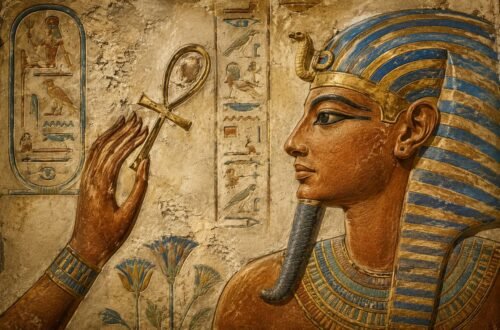
In the ruins of ancient Carthage — modern Tunisia — archaeologists have recovered more than six thousand stone markers carved with a single recurring motif: an open right hand, fingers pointing skyward. Every one of them faces upward. That single detail is the oldest clue to the hamsa hand facing up or down meaning — and to why the direction still matters today.
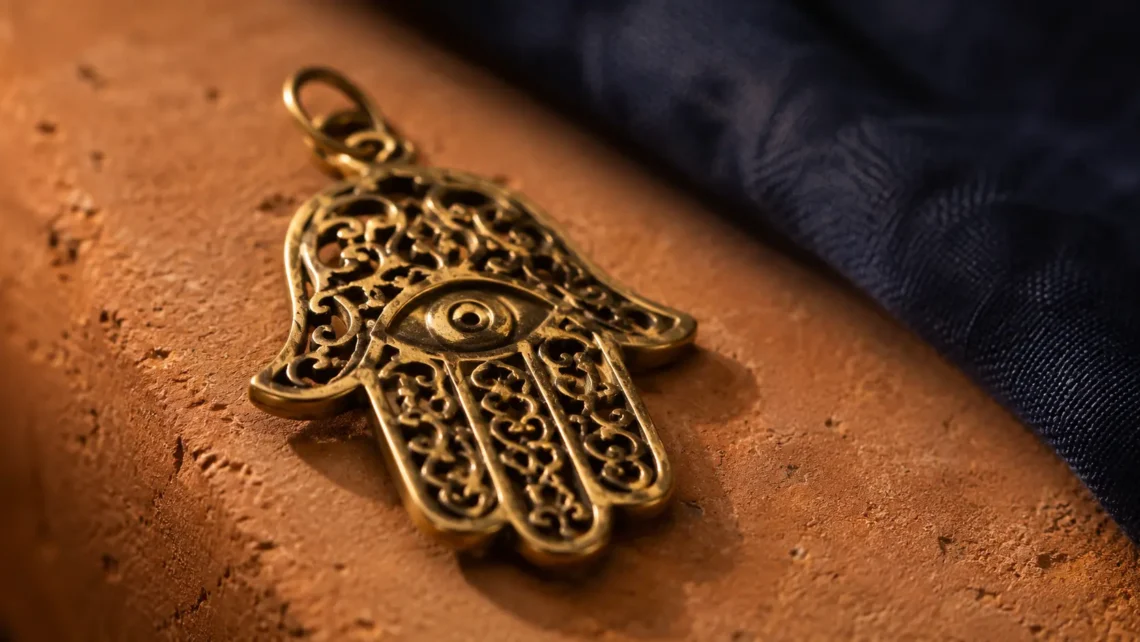
That detail matters if you’ve ever held a hamsa pendant and hesitated before putting it on. A hamsa hand facing up or down carries different symbolic weight depending on the direction. Fingers pointing skyward are traditionally read as a protective gesture — a shield against negativity and the evil eye. Fingers pointing earthward are interpreted as a receiving posture — an open palm inviting abundance, blessing, and good fortune. Neither direction is wrong. Each changes what the amulet is believed to declare.
The split between the two isn’t decorative, though. It traces back to a gestural vocabulary far older than the hamsa itself — one that connects Phoenician amulets to Buddhist hand positions and suggests that the direction most people instinctively choose may reflect something more specific than a product description can capture.
The Hand That Existed for Three Thousand Years Before Anyone Asked Which Way It Should Face
Most hamsa guides start with the meaning. This one starts with the timeline, because the timeline changes the meaning.
The oldest known ancestor of the hamsa surfaces in ancient Mesopotamia around 1800 BCE, associated with the goddess Inanna. But the version most directly linked to the modern amulet appears in Carthage around 800 BCE, where it represented the Hand of Tanit — patron goddess and protector of the city, consort of Ba’al Hammon, a figure so central to Carthaginian life that her symbol appeared on coins, burial stones, and household objects across the Mediterranean.
Here’s what’s easy to miss: those early Carthaginian hands almost always point upward. The open palm faces outward, fingers toward the sky. It’s a barrier. Not an invitation.
The “receiving” interpretation — hand facing down, palm open to catch blessings — appears later, as the symbol traveled westward along Phoenician trade routes and eventually entered Jewish and Islamic practice. In Judaism, it became the Hand of Miriam. In Islam, the Hand of Fatima. The word “hamsa” itself comes from the Arabic and Hebrew word for five — a reference to the fingers, and in some readings, to the five books of the Torah or the Five Pillars of Islam.
By the time the two-direction distinction became widely discussed, the symbol was already ancient. The question “should it face up or down?” is a relatively recent addition to a three-thousand-year-old object.
Worth remembering the next time a jewelry listing presents “up = protection, down = abundance” as if those were factory settings. They’re not. They’re layered readings that accumulated across centuries, geographies, and belief systems. The same context-first principle appears in ring symbolism, where a wedding band, bishop’s ring, mourning ring, and signet ring can share a form without sharing one fixed meaning.
The same historical layering appears in the labyrinth symbol meaning, where Greek myth, civic imagery, medieval Christian architecture, and modern contemplative practice contribute different meanings rather than one fixed definition.
If you’re familiar with protective amulets, the hamsa’s upward-facing origins connect directly to the tradition behind an evil eye bracelet breaking — both share the idea that a protective object absorbs or deflects something on behalf of the wearer. The hamsa and the nazar (evil eye bead) are adjacent symbols, frequently combined in the same piece of jewelry, but visually and historically distinct.
🖐️ Two Gestures Older Than the Hamsa Itself
Where does the idea that a hand facing up means “stop” and a hand facing down means “welcome” actually come from?
The hamsa didn’t invent that distinction. It inherited it.
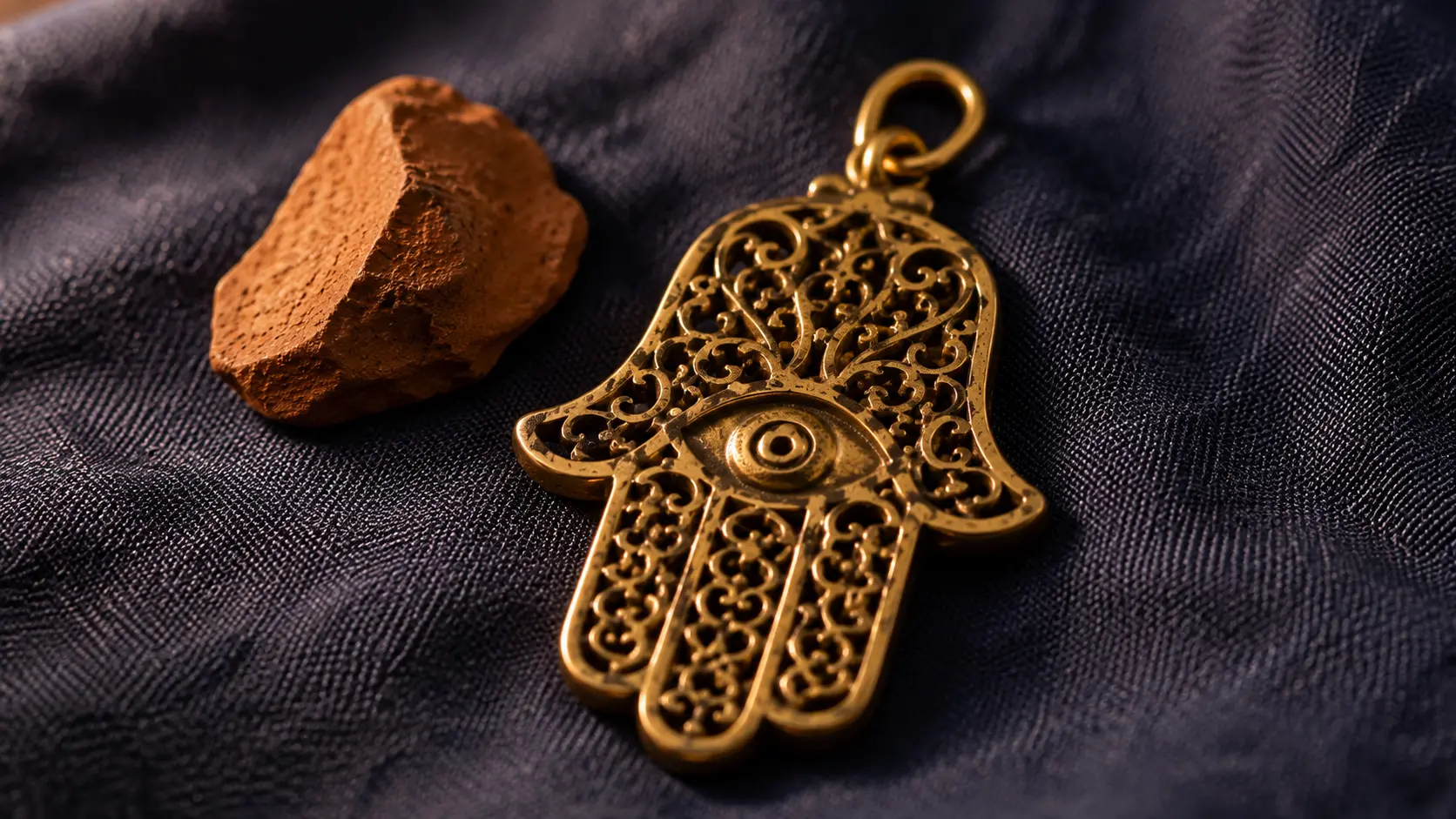
In Buddhist and Hindu iconography, two specific hand positions — called mudras — carry precisely the same meaning split that the hamsa encodes. The Abhaya mudra is performed with the right hand raised, palm outward, fingers pointing up. The word “abhaya” is Sanskrit for “fearlessness.” It’s one of the oldest documented symbolic gestures in Asia, depicted on Gandharan sculptures as early as the first century CE and associated with the fifth Dhyani-Buddha, Amoghasiddhi. According to Buddhist tradition, the historical Buddha used this gesture to halt a charging elephant sent by his rival Devadatta. The message is unmistakable: no harm passes this hand.
The Varada mudra is the mirror position. The hand extends downward, palm open, fingers toward the earth. “Varada” translates roughly as “favorable” or “gift-granting.” It represents generosity, compassion, and readiness to receive. In Buddhist art, it’s the gesture of the bodhisattva who has something to offer — and in many standing Buddha figures, the two mudras appear on the same body. Right hand raised in Abhaya. Left hand lowered in Varada. Protection and generosity, held simultaneously.
Here’s the connection almost nobody makes when discussing the hamsa hand facing up or down meaning: the hamsa’s two orientations mirror these two mudras with structural precision. Hand up, fingers skyward, palm outward — Abhaya. Hand down, fingers earthward, palm open — Varada.
This doesn’t mean the hamsa was copied from Buddhist iconography. What it means is that the human hand, held in these two positions, communicates something that cultures separated by thousands of miles independently recognized. An open hand raised is a universal barrier. An open hand lowered is a universal offering. The gesture precedes the amulet.
So when a product listing tells you the hamsa “means protection” when it faces up, they’re describing something far older than a pendant option. They’re describing a gesture that predates written language itself — encoded into the body before any religion formalized it.
The Direction You Choose Says More About You Than About the Symbol
Every site explaining the hamsa hand facing up or down meaning delivers the same answer: up for protection, down for abundance. Pick one. Done.
What none of them explore is why the question feels personal in the first place.
If the hamsa were purely aesthetic, nobody would search for its meaning. The fact that people do — often right after receiving one as a gift, or buying one during a specific chapter of life — suggests the direction question is doing something more than decorating a neckline. It’s asking the wearer to declare a posture.
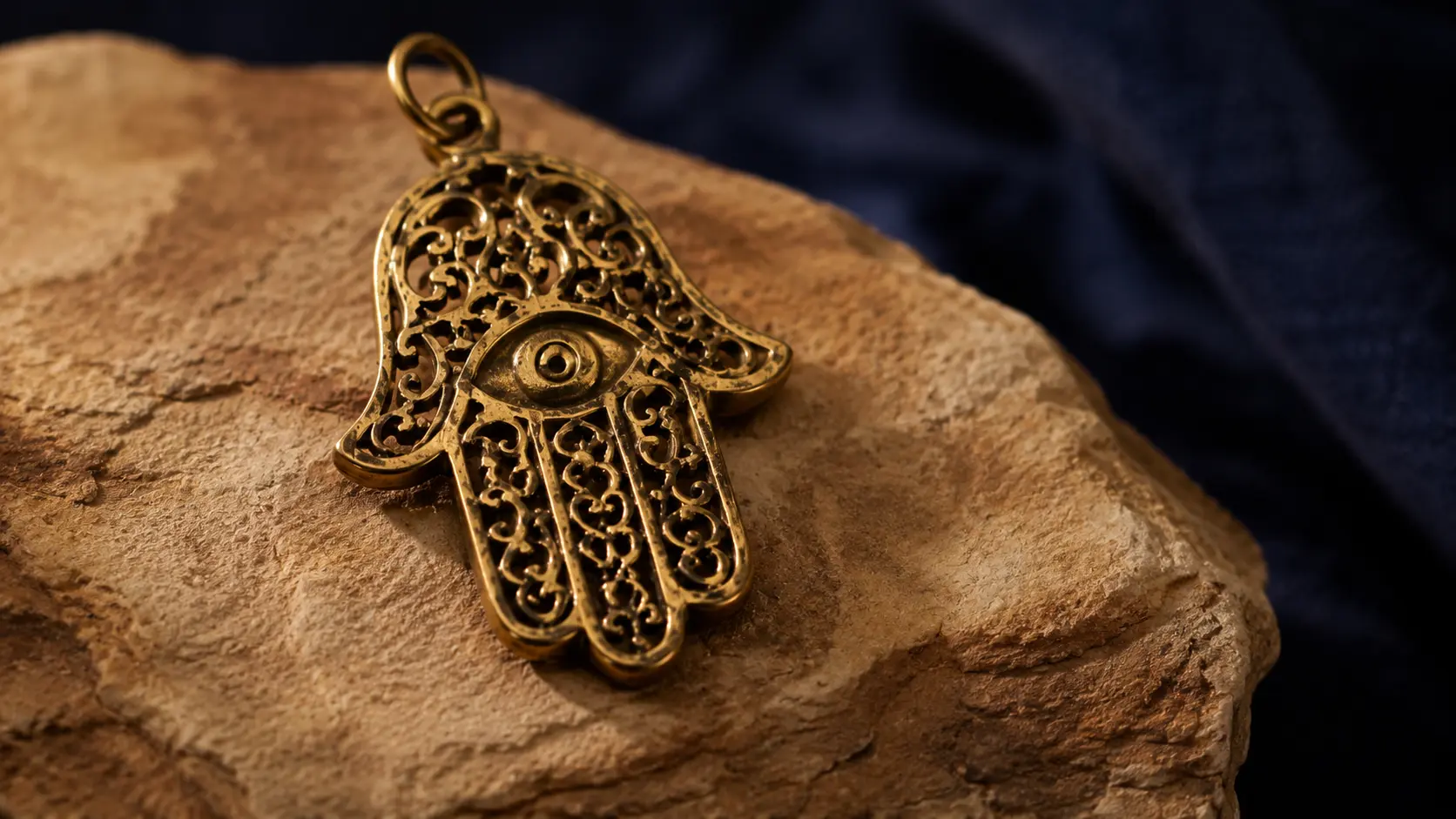
Think about what each orientation states. Fingers up: I need a boundary. Something needs to stay out. Fingers down: I’m open. Something is welcome to arrive.
Those aren’t interchangeable. And they’re not permanent.
Some people wear a hamsa facing up during a turbulent stretch — conflict, exposure, instability — and rotate it downward once the pressure lifts. Others never change direction because the posture they chose first still fits. A few wear both at once: one up, one down, on different chains or wrists, holding both intentions simultaneously, much like the standing Buddha with Abhaya and Varada on the same body.
No documented tradition says any of those approaches is wrong. The hamsa’s entire history is a record of adaptation. It changed meaning when it crossed the Mediterranean. It changed again when it entered Kabbalistic practice. It will keep shifting in whoever wears it next.
That’s the part the product descriptions leave out. The direction isn’t a setting you configure once. It’s a statement — and that statement might need updating as circumstances change.
Among people who’ve experienced loss, a downward-facing hamsa sometimes becomes a quiet gesture of receptivity — a way to remain open to comfort, connection, or what some interpret as signs a loved one may still be near. The hand turns downward not because abundance is expected, but because something still worth receiving hasn’t finished arriving.
Hamsa Hand Facing Up or Down Meaning: FAQ
Can you wear the hamsa facing both directions at the same time?
Yes. Some people layer two pendants — one up, one down — as a way to hold both intentions simultaneously. No tradition prohibits this. The dual gesture mirrors a common arrangement in Buddhist sculpture, where Abhaya and Varada appear on the same figure’s two hands. One shields. The other receives. Both are considered active.
Does the hamsa need to be gifted to work?
No. The protective association belongs to the symbol, not to how it was obtained. Purchasing a hamsa for yourself carries the same symbolic weight as receiving one. What most traditions emphasize is the intention behind wearing it — not the transaction that preceded it.
What does the eye in the center of the hamsa represent?
The central eye is usually an adaptation of the nazar — the blue evil eye bead common in Turkish, Greek, and Levantine traditions. Embedded in the hamsa’s palm, it adds a layer of watchful protection, as if the hand can see what it blocks. Not every hamsa includes one. Its presence is stylistic and cultural, not structurally required for the symbol to function.
The Gesture You Are Already Making
The hamsa’s two directions were never a quiz with a correct answer. They were a question the symbol asks back.
The next time you hold one — on a chain, in a box, between your fingers at a market stall — notice which way you instinctively turn it before putting it on. Don’t consult a chart. Don’t check the listing. Just observe the gesture your hand already makes.
That reflex, before any article or product page intervenes, is the hamsa doing what it has done for three thousand years: not telling you what to believe, but showing you what you already carry. The interpretations presented here reflect cultural, historical, and cross-traditional readings of the hamsa as a symbolic object. They are not prescriptive spiritual claims. The hamsa’s meaning has always been shaped by the hands that hold it — yours included.



Alex Turner
Alex Turner is the editorial pen name used for articles published on Signs of Universe. The website covers dreams, symbolism, and cultural interpretations for informational and reflective purposes. Alex Turner is not a medical, mental health, scientific, or spiritual authority.