Eclipse Spiritual Meaning: What Different Cultures Saw in a Darkened Sun
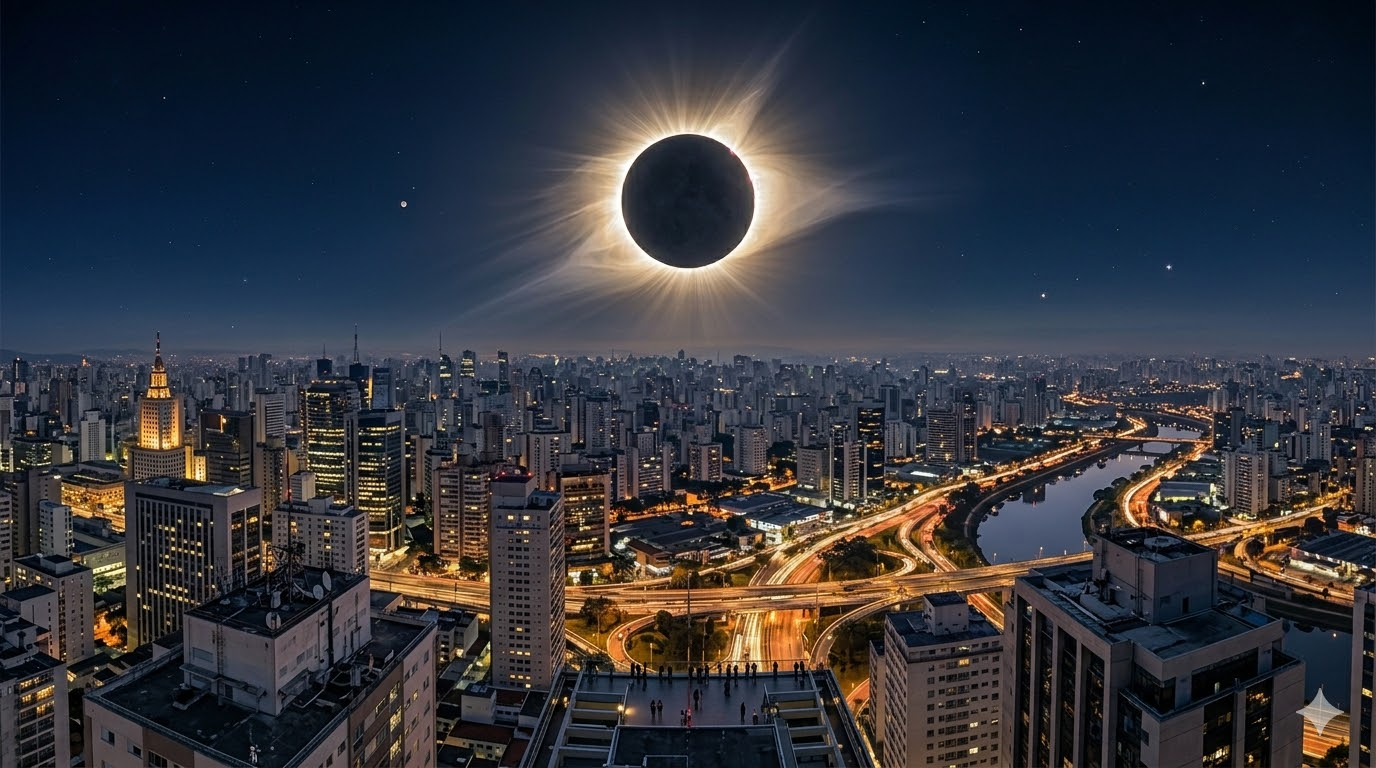
An eclipse is one of the few sky events that stops people in the middle of their day. The light changes, the air can feel cooler, and for a few minutes the Sun or Moon looks wrong.
Almost every culture with written records tried to explain what that moment meant, so there is no single eclipse spiritual meaning. This guide keeps three things separate: what an eclipse physically is, what specific traditions believed about it, and what modern spiritual writers say it means.
Looking back after a major change, it is easy to connect the event with a nearby eclipse. That connection may feel symbolic, but timing alone does not show that the eclipse disrupted or redirected a person’s life.
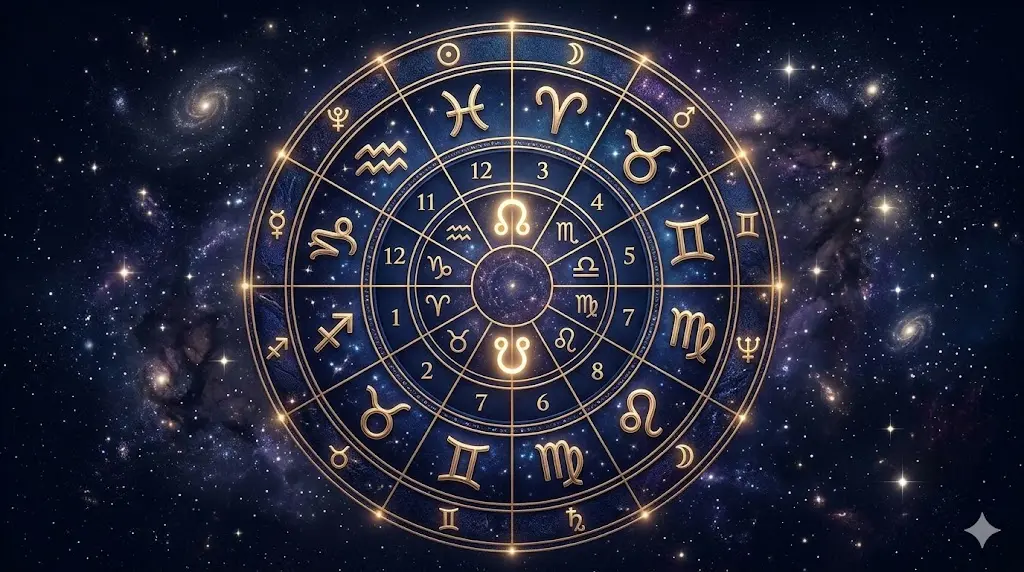
In astrology, eclipses are often described as accelerators because they occur near the lunar nodes, the points where the Moon’s orbit crosses the ecliptic. Astronomy uses those nodes to explain eclipse geometry; astrology assigns them themes such as fate or direction. The geometric fact does not verify the prediction.
Astrological writing often contrasts solar eclipses with outward beginnings and lunar eclipses with emotional culmination. These are symbolic conventions. Vivid dreams, emotional surges, and sudden clarity can occur at any time and should not automatically be attributed to an eclipse.
What Is the Spiritual Meaning of an Eclipse?
To understand why eclipses feel so significant, you have to step back from the telescope and into something older.
In many spiritual readings, an eclipse is treated as a moment when ordinary reality is interrupted.
The light, whether solar or lunar, is temporarily blocked. In many spiritual traditions, light symbolizes consciousness, clarity, and the known world, so some writers describe an eclipse as a moment when something hidden comes into view. That is a metaphor, not a physical effect of the eclipse.
Why Some People Feel Uneasy Around an Eclipse
Some people report uneasiness around an anticipated eclipse; others feel excitement or nothing unusual. Expectations, media coverage, disrupted routines, and the drama of the event can all influence the experience.
It is tempting to borrow Jungian or spiritual language such as “the unconscious surfacing” or “the veil thinning,” but those phrases are metaphors, not explanations of what an eclipse physically does.
There is no established pattern in which hidden matters reliably surface when an eclipse arrives. A person can still choose the event as a scheduled time for reflection.
More Than Astronomy: Symbolism Without Calling It a Signal
In natal astrology, practitioners compare an eclipse degree with points in a birth chart. The result is an interpretation within astrology, not evidence that an area of life is objectively ready for transformation.
In astrology, these points are called the North and South Nodes. Astrologers often describe them as symbols of past patterns and future direction.
Astrologers may describe close chart contacts as important, but an eclipse does not move relationships, jobs, or events by overriding a person’s choices.
Do Eclipses Mark the End of a Cycle?
This is the question that brings most people here — and the answer is more layered than most articles admit.
An eclipse does not demonstrate that something was already finished. If an ending occurs near one, examine the observable history, decisions, and circumstances rather than treating timing as proof.
Some astrology writers describe eclipses as a kind of “cosmic audit” that highlights situations a person has outgrown. That is a metaphor from astrology, not something an eclipse can do. Life changes happen throughout the year, and there is no evidence that eclipses cause or mark them.
The Lunar Nodes: Geometry in Astronomy, Fate in Astrology
The lunar nodes are mathematical points where the Moon’s orbit intersects the ecliptic — the Sun’s apparent path across the sky.
Eclipses occur when the Sun, Earth, and Moon align near the lunar nodes. Astrology may associate those nodes with fate, karma, or development; astronomy does not infer those themes from the alignment.
In astrology, the South Node is often described as past patterns, inherited behaviors, and comfort zones.
The North Node is often described as the direction of growth and purpose. Both are astrological interpretations, not properties of the nodes themselves.
Some astrologers associate the South Node with release and the North Node with development. This is symbolic language, not a reliable rule that an eclipse will take something away or push a person toward a new event.
Solar vs. Lunar Eclipses: Two Different Alignments
Solar and lunar eclipses are different events, and astrology reads them differently.
A solar eclipse occurs at new moon when the Moon passes between Earth and the Sun near a node. Astrologers may read this as a beginning, but the event does not predict jobs, moves, closed doors, or external changes.
A lunar eclipse occurs at full moon when Earth is between the Sun and Moon and the Moon enters Earth’s shadow. Its classification as an emotional revelation belongs to astrology, not to the astronomical mechanism.
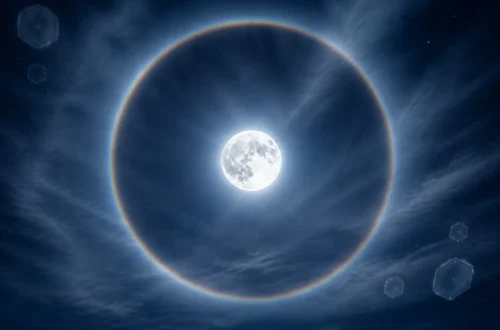
A luminous ring around the Moon is a different event from a lunar eclipse: the Moon is not entering Earth’s shadow. The guide to moon halo meaning separates that atmospheric optics from weather lore and optional symbolism.
What the Saros Cycle Is
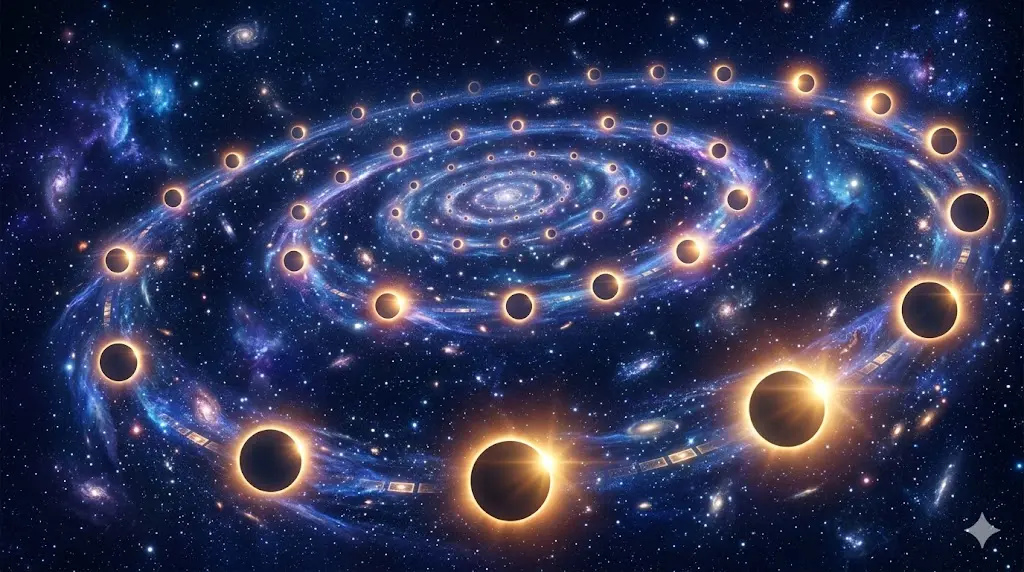
Eclipses repeat in series called Saros cycles. According to NASA, one Saros lasts about 6,585.3 days, or 18 years, 11 days, and 8 hours, and two eclipses one Saros apart have very similar geometry.
Saros cycles help astronomers group eclipses with similar geometry. A cycle of roughly 18 years does not mean a person’s current life events continue a story from 18 years earlier.
🔮 The Emotional Shifts People Feel During Eclipses
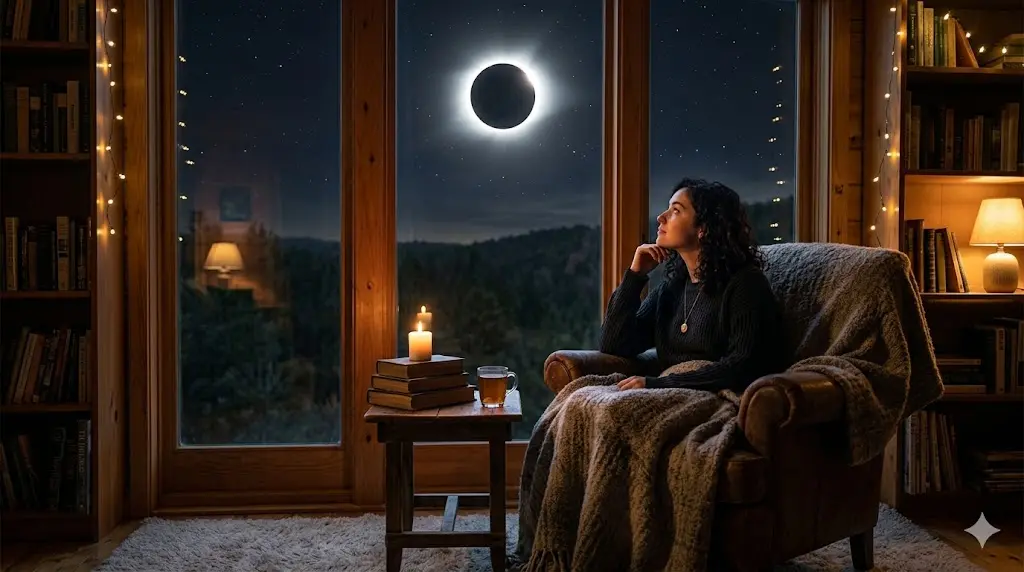
Feeling derailed near an eclipse does not prove that the eclipse caused it. Check what else changed: sleep, schedule, news exposure, relationships, work, health, or expectation.
Reports of emotional intensity are anecdotes unless collected and compared systematically. People who follow astrology may monitor eclipse dates more closely, making matching experiences easier to notice.
Sudden Clarity or Sudden Chaos
Some people say an eclipse period brought them a sense of clarity, or that a decision they had been stuck on suddenly felt obvious.
Others describe the same period as chaotic, with unexpected news or strong emotions.
Both clarity and chaos are valid experiences, but neither shows that an eclipse moved stagnant energy.
Relationship Endings Near an Eclipse
Relationship endings occur throughout the year. Calling them an eclipse-season pattern requires data comparing eclipse periods with ordinary periods.
Endings can involve friendships, work partnerships, or family relationships, not only romance. Some feel painful and others feel peaceful, but how an ending feels says nothing about the eclipse.
If a relationship ends near an eclipse, the event can be used as a personal symbol of transition. The ending itself should be understood through the relationship’s history and the people involved, not declared a completed cosmic purpose.
Restlessness Before an Eclipse
Many people describe a low-grade restlessness in the week before an eclipse — a feeling that something is about to shift without knowing what.
Some describe lighter sleep, more vivid dreams, or feeling easily irritated. These are personal reports, not a documented effect of eclipses.
Restlessness is not evidence that an “energy body” detected change before the conscious mind. Treat it as a real feeling and look for sleep, stress, health, caffeine, news, or practical concerns that may need attention.
What Ancient Cultures Believed About Eclipses
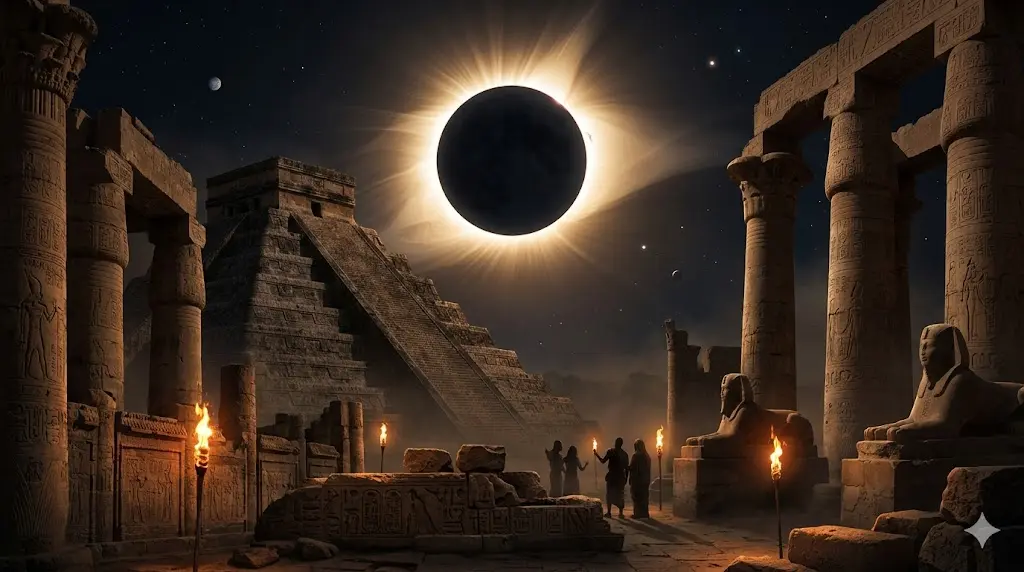
Long before astrology apps and birth chart readings, civilizations around the world recorded eclipses, and several of them treated eclipses as serious omens.
Cultures recorded different eclipse stories, rituals, fears, and astronomical observations. Similar attention to a dramatic sky event does not mean separated cultures reached one identical spiritual conclusion.
Vedic Astrology and Rahu/Ketu
In Vedic astrology, the lunar nodes are named Rahu (North Node) and Ketu (South Node) — and they’re not treated as points, but as shadow planets with distinct personalities.
Rahu is associated with obsession, desire, and the hunger for new experience. Ketu carries the energy of detachment, spiritual wisdom, and release.
In Hindu mythology, a demon disguised himself among the gods and tasted amrita, the nectar of immortality. The Sun and Moon exposed him, and Vishnu cut off his head. The head survived as Rahu and the body as Ketu. In the story, Rahu chases the Sun and Moon and sometimes swallows them, which explains an eclipse, but the light always reappears because Rahu has no throat. According to Britannica, Rahu and Ketu were later identified with the Moon’s north and south nodes, the same points astronomy uses to explain when eclipses can happen.
The Maya Eclipse Table
The Maya recorded eclipses with remarkable precision. The Dresden Codex, one of only four Maya books that survive, contains a table used to track when eclipses could happen.
Research published in Science Advances concluded that the table developed from earlier lunar tables connected to the 260-day ritual calendar and could be reused over long periods. The table shows serious astronomical skill, but it does not by itself reveal what personal meaning the Maya gave each eclipse.
Ancient China: A Dragon and a Warning to the Emperor
In ancient China, a solar eclipse was described as a dragon eating the Sun. NASA’s material on ancient Chinese eclipses explains that unusual events in the sky were recorded for possible omens, good or bad, for the reigning emperor.
Some of the earliest records come from oracle bones, pieces of shell and bone used in divination. Questions were carved into them, and cracks made by heat were read as answers. In this tradition, the eclipse was a political sign about the ruler, not a message about an individual’s personal life.
Mesopotamia: The Substitute King
In Assyria and Babylonia, scholars recorded thousands of sky omens in a long series of texts known as Enuma Anu Enlil. Certain eclipses were read as a threat to the king.
To protect him, a ritual was sometimes performed in which a substitute sat on the throne while the real king stayed out of sight. The Metropolitan Museum of Art describes this “substitute king” practice, which appears in dozens of Neo-Assyrian letters from the first millennium BCE. Here too, the omen concerned the ruler and the state.
What These Traditions Did Not Share
These cultures did not reach one common meaning. In China and Mesopotamia, eclipses were mostly read as signs about rulers. In the Hindu story, the eclipse is part of a myth about deception and immortality. The Maya table is mainly a record of calculation. The shared thread is attention to the sky, not a single spiritual conclusion.
💡 What Science Can—and Cannot—Explain
Science can explain what an eclipse is. It cannot confirm the spiritual meanings people give it.
Why the Electromagnetic Claim Is Misleading
The Sun and Moon exert measurable electromagnetic influence on Earth. Solar activity — flares, storms, shifts in the solar wind — affects the Earth’s geomagnetic field in documented ways.
Claims that eclipse seasons produce geomagnetic changes that disrupt human sleep or emotions are not established by the source previously cited here. An eclipse is a temporary alignment and shadow; it should not be presented as a period of heightened solar activity.
Some people report feeling physically affected during eclipses, but those reports do not show that an eclipse changes the body or the emotions.
Real Changes You Can Notice During a Solar Eclipse
During a solar eclipse, light and temperature can change and animal behavior may shift. Those are observable environmental effects. A nervous response to a dramatic change is different from a prediction about fate.
Physiological response and symbolic meaning are different layers of interpretation. One does not validate the other.
How to Observe Safely and Reflect Without Predictions
If you want to mark an eclipse in some way, the question becomes practical: what can you do that is safe and grounded?
Decision-Making: Use Evidence, Not an Eclipse Rule
There is no evidence-based rule against projects, contracts, or irreversible decisions during an eclipse. A pause can be wise whenever someone is emotionally activated, regardless of the sky.
If a decision can wait, review evidence, consequences, and professional advice. The reason is good decision-making, not an unpredictable eclipse charge.
Decisions made in a state of strong emotion often benefit from a short waiting period, whether or not an eclipse is happening.
Simple Ways to Mark an Eclipse
If you want to use an eclipse as a moment for reflection, some people find these practices helpful:
- Taking stock — quietly noticing what is going well and what you want to change
- Slowing the pace — giving yourself less input and more quiet during the eclipse window
- Time in nature — watching the change in light and sound outdoors, with safe eye protection
- Reducing unnecessary stimulation — less scrolling, less noise, more quiet
None of these are requirements, and none of them change what the eclipse does.
Journaling Prompts for Eclipse Season
If you want to use the date as a prompt for reflection, these questions can help:
- What in my life do I want to review right now?
- What have I been holding onto out of fear rather than genuine desire?
- Where do I want to grow, even if it feels uncomfortable?
- What would I do differently if I made this choice on purpose?
Sit with these questions without rushing toward answers. The reflection is yours, not something the eclipse does.

Solar Eclipse Safety Comes Before Symbolism
Except during the brief total phase of a total solar eclipse—and only for observers inside the path of totality—looking directly at the Sun requires proper solar viewing protection. Regular sunglasses are not sufficient. The NASA eclipse-viewing safety guide explains safe solar viewers, indirect projection, and precautions for cameras, binoculars, and telescopes.
According to NASA, safe eclipse glasses and handheld solar viewers must meet the ISO 12312-2 international standard, and glasses with scratches or holes in the lenses should not be used.
Do not look through a camera, telescope, or binoculars while merely wearing eclipse glasses; optical equipment requires a suitable solar filter placed correctly on the Sun-facing end. Inspect viewers for damage and supervise children. During partial and annular eclipses there is no total phase in which the bright face of the Sun is completely covered.
A Three-Layer Way to Interpret an Eclipse
Astronomical layer: Record the eclipse type, local visibility, start and end time, and safe viewing method. NASA’s eclipse resource explains the physical alignment and current events.
Cultural layer: Identify a specific tradition, community, or source instead of saying “ancient cultures believed.” Describe what that source teaches and avoid blending separate Indigenous, Hindu, Maya, Chinese, or Western astrological traditions into one universal story.
Personal layer: If the event symbolizes change for you, write the interpretation as a choice: “I am using this eclipse as a reminder to review this situation.” Do not write it as an external fact: “The eclipse ended this relationship” or “the universe is forcing this decision.”
Decision layer: If a major choice is near, list what is known, what remains uncertain, who will be affected, and which step is reversible. An eclipse date does not improve a contract, establish compatibility, diagnose a feeling, or make a risky decision safer.
❓ FAQ — Eclipse Spiritual Meaning
What is the spiritual meaning of a solar eclipse? In many modern spiritual and astrological sources, it symbolizes interruption, reset, or a new perspective. That meaning is optional and does not establish that the universe closed or opened a chapter.
Does an eclipse mark the end of a cycle? Some modern astrology writers describe eclipses that way, but it is an interpretation, not a fact. Life changes happen throughout the year, and there is no evidence that eclipses cause or mark them.
Why do I feel emotional during an eclipse? Anticipation, media attention, changes in routine, travel, sleep, and the drama of altered light may affect a person’s experience. The lunar nodes describe orbital geometry; they do not demonstrate karmic activation or a measurable emotional field.
How long does eclipse energy last? Astrology offers different windows, often days, weeks, or months, but there is no scientifically measured period of “eclipse energy.” The astronomical event has a precise path and duration that depend on location.
Is an eclipse a bad omen spiritually? Traditions disagree. A person may choose a symbolism of change without treating the event as an omen, a prediction, or proof that an ending was inevitable.
What should I do spiritually during an eclipse? Observe safely, follow any meaningful cultural practice respectfully, and avoid making claims about other people’s fate. Reflection is optional; ordinary responsibilities and sound decisions do not need to stop.
The Space Left Behind When the Sky Goes Dark
An eclipse is an astronomical event visible from particular places. It does not happen “for” or “against” an individual.
There is no single spiritual meaning shared by every tradition. Eclipses can serve as symbols of obscurity, awe, uncertainty, time, or change, but the universe is not known to assign them to move something significant in an individual’s life.
A dragon, a demon, a warning to a king, and a line in a calculation table are all human answers to the same sight. Knowing those answers makes an eclipse richer to watch. It does not turn the eclipse into a message about your life.
If the event feels meaningful to you, that meaning is yours to choose.
The spiritual, symbolic, and reflective interpretations explored here are offered as perspective, not as fact.
These ideas are drawn from a variety of traditions and astrological viewpoints. They are not scientific facts or predictions, and they should not replace professional psychological or medical advice.
Related reading: Full Moon Spiritual Meaning.


Alex Turner
Alex Turner is the editorial pen name used for articles published on Signs of Universe. The website covers dreams, symbolism, and cultural interpretations for informational and reflective purposes. Alex Turner is not a medical, mental health, scientific, or spiritual authority.