What Does a Moon Halo Mean? Science, Weather Lore, and Symbolic Interpretation
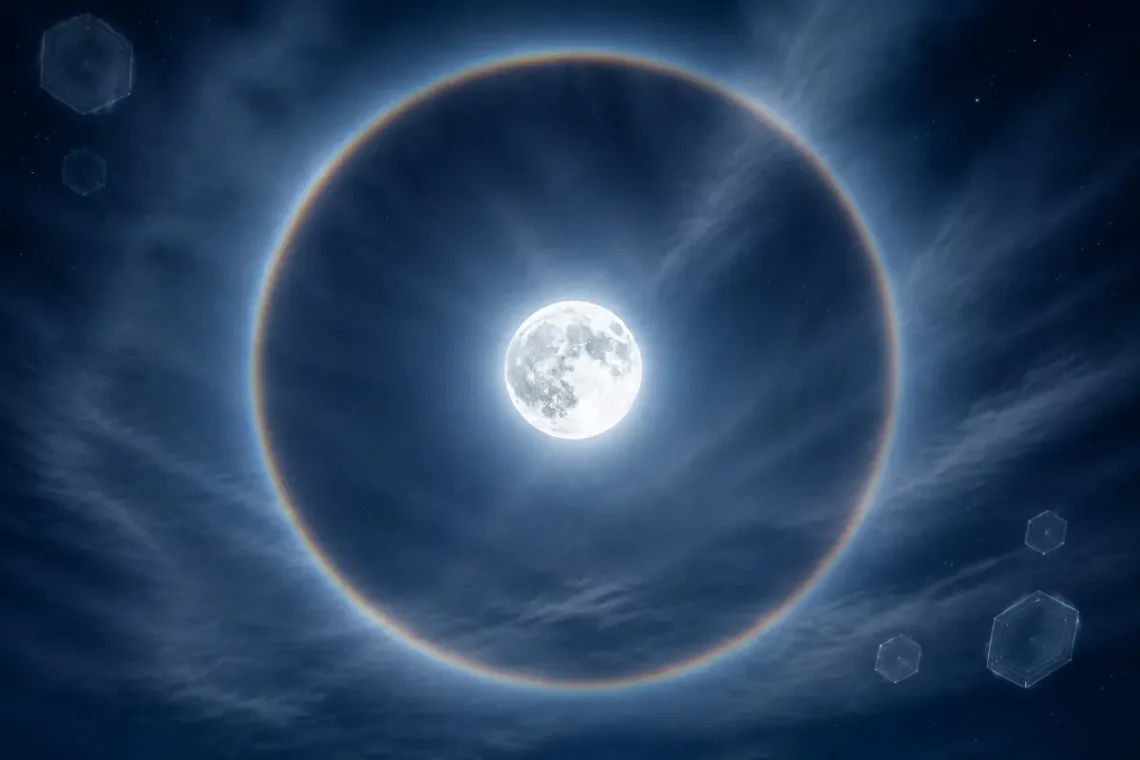
A moon halo is, first of all, a real atmospheric optical phenomenon: moonlight passes through ice crystals high in the atmosphere and forms a large ring around the Moon. The most common version is called a 22° halo. High, thin clouds containing those crystals can sometimes arrive ahead of rain or snow, which gives old weather sayings about a “ring around the moon” an observable basis—but a halo does not guarantee precipitation.
If you are looking for a spiritual meaning, that belongs to a different layer. A moon halo can be personally interpreted as a symbol of change, boundaries, or heightened attention without treating it as a supernatural message or a prediction.
Three Different Layers of Moon Halo Meaning
The clearest way to interpret a moon halo is to separate three questions that are often blended together.
| Layer | Question | What can reasonably be said | What it does not prove |
|---|---|---|---|
| Optical phenomenon | What am I physically seeing? | Moonlight interacting with ice crystals can produce a 22° halo. | That the ring was sent as a message. |
| Documented weather lore | Why is a ring around the Moon associated with rain? | U.S. folklore archives preserve several versions of that belief, and the high clouds involved can occur before rain or snow. | That rain is certain, or that a folk rule can replace a forecast. |
| Contemporary symbolism | What might the sight mean to me? | You can use the image as a personal symbol of change, boundaries, attention, or transition. | That one spiritual meaning applies to everyone. |
Keeping those layers separate does not make the symbolic reading less meaningful. It simply prevents a personal interpretation from being presented as meteorology, history, or fact. The same distinction can be useful when thinking about seeing a rainbow after praying: the physical explanation of an event and the meaning someone gives its timing answer different questions.
What a Moon Halo Actually Is
NASA Astronomy Picture of the Day describes lunar halos as the result of bright moonlight interacting with hexagonal ice crystals in high clouds. The light can be refracted and reflected by those crystals, producing luminous arcs and rings around the Moon. The National Weather Service likewise describes halos around the Sun or Moon as atmospheric optical effects involving light and ice crystals in thin high clouds.
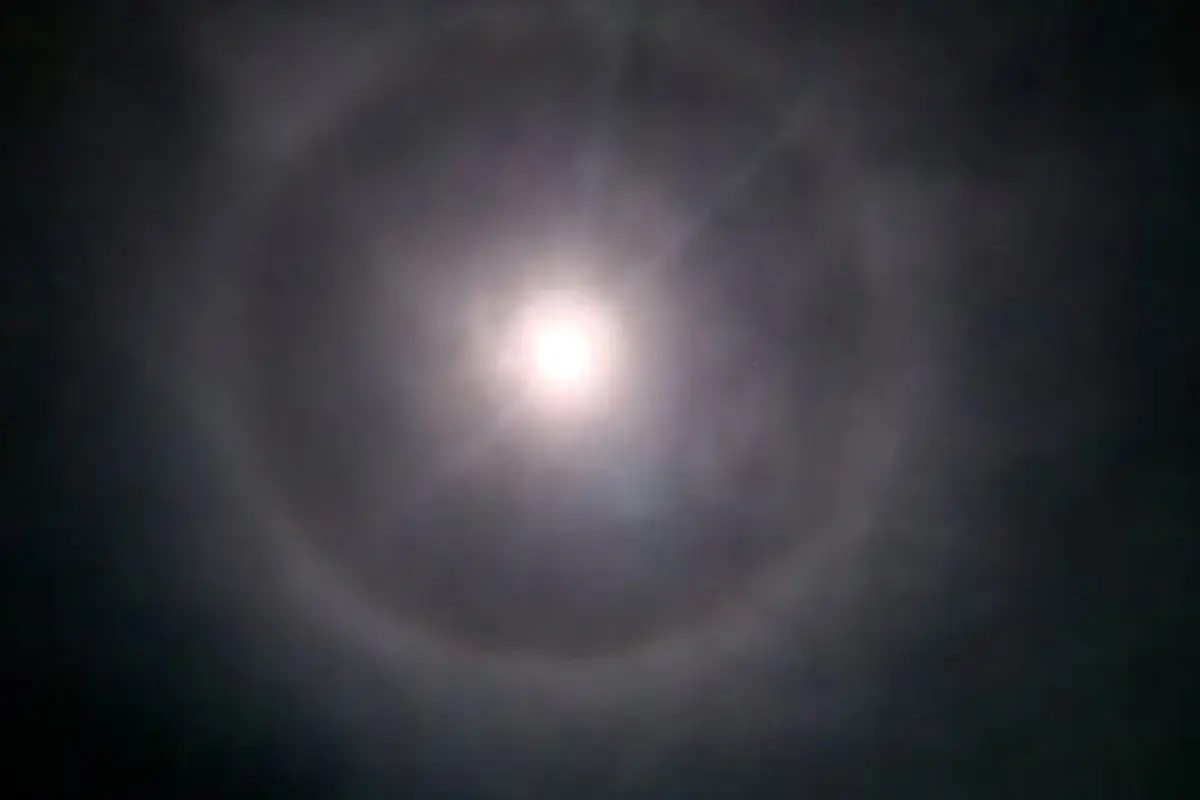
The familiar 22° halo gets its name from its apparent angular radius. NASA explains that the geometry of common hexagonal ice crystals can refract light by about 22 degrees, while the National Weather Service notes that the radius of the visible ring is usually about 22 degrees—roughly the width of an outstretched handspan at arm’s length.
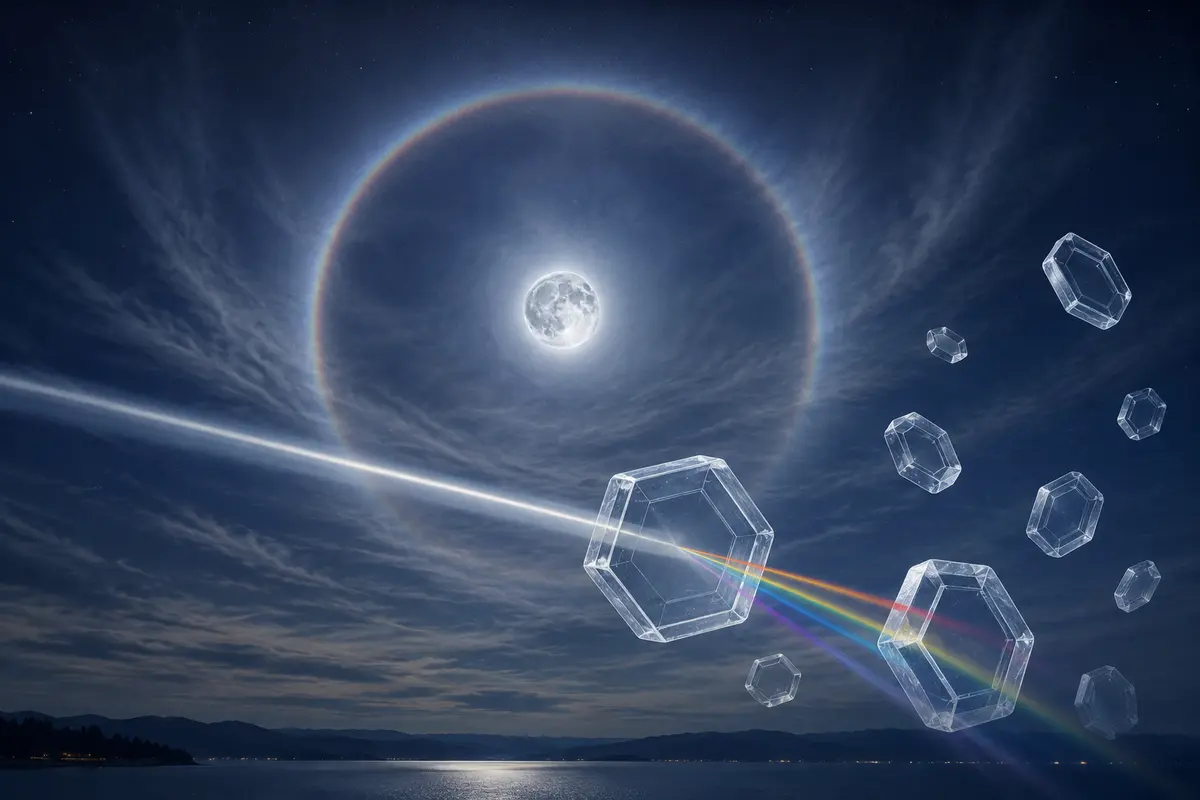
That large circle is therefore not an aura coming from the Moon. It is an optical effect created along the path between moonlight, ice crystals in Earth’s atmosphere, and the observer. The ring can look unusually precise because many individual crystals redirect light at similar angles.
Does a Ring Around the Moon Mean Rain?
The old saying has a limited meteorological connection, but it should not be treated as a forecast.
The National Weather Service explains that the wispy high clouds responsible for 22° halos often form ahead of rain or snow. At the same time, it explicitly warns that precipitation is not guaranteed and that halos do not actually predict the weather on their own.
That distinction matters. Seeing a halo can tell you something about what is already present in the upper atmosphere: ice-crystal clouds are in the right position to redirect moonlight. In some weather patterns, those clouds may precede a system that later brings precipitation. But the halo itself cannot tell you that rain will definitely reach your location, when it will begin, or how much will fall.
This relationship may help explain why the “ring around the moon, rain soon” idea felt persuasive enough to survive as weather lore. That is a synthesis of the documented meteorology and folklore, not proof of the saying’s historical origin.
Where the Rain Saying Appears in American Weather Lore
The James T. Callow Folklore Archive at the University of Detroit Mercy preserves multiple U.S. records connecting a ring or halo around the Moon with rain. Records collected in Michigan include versions stating that a ring means rain or rain the following day, while other entries from places including Ohio, Alabama, Tennessee, and West Virginia preserve related variants.
These records are useful because they document that the belief was actually collected in particular places and periods. They should not be stretched into a claim that every culture, every Indigenous tradition, or all “ancient people” gave a moon halo the same meaning.
A folklore record also documents a belief; it does not validate that belief as meteorological fact. That is why the National Weather Service is still necessary for the scientific layer: high ice-crystal clouds can precede precipitation, but the halo itself is not a guaranteed forecast.
What About Counting Stars Inside the Ring?
A more specific version of the lore says to count the stars visible inside the halo.
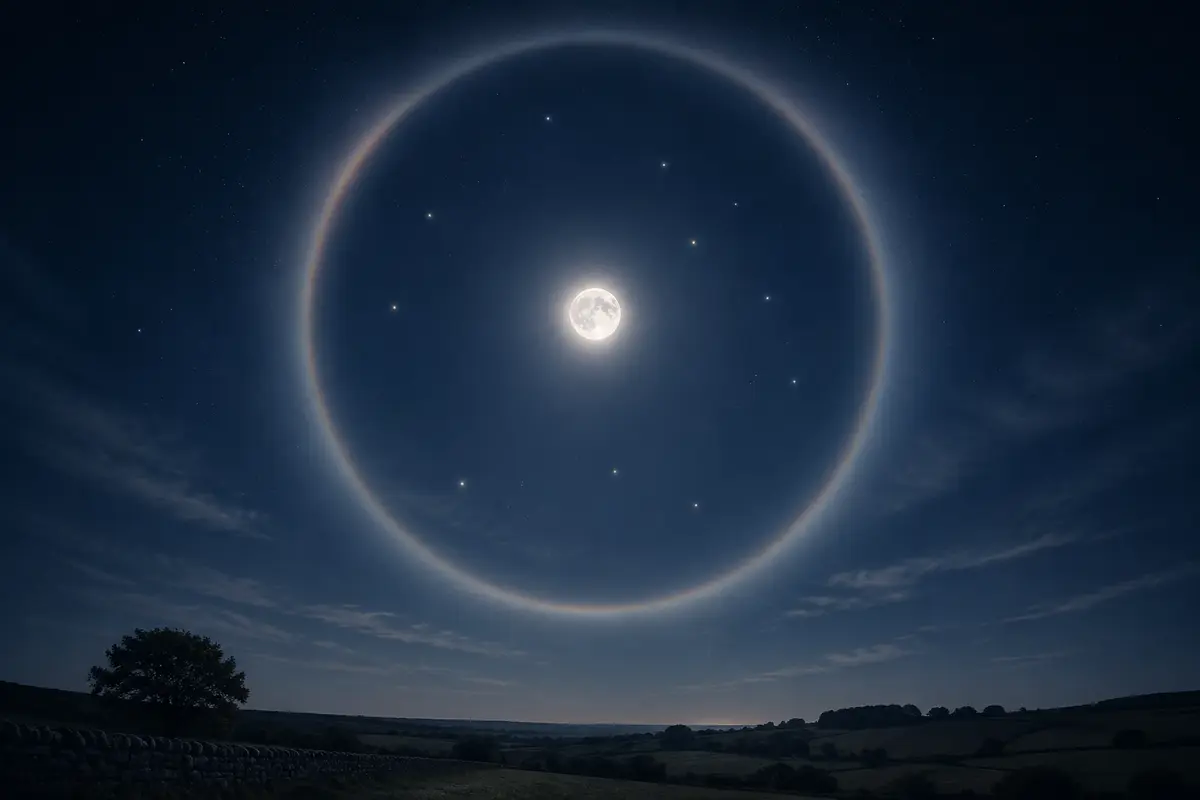
The Callow archive contains Tennessee records in which the number of stars inside the circle is said to equal the number of days before rain. A Virginia record similarly associates the number of stars with the number of days until “falling weather,” while another collected version links a ring in summer with rain and a ring in winter with snow.
The archive establishes that these counting rules existed as folklore. It does not show that counting stars is a reliable way to calculate when precipitation will arrive. The National Weather Service provides the important limit: halos may accompany high clouds that precede rain or snow, but they are not standalone weather forecasts.
Does a Moon Halo Have a Spiritual Meaning?
The scientific sources used to explain a moon halo describe an atmospheric optical mechanism; they do not establish a spiritual meaning for the phenomenon.
That does not prevent the sight from becoming meaningful to the person who sees it. Symbolism works differently from meteorology. A symbol can be useful because of its shape, timing, emotional context, or the associations you bring to it. It does not need to be a universal rule.
This is similar to the distinction used when discussing the spiritual meaning of a full moon: astronomy explains what is happening in the sky, while symbolism asks what the image may represent to an observer. A halo adds a different visual element—the circle itself—and a different physical context because it is an atmospheric optical effect rather than a lunar phase.
Change, Boundaries, and Attention as Personal Symbols
Three interpretations fit a moon halo without pretending to be ancient universal teachings.
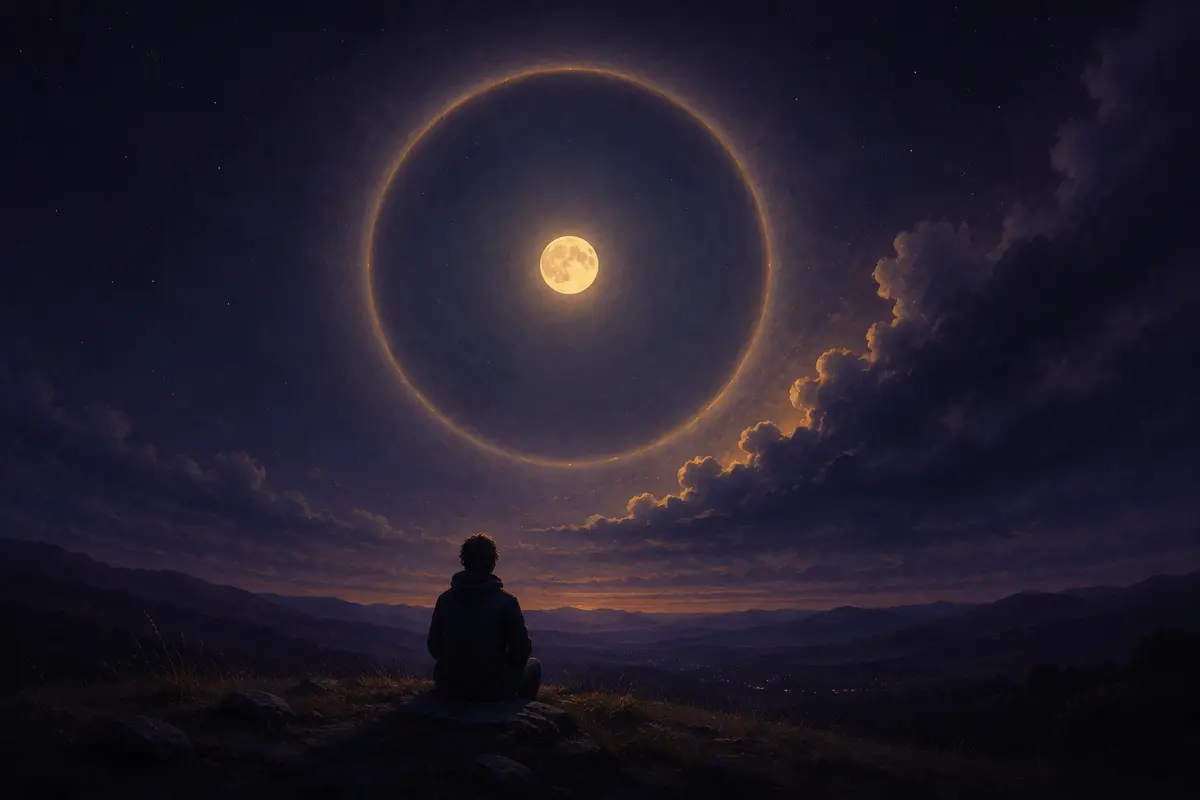
Change. High ice-crystal clouds can sometimes appear ahead of changing weather. Symbolically, you might use the halo as a reminder that conditions can shift before the outcome is visible. This is a metaphor, not a prediction that a particular life event is about to occur.
Boundaries. The most striking feature of the halo is its circular form surrounding the Moon. If the image makes you think about limits, containment, or what you are choosing to keep inside or outside your attention, that is a personal symbolic association. It does not mean the ring is objectively creating spiritual protection.
Attention. A bright circle around the Moon interrupts an ordinary view of the night sky. You may treat that interruption as a cue to notice what you were thinking or feeling at the moment you looked up. The useful information comes from your own context, not from assuming that the sky encoded a specific instruction.
These interpretations are deliberately optional. Someone else may see the same halo as beautiful weather optics and assign no spiritual meaning at all. Neither response is incomplete.
For another celestial event that often attracts symbolic interpretations while having a distinct physical mechanism, the same fact-versus-symbol distinction can be applied to eclipse spiritual meaning.
Is a Moon Halo a Good or Bad Omen?
Physically, a moon halo is neither good nor bad. It is an optical phenomenon produced by light interacting with atmospheric ice crystals.
In documented American weather lore, the ring is often treated as a sign of approaching rain or snow, not as a moral judgment about the observer. Even there, the prediction varies from record to record and is not meteorologically certain.
As a personal symbol, the halo does not need to be classified as a positive or negative omen. If it appeared during a difficult decision, you might associate the circle with caution, boundaries, or transition. If it appeared during a peaceful moment, you might associate it with clarity or attention. Those meanings come from the context you give the experience; the halo itself does not predict what will happen next.
A moon halo can therefore be understood without forcing all of its meanings into one category. Scientifically, it is a 22° atmospheric halo formed by moonlight and ice crystals. Historically, U.S. folklore archives document beliefs connecting rings around the Moon with approaching precipitation, including star-counting variants. Spiritually, it can be used as a personal symbol—but that symbolic layer is an interpretation, not evidence that the Moon or the universe sent a forecast about your life.
The most useful moon halo meaning is the one that keeps those three layers visible at the same time: what happened in the atmosphere, what people have actually documented as weather lore, and what the sight may mean to you personally.



Alex Turner
Alex Turner is the editorial pen name used for articles published on Signs of Universe. The website covers dreams, symbolism, and cultural interpretations for informational and reflective purposes. Alex Turner is not a medical, mental health, scientific, or spiritual authority.