

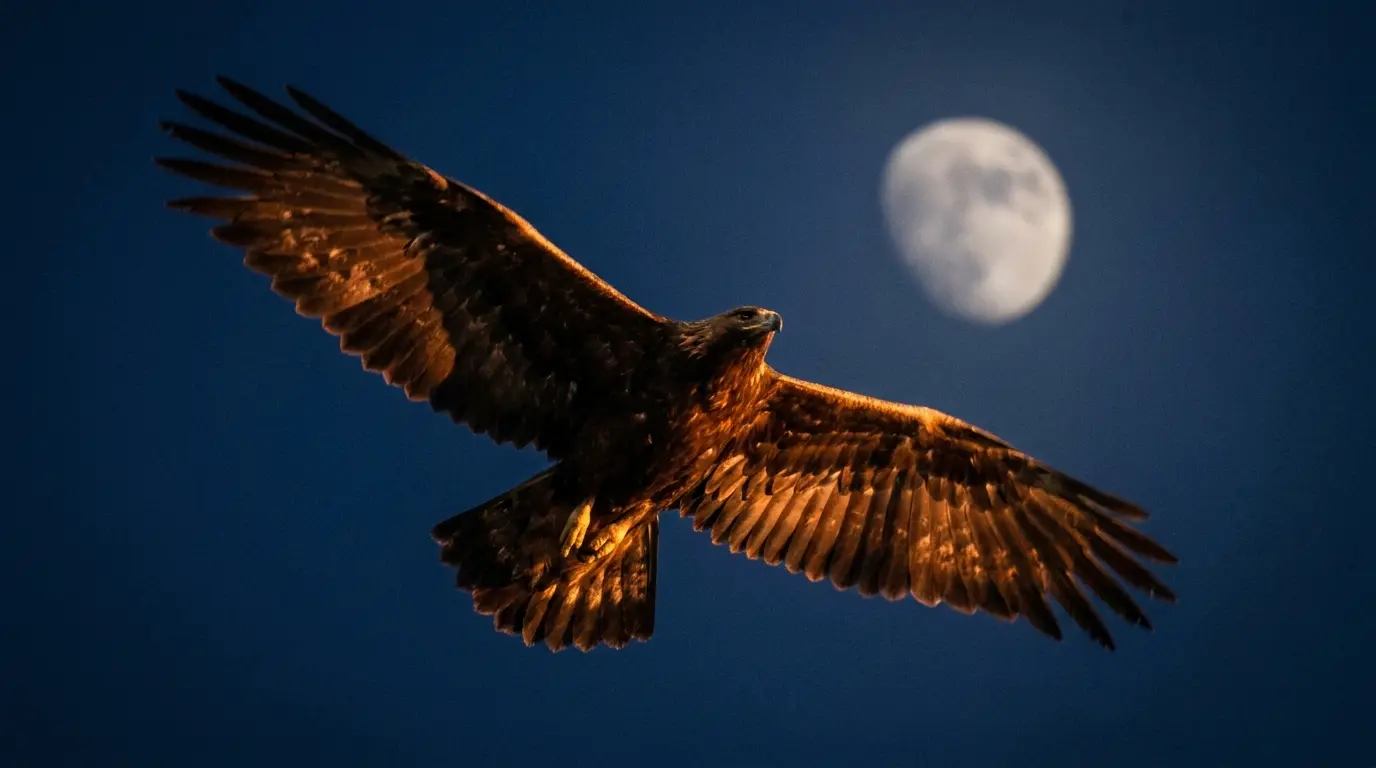
What exactly separates protection from surveillance when the thing watching you has talons?
That question rarely surfaces during the dream itself. You’re standing somewhere — a field, a rooftop, a road you half-recognize — and overhead, something enormous crosses the dark sky. Not a plane. Not a cloud shifting. A bird. Specifically, an eagle. And it’s flying directly over you, at night, when eagles have no biological reason to be airborne.
The dream of an eagle flying over you at night sits at a strange intersection. It pulls together authority, fear, spiritual guardianship, and raw predatory power into a single image — and depending on what you felt first (safety or exposure), the reading changes entirely.
The fact that eagles are almost exclusively diurnal hunters, with night vision roughly equivalent to a human’s, makes the dream even more unusual: your subconscious placed a creature of supreme visual power in a setting where it cannot see. Whether that speaks to protection beyond sight, authority you haven’t consented to, or something watching you from a position you can’t challenge, the answer hides inside the specific architecture of your version of this dream.
The Case for Protection: Why Some Traditions Read the Night Eagle as a Guardian
Most interpretations of eagle dreams default to a single word: power. But that reading collapses the moment you add darkness.
An eagle during the day represents clarity, dominance, the ability to see what others miss. Remove daylight and all of that shifts. The Lakota tradition offers a more specific frame. The eagle — Wanbli — served as a direct intermediary between the visible and invisible worlds. Not a generic spiritual symbol. A functional messenger. When the Lakota holy man Black Elk described his Great Vision in 1932, the eagle appeared during the most disorienting phase of the experience: the moment between understanding and not-understanding, between the familiar world and what lay behind it.
That’s worth pausing on. The eagle didn’t arrive when things were clear. It arrived at the threshold.
In a dream set at night, this tracks. The darkness isn’t incidental scenery. It’s the condition. And if the eagle chose to fly when it biologically shouldn’t — when its greatest asset, vision, is functionally offline — then whatever it’s doing overhead isn’t about watching you. It might be about covering you. Some nocturnal guardian dreams carry this same tension: the protector appears precisely when you cannot protect yourself, not when you’re already safe.
The ancient Roman concept of the oraculum — a prophetic dream where an authority figure delivers guidance — was one of five dream categories documented before modern psychology existed. A 2016 article in Psychology Today by sleep medicine researcher Meir Kryger traces this classification back through centuries of pre-scientific dream study. The eagle overhead at night may echo that older category: not a threat delivering fear, but an authority delivering presence.
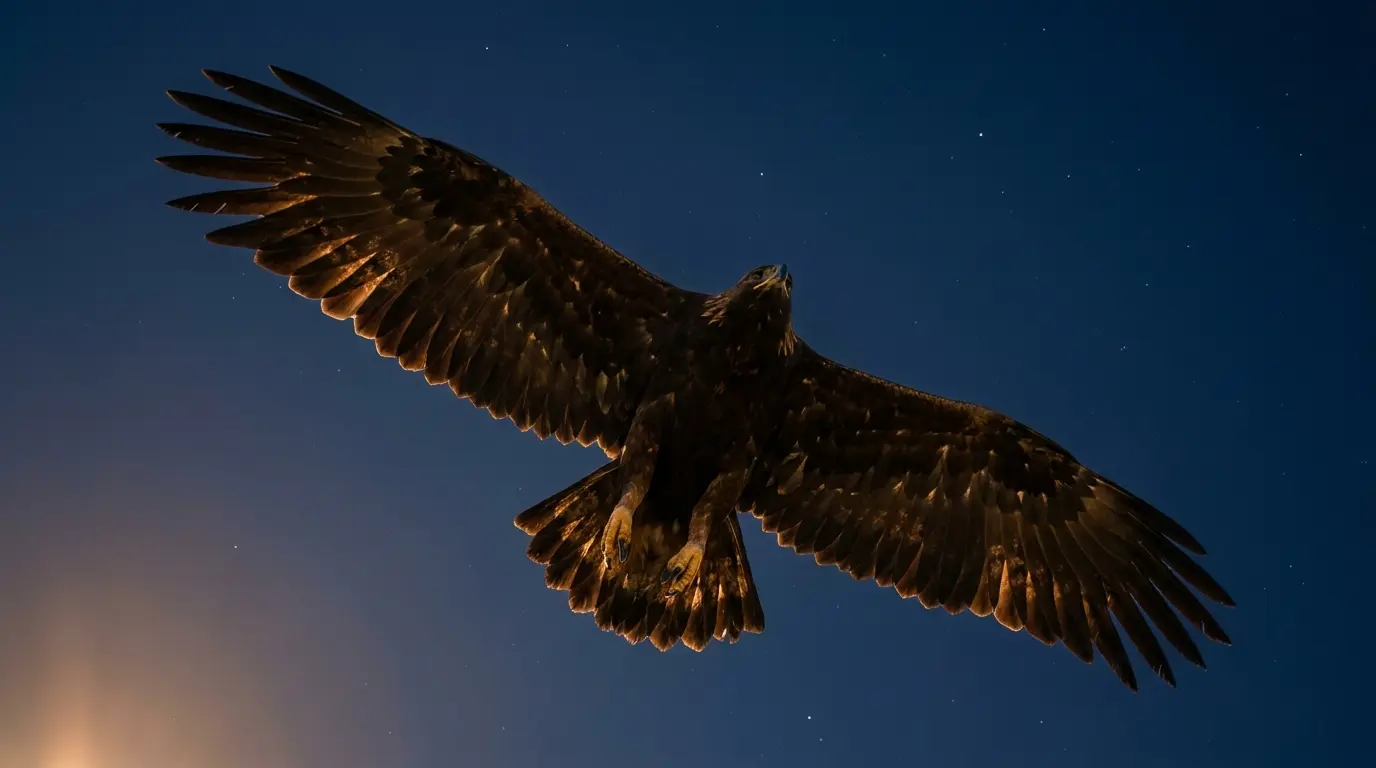
The Case Against Comfort: When the Eagle Overhead Feels Like Surveillance
Not every eagle dream delivers relief.
Some people wake from this dream with their chest tight, jaw clenched, a residue that feels closer to being hunted than being guarded. And that reaction isn’t irrational — it’s instinctive. Eagles are apex predators. Biologically, being observed from above by a raptor triggers a different neurological response than being observed at eye level. Prey animals don’t look up for comfort. They look up to check if they’re about to be taken.
In the dream, this distinction matters. If the eagle felt like surveillance — circling, returning, not leaving — the dream may not be about spiritual protection at all. It may be reflecting an authority in your waking life that operates from a position you can’t reach, can’t challenge, and can’t negotiate with. A boss. A parent. A belief system that watches without explaining why.
Jung’s concept of the Senex archetype — the old authority figure, wise but rigid — maps onto this version of the eagle dream more precisely than the guardian reading. The Senex doesn’t comfort. It evaluates. And when that evaluation happens at night, in a space where you’re already vulnerable, the emotional tone shifts from guidance to judgment.
There’s a difference between something flying over you to protect the perimeter and something flying over you to make sure you don’t leave it.
The way predator dreams land in the body often reveals this distinction faster than any symbol dictionary. If you woke up frozen rather than calm, the eagle may have been wearing the face of something unresolved — not a messenger, but a mirror of pressure you haven’t named yet.
What a Dream of an Eagle Flying Over You at Night Reveals
Here’s the biological fact most dream interpretation sites skip entirely: eagles cannot hunt at night. According to ornithological data documented by Cornell University’s Lab of Ornithology, eagles see roughly as well as humans do after dark. Their eyes evolved for maximum acuity in daylight — detail, color, distance. Remove sunlight and that extraordinary vision drops to ordinary.
So the dream places the most visually dominant predator on Earth in the one condition where its primary power doesn’t function.
That’s not an accident. Dreams don’t waste architecture.
If the eagle’s power is vision, and the dream removes vision, then whatever the eagle represents in your specific version of this dream isn’t operating through sight. It’s operating through something else. Presence. Weight. The sheer fact of being above you, whether or not it can see you clearly.
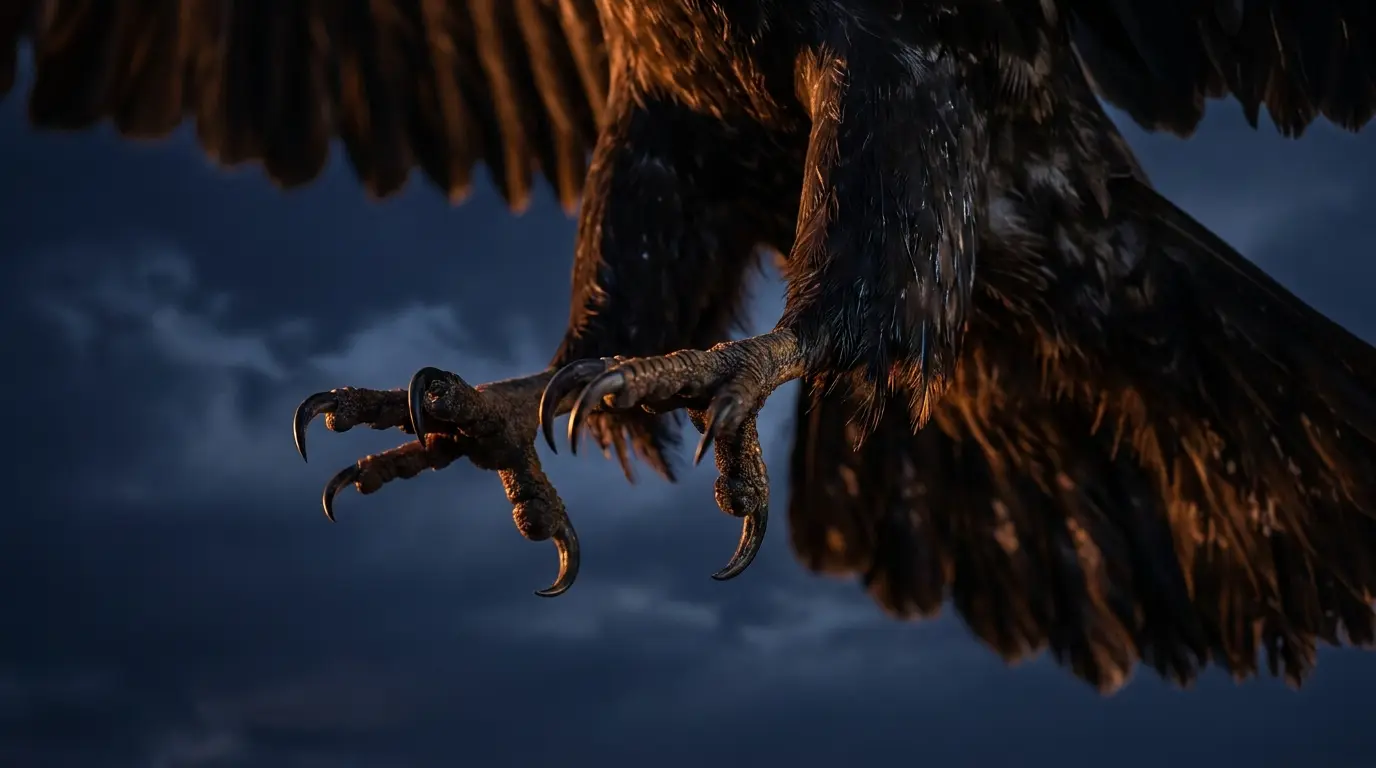
This is where the self-investigation begins. Not with a technique. Not with a protocol. With three questions that only you can answer, because they depend on what happened inside your specific dream:
What did you feel first — before your mind started interpreting? Not what you decided the dream meant afterward. The raw, pre-verbal sensation. Was it compression (chest tightening, breath shortening) or expansion (a strange relief, as if something heavy had been lifted)? The body often registers the dream’s meaning before the mind assigns a story.
Was the eagle moving toward something, or circling over you? An eagle in transit — crossing the sky with direction — suggests a message in motion, something being carried over your life that hasn’t landed yet. An eagle circling, returning, hovering suggests observation. The difference between a messenger and a monitor lives in the flight pattern.
Were you standing still or trying to move? If you were frozen, the dream may be pointing at a place in your life where an authority has immobilized you — not by force, but by altitude. Something above you that you’ve stopped trying to reach, challenge, or escape. If you were walking and the eagle simply accompanied your movement, the reading shifts toward companionship — uncomfortable, maybe, but not hostile.
These aren’t abstract exercises. They’re architectural readings of the dream itself. The appearance of dark birds at night follows a similar interpretive logic: what the bird does matters more than what the bird symbolizes in a book.
Frequently Asked Questions
Does dreaming of an eagle at night always mean spiritual protection?
No. The emotional tone of the dream determines the reading more than the symbol itself. An eagle circling overhead while you feel calm may reflect guardianship. The same eagle circling while your body feels compressed or trapped may reflect authority pressure. Protection and surveillance use the same flight pattern — your body knows which one it was.
Why would I dream of an eagle at night if eagles are daytime birds?
Dreams regularly place familiar symbols in unfamiliar conditions to force a different interpretation. An eagle at night strips the bird of its defining power — extraordinary vision — and asks what remains. Some interpreters suggest this points to protection that operates without needing to see you clearly, a form of spiritual covering rather than visual monitoring. Others read it as confrontation with an authority that persists even when conditions don’t support it.
Can this dream mean something negative?
It can. Not all overhead authority is benevolent. If the eagle in your dream felt threatening, oppressive, or inescapable, it may reflect a waking-life dynamic where someone or something holds power over you from a position you cannot access or negotiate with. The dream isn’t labeling this as good or bad — it’s showing you the spatial arrangement of the relationship, and asking whether you’ve noticed it while awake.
The Eagle Doesn’t Fly at Night to Be Seen
Every eagle dream article on the internet will tell you the eagle means power. Freedom. Vision. Spiritual ascension.
None of that is wrong. But none of it accounts for the darkness.
An eagle flying over you at night has already abandoned its greatest advantage. It isn’t soaring to see farther. It isn’t hunting. It’s doing something that, biologically, makes no sense — which is exactly why the dream chose it. The image works because it shouldn’t exist. A predator without its primary sense, still airborne, still above you, still present.
Maybe what flies over you in the dark isn’t there because it can see you. Maybe it’s there because it doesn’t need to. And maybe the question isn’t whether the eagle is a guardian or a threat. Maybe the question is simpler: what in your life right now holds authority over you from a place you cannot reach — and did you choose to give it that position, or did it take it while you weren’t looking?
The eagle won’t answer that. It just keeps flying.
The interpretations explored in this article reflect symbolic, cultural, and reflective perspectives on dream imagery — not clinical assessments. Dreams carry personal meaning shaped by individual experience, and no external reading replaces your own felt sense of what the dream held. If recurring dreams cause distress, speaking with a qualified professional may offer additional clarity.