

Most people will tell you that losing interest in people you once loved means something is wrong with you. That you’re cold. That you need therapy. That you’ve become someone difficult to be around.
What if the opposite is true?
Not always — but more often than anyone is willing to admit. The experience of slowly, quietly detaching from people who used to be the center of your world is one of the most misunderstood human experiences. And the guilt that comes with it can eat you alive if you don’t understand what’s actually driving it.
The spiritual meaning behind losing interest in people you once loved sits at a rather complicated crossroads. Which road it actually points to depends on something most articles won’t tell you honestly. For instance, emotional detachment can simply be a symptom of depression, unresolved trauma, or severe burnout. Mislabeling those very real struggles as “spiritual growth” only delays true healing. On the other hand, this detachment can also be a genuine sign that your consciousness has shifted far beyond the frequency of your current relationships.
The guilt you feel about pulling away is almost universal, but it is certainly not proof that you are doing something wrong. In fact, your body carries specific signals that can reveal whether your detachment is actually protective or destructive.
Interestingly, some people even experience both depression and spiritual expansion simultaneously—a combination that is far more common than anyone talks about. Ultimately, what you decide to do next should depend entirely on which kind of detachment you are actually living through.
The Moment You Realized You Didn’t Feel Anything
Losing interest in people you once loved rarely happens all at once. There’s no dramatic argument, no betrayal, no single event that flips a switch.
One day you just noticed. Your best friend called and you let it ring. Your partner told a story they were excited about and you caught yourself mentally somewhere else entirely. A family dinner that used to feel warm now felt like something to survive.
The strangest part? You couldn’t explain why.
Nothing happened between you and these people. They didn’t change. You did — and that’s the part that makes it so confusing.
When the Guilt Hits Harder Than the Distance
The detachment itself isn’t what keeps people up at night. It’s the guilt.
Because you remember loving these people. You remember caring. You remember a version of yourself that would have dropped everything for a phone call from them.
And now that version feels like a stranger.
So the internal monologue begins: Am I a bad person? Am I broken? Did I ever really love them, or was I faking it the whole time?
None of those questions lead anywhere useful. But they’re almost impossible to stop once they start — especially when the people around you have no idea what shifted inside you.
What This Experience Actually Looks Like Day to Day
The day-to-day reality of this experience isn’t dramatic. That’s what makes it so disorienting.
You still show up. You still say the right things. You still go to the birthday parties and answer the texts. But the emotional fuel behind all of it has quietly drained out.
Conversations feel like performances. Hugs feel mechanical. Laughter comes a half-second late because you’re manufacturing it instead of feeling it.
And underneath all of that effort, a single quiet thought keeps returning: I don’t recognize myself anymore.

Losing Interest in People You Once Loved Spiritual Meaning
Here’s where most people land when they search for answers about losing interest in people you once loved — and where the conversation gets genuinely interesting.
Because spiritual traditions across the world have been describing this exact experience for centuries. And what they say about it isn’t what you’d expect.
The Frequency Shift Nobody Warned You About
Every spiritual tradition that works with energy — from Hindu philosophy to Sufi mysticism to modern energetic healing — describes human consciousness as operating on a frequency.
When that frequency changes — through grief, growth, crisis, awakening, or simply the slow accumulation of life experience — the relationships calibrated to your old frequency start feeling off.
Not wrong. Not bad. Just… misaligned.
It’s the same reason a song you loved at sixteen can feel almost unbearable at thirty-five. You’re not the same listener anymore. The song didn’t change. Your ears did.
The losing interest in people you once loved spiritual meaning, in this framework, is a signal that your internal operating system has been updated — and not all your connections are compatible with the new version.
When Your Inner World Evolves Faster Than Your Outer One
Spiritual growth rarely happens on a schedule that your relationships can follow.
You might spend six months going through a quiet internal revolution — questioning your values, shedding old beliefs, discovering parts of yourself you didn’t know existed — while the people around you are exactly where you left them.
That gap creates a specific kind of loneliness. Not the loneliness of being abandoned. The loneliness of standing in a room where no one can see what you see.
Hindu philosophy calls this vairagya — a natural detachment from worldly bonds that accompanies deeper spiritual development. It’s not considered a failure of love. It’s considered evidence that consciousness is expanding beyond its previous container.
The Sufi tradition names it ghurba — spiritual exile. The mystic poets described it as the price of tasting something the ordinary world can’t offer. Beautiful and painful in equal measure.
What Ancient Traditions Say About Emotional Withdrawal
The Desert Fathers of early Christianity — monks who withdrew to the Egyptian desert in the 3rd and 4th centuries — documented a specific phase of spiritual development they called acedia. Often mistranslated as “sloth,” acedia actually described a profound emotional flatness that arrived during intense spiritual transformation.
They didn’t treat it as a disease. They treated it as a passage — uncomfortable but necessary, a stripping away of superficial attachments to make room for something deeper.
In Buddhist teaching, non-attachment is literally the path to liberation. But the Buddha was careful to distinguish between non-attachment (letting go with awareness) and aversion (pushing away from pain). The first is growth. The second is avoidance wearing a spiritual mask.
That distinction matters enormously here — and it leads directly to the other side of this conversation.

The Depression Side: When Detachment Is a Wound, Not an Upgrade
Now the uncomfortable part — because this article would be incomplete without it.
Sometimes losing interest in people you once loved has nothing to do with spiritual evolution. Sometimes it’s your nervous system shutting down because it can’t handle any more input.
And the difference between the two can be razor-thin from the inside.
Clinical Signs That Separate Depression From Growth
Depression-driven detachment carries specific markers that spiritual detachment typically doesn’t:
- Loss of pleasure across the board — not just in relationships, but in food, hobbies, music, sunlight, everything. Spiritual detachment tends to be selective; depression is indiscriminate.
- Physical symptoms — persistent fatigue that sleep doesn’t fix, appetite changes in either direction, body aches with no medical explanation, a heaviness that lives in the limbs.
- Cognitive fog — difficulty concentrating, making decisions, or remembering things that used to be automatic.
- Hopelessness — not just about relationships, but about the future itself. A flat certainty that nothing will improve.
- Duration without fluctuation — depressive detachment tends to be constant. Spiritual detachment often comes in waves with periods of clarity in between.
None of these are definitive on their own. But if several show up together and persist for more than two weeks, what you’re experiencing likely has a clinical component that deserves professional attention.
Attachment Theory and Emotional Numbing
Dr. Amir Levine’s work on adult attachment patterns reveals something crucial: people with avoidant attachment styles — roughly 25% of adults — often experience emotional shutdown as a default response to relational stress.
The pattern looks like this: closeness builds, vulnerability increases, the nervous system perceives threat, and the emotional drawbridge goes up. Not because the love disappeared — but because the system protecting you decided love was dangerous.
This kind of detachment feels calm from the inside. It can even feel peaceful — like finally being free. But it’s not freedom. It’s a defense mechanism that learned, probably in childhood, that distance equals safety.
The tricky part? This pattern and spiritual detachment produce almost identical emotional experiences. The calm of genuine non-attachment and the calm of emotional shutdown look the same — until you dig deeper.
Why Spiritualizing Pain Can Be Dangerous
This needs to be said directly: using spiritual language to avoid psychological reality is one of the most common traps in the spiritual community.
Calling depression “an awakening” feels empowering. It gives the suffering meaning. It transforms a medical condition into a spiritual credential.
But it also delays treatment. It prevents people from getting support that could genuinely help. And in severe cases, it puts lives at risk.
Spiritual growth and mental health aren’t opposites. A person can be expanding spiritually and struggling with depression at the same time. The two aren’t mutually exclusive — and pretending they are serves no one.
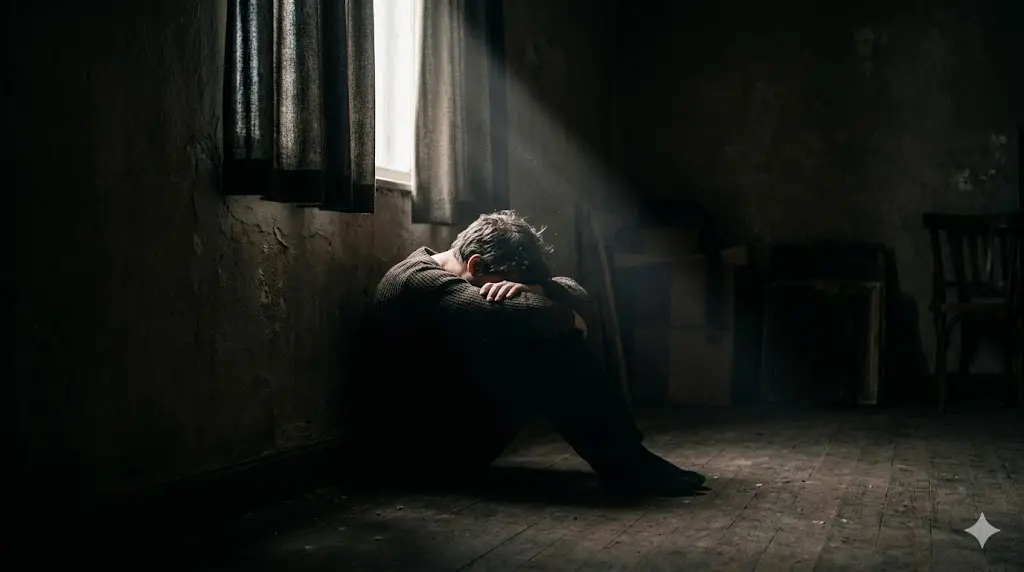
💡 How to Tell the Difference — Honestly
This is the section most people actually need. Because knowing both explanations exist doesn’t help if you can’t figure out which one applies to you.
5 Questions That Reveal the Real Source
These aren’t therapy questions. They’re honest self-assessment tools that separate spiritual detachment from emotional shutdown.
1. Did your interests change — or did everything go flat? Spiritual shifts redirect energy. You lose interest in some things but gain intense interest in others — new ideas, deeper questions, different kinds of people. Depression flattens everything equally. If nothing excites you at all, that’s a clinical signal.
2. Do you feel pulled toward something — or just away from everything? Spiritual detachment has a direction. It moves you toward solitude, toward depth, toward meaning. Depressive detachment is directionless. It pulls you away from everything without pulling you toward anything.
3. When did this start — and what was happening in your life? Spiritual detachment often follows a significant inner shift: a realization, a loss, a deep questioning of values. Depressive detachment tends to creep in during periods of sustained stress, sleep disruption, or biochemical change.
4. How does your body feel when you’re alone? Spiritual solitude tends to feel expansive — the chest opens, the breathing slows, there’s a sense of returning to center. Depressive isolation feels heavy — the body contracts, energy drops, the couch becomes a prison that also feels like the only safe place.
5. If someone offered you the perfect connection right now — deep, authentic, meaningful — would you want it? If the answer is yes but you can’t find it in your current circles, you’re likely outgrowing your environment. If the answer is a flat, disinterested no, the detachment may have roots that go beyond spiritual growth.
The Quality of Your Solitude Is the Clue
This is perhaps the most reliable indicator.
People experiencing spiritual expansion describe their solitude as alive. Uncomfortable sometimes, lonely sometimes, but never empty. There’s movement inside the stillness — questions forming, old beliefs crumbling, a new self slowly assembling.
People experiencing depression describe their solitude as dead space. No movement. No questions. No curiosity about what comes next. Just a heavy, muted blankness that doesn’t shift regardless of the setting.
Pay attention to which version you recognize.
When Both Are Happening at the Same Time
Here’s what almost nobody talks about: for many people, it’s both.
Spiritual growth can trigger depression. The dismantling of old beliefs, old identities, old relational patterns — that’s a kind of death. And the psyche grieves it, sometimes with full clinical intensity.
A person can be genuinely expanding in consciousness while simultaneously experiencing depressive episodes driven by the very transformation they’re going through. One doesn’t cancel the other.
If this is you, the answer isn’t choosing between spiritual practices and professional help. It’s pursuing both — without using one to dismiss the other.

- Local: após o H2 “How to Tell the Difference — Honestly”
- Tipo: ilustrativa
- Nome do arquivo: how-to-tell-spiritual-detachment-vs-depression.webp
- ALT: two paths diverging in a misty forest, one leading to light and one deeper into shadow, symbolizing the crossroads between spiritual growth and depression
- Prompt IA:
What to Do When You’re Losing Interest in Everyone Around You
This is where generic advice fails — because the right response depends entirely on what’s driving the detachment. Here are specific actions for each scenario.
If It’s Spiritual: Recalibrate Without Burning Bridges
The biggest mistake people make during spiritual expansion is dramatic exit. Cutting off friends. Announcing you’ve “outgrown” people. Making your inner shift everyone else’s problem.
Resist that impulse.
Instead, reduce your exposure to environments that drain you without issuing declarations about it. Spend less time performing connection and more time in spaces where connection actually flows. Let relationships evolve at their own pace — some will naturally fade, others will surprise you by meeting you at your new depth.
Seek one aligned connection. You don’t need a new social circle. You need one person who understands what you’re going through without needing you to explain it. One real conversation can neutralize weeks of feeling invisible in a crowd.
If It’s Emotional: Steps That Actually Help
If the detachment is rooted in depression, burnout, or attachment patterns, the path forward is different — and more structured.
Talk to a professional. Not because something is wrong with you, but because a trained perspective can separate the threads in ways self-reflection can’t. A therapist who understands both psychological and spiritual frameworks is ideal, but any competent mental health professional can help you assess what’s happening.
Examine your baseline, not your peak. Depression distorts memory. It makes you believe you’ve always felt this way and always will. Tracking your mood, energy, and social engagement over a few weeks gives you data instead of distortion.
Address the physical layer. Sleep quality, nutrition, movement, and light exposure aren’t spiritual bypasses — they’re the biological foundation that emotional and spiritual health are built on. If the foundation is cracked, nothing built on top of it will hold.
The One Action That Applies Either Way
Regardless of whether this detachment is spiritual, emotional, or both — one thing helps universally:
Name it out loud. Say it to yourself, to a journal, to one trusted person: “I’ve changed. The way I connect has shifted. I don’t know exactly what this is yet, but I’m not going to pretend it isn’t happening.”
That single act of honest acknowledgment — without judgment, without a diagnosis, without forcing it into a category — creates breathing room. The experience stops being something happening to you and becomes something you’re navigating with awareness.
That shift alone changes everything about what comes next.

- Local: após o H2 “What to Do When You’re Losing Interest in Everyone Around You”
- Tipo: ilustrativa
- Nome do arquivo: what-to-do-losing-interest-loved-ones.webp
- ALT: person walking alone on a quiet city street at dawn, first light breaking over buildings, posture suggesting determination and forward movement
- Prompt IA:
❓ FAQ — Losing Interest in People You Once Loved Spiritual Meaning
Is losing interest in people you once loved a sign of spiritual awakening?
It can be — but not automatically. Spiritual awakening often includes a period of emotional recalibration where old connections feel misaligned. The key indicator is whether the detachment feels directional (pulling you toward deeper meaning) or flat (draining interest in everything). Genuine spiritual shifts redirect your energy; depression removes it entirely.
Why do I feel guilty about not caring anymore?
The guilt comes from the gap between who you remember being and who you are now. Your identity still carries the template of someone who cared deeply about these people — and the current reality contradicts that template. Guilt in this context is not proof of wrongdoing. It’s the emotional friction of identity change.
Can you love someone and still lose interest in them?
Absolutely. Love and interest operate on different systems. You can deeply care about someone’s wellbeing while simultaneously feeling unable to engage with them the way you used to. The love doesn’t disappear — the energy to express it through the old channels does. This is especially common during major life transitions and inner shifts.
Should I tell the people I’m pulling away from?
That depends on the relationship and the person. Some people can hear “I’m going through something internal that’s changing how I connect” and hold space for it. Others will take it as rejection regardless of how you frame it. A general rule: share what’s happening with people who’ve earned honesty, and give yourself permission to be quieter with those who haven’t.
When should I see a therapist about emotional detachment?
If the detachment persists beyond a few weeks, affects all areas of your life equally, comes with physical symptoms like persistent fatigue or appetite changes, and carries a sense of hopelessness rather than quiet transformation — seek professional support. There’s no conflict between spiritual growth and therapy. The most grounded path often includes both.
Conclusion
The losing interest in people you once loved spiritual meaning doesn’t collapse into a single tidy answer — and anyone offering one is skipping the parts that matter most.
What the experience of losing interest in people you once loved demands from you is something harder than a label: discernment. The willingness to look at the detachment without immediately calling it awakening or pathology. To sit in the uncertainty long enough to feel which direction the current is actually flowing.
Maybe you’re outgrowing a frequency. Maybe your nervous system is protecting you from overload. Maybe you’re grieving an identity that’s dissolving faster than the new one can form. Maybe all three are happening simultaneously — and the answer isn’t choosing one explanation, but holding them all with enough honesty to see which ones light up.
The next time someone tells you that losing interest in people you love means something is wrong with you, consider the possibility that something is finally right — and also consider the possibility that it’s more complicated than either story. Both deserve your attention.
That willingness to look without flinching? That’s not detachment. That’s the beginning of real clarity.
Before you start analyzing your own emotional detachment, please keep in mind that the spiritual, symbolic, and psychological perspectives discussed here are meant purely for your personal exploration and self-awareness.
They should never be used as a substitute for professional mental health support. If you find yourself experiencing persistent emotional numbness, a complete loss of interest in daily life, or symptoms of depression, please reach out and consult a qualified therapist or healthcare provider to help you navigate this season safely.