


Last Tuesday, a woman in Ohio opened her eyes at 3:47 AM and could not explain why. No alarm, no noise, no dream she could remember — just sudden wakefulness in a room that hadn’t changed since midnight.
That pattern — waking up between 3AM and 5AM without a trigger — has been reported so consistently across centuries, traditions, and continents that it earned its own category in at least two ancient medical systems. The window is not random. In Traditional Chinese Medicine, the 24-hour energy cycle begins at exactly 3 AM with the lung meridian, because the classical texts state that all meridians originate from the lungs — the first organ activated at birth. In Ayurvedic tradition, the pre-dawn slot falls within what practitioners call Brahma Muhurta, a 48-minute period calculated relative to local sunrise that some texts describe as the most receptive state a human body enters in any given day.
But what none of those traditions distinguish clearly — and what almost no modern article addresses — is the difference between two very different experiences inside the same window. One kind of waking arrives heavy: chest tight, eyes wet, a sadness with no story attached. The other arrives clean: no emotion, no discomfort, just total alertness that feels unearned at an hour when sleep should still be deep.
Whether the body is releasing something it stored during the day, processing a loss the mind hasn’t fully named, or simply reaching a threshold where stillness becomes louder than sleep, the meaning of the hour depends less on the clock and more on what happens in your body during the first thirty seconds after your eyes open.
Why the Body Clock Starts at 3 AM and What It Resets
In Traditional Chinese Medicine, the organ clock is a 24-hour map of energy moving through twelve meridians in two-hour intervals. The cycle does not start at midnight. It starts at 3 AM — with the lungs.
The reason is recorded in classical TCM texts with a principle that translates roughly to ‘the lungs face all one hundred meridians.’ The logic is biological before it is symbolic: the first act of life outside the womb is a breath. The lung meridian begins the cycle because respiration begins everything.
From 3 to 5 AM, according to this framework, the lung meridian is at peak activity. The lungs govern breathing, skin, and — in the TCM emotional map — grief. Not grief as a clinical term. Grief as a somatic category: the emotion most closely tied to contraction in the chest, shallow breathing, and the impulse to hold rather than release.
At 5 AM, the energy shifts to the large intestine meridian. The function changes from holding to expelling. What was processed during the lung window is meant to move out — physically and, some practitioners suggest, emotionally.
So the 3–5 AM window is not a single event. It is a sequence: absorb, process, release. If you wake inside it, when you wake — closer to 3 or closer to 5 — may say something different about which part of that sequence was interrupted or activated.
Certain clock-based spiritual patterns follow a similar logic: the hour carries weight not because of superstition, but because the body assigns different operations to different windows, and disruption at a specific point reveals which operation demanded attention.

If You Wake Up With Weight on Your Chest
Not everyone who opens their eyes at 3:30 AM feels the same thing.
Some people wake into emotion. A tightness between the ribs. A heaviness that arrived without a story. No nightmare preceded it. No obvious stressor triggered it. Just the body pressing inward, as if the lungs themselves were asking for something the mind hadn’t acknowledged during the day.
In the TCM emotional map, the lung meridian carries grief. Not only fresh grief — the kind tied to a recent loss — but accumulated grief. The kind that builds when someone spends weeks or months functioning normally while a part of their emotional architecture quietly collapses under weight it was never designed to hold indefinitely.
This matters because the experience of waking up between 3AM and 5AM with chest heaviness is qualitatively different from waking up with anxiety. Anxiety tends to arrive with speed: a racing pulse, a mental loop, a sense of threat. Grief-based waking tends to arrive with slowness. The body feels dense. Breathing is shallow not because of panic, but because of compression. The room feels still, not dangerous.
There is a distinction worth noting here. In TCM, the liver meridian governs the window just before — 1 to 3 AM. The liver is associated with anger, frustration, and stagnation. If someone consistently wakes before 3 AM with irritation or restlessness, TCM practitioners would look at liver Qi stagnation. If they wake after 3 AM with sadness or heaviness, the reading shifts to the lungs.
The boundary between those two meridians — right around 3 AM — is not arbitrary. It is the line between processing what angered you and processing what you lost.
One way to read this: if the weight on your chest has no name, it may not need one yet. The lung window is built for release, not for diagnosis. The emotion surfacing at that hour may not be asking to be understood. It may be asking to be exhaled.
If You Wake Up in Complete Silence and Total Clarity
Different body. Different signal.
Some people wake at 4:15 or 4:30 AM and feel nothing heavy at all. No sadness. No tightness. Just a strange, unearned alertness — as if the brain finished a task it never announced and the eyes opened as a side effect of completion.
This is the waking that confuses people most. It does not feel like insomnia, because insomnia carries frustration. This carries none. The body is calm. The mind is not racing. There is no desire to check the phone, no urge to worry. Just a kind of pre-verbal clarity that has no equivalent during daylight hours.
In Ayurvedic tradition, this experience has a name and a framework. Brahma Muhurta — literally ‘the time of Brahma’ or ‘the Creator’s hour’ — is a 48-minute window that begins approximately 96 minutes before local sunrise. It is the 14th muhurta of the night, calculated not by the clock but by the sun’s position. If sunrise is at 6:00 AM, Brahma Muhurta begins around 4:24 AM and ends at 5:12 AM. The timing shifts daily with the season and latitude.
What makes this relevant is not the spiritual prescription that comes with it — many Ayurvedic texts recommend using the window for practice, prayer, or study — but the observation underneath the prescription. Across centuries of documented Ayurvedic clinical practice, practitioners noticed that the body’s Vata dosha (the principle governing movement, communication, and subtlety) naturally increases during the pre-dawn hours. Vata rising does not mean illness. It means the body enters a state characterized by lightness, speed of thought, and heightened receptivity.
For someone who wakes during this window with no emotional weight and no frustration, the question is not “why can’t I sleep?” The question may be closer to: “what if the body isn’t broken — what if it arrived somewhere the day never lets it reach?”
That is a fundamentally different reading than the one offered to someone waking at 3AM specifically, where the emphasis often falls on disruption, spiritual emergency, or hypervigilance. The silent 4:30 AM waking may not be a disruption at all. It may be the one interval where the nervous system is neither processing yesterday nor bracing for tomorrow.
If It Happens Every Night and You Cannot Find the Trigger
Repetition changes everything.
A single waking at 4 AM is an event. Two weeks of it is a pattern. Three months of it becomes part of who you are at night — and that shift from event to identity is where the reading gets complicated.
When the waking is occasional, it invites interpretation: what was I processing? What does this hour mean? When the waking becomes nightly, interpretation loses traction. The body stops feeling like it is sending a message and starts feeling like it is stuck in a loop.
Here is where most spiritual content fails the reader. The standard advice assumes the waking is meaningful in real time — that each instance carries fresh symbolic weight. But bodies do not work that way. A nervous system that learned to activate at 3:40 AM on three consecutive nights may continue activating at 3:40 AM for weeks afterward, not because a message persists, but because the activation itself became a learned response. The body rehearsed it. Now it performs on schedule.
This does not make the original trigger irrelevant. It means the original trigger and the current pattern may no longer be the same thing.
One observable distinction: pay attention to what happens in the first 90 seconds after waking. Not what you think about — what the body does. Does the chest tighten? Do the hands grip the sheet? Does the jaw clench? Or does the body simply lie still, neutral, neither distressed nor alert?
If the body tightens, the loop may still be emotionally loaded. Something unprocessed keeps surfacing at the hour assigned to it.
If the body stays neutral, the loop may have become mechanical. The waking persists, but the original cargo has already been delivered. What remains is the habit of opening your eyes at an hour that once meant something — and no longer does.
The hardest part of that second scenario is accepting that a pattern can outlive its purpose. That the 4 AM waking that once carried grief or clarity or spiritual weight can eventually become just… a waking. Not everything that repeats is still speaking.
For some, the unexplained fatigue that follows months of fragmented sleep in this window becomes the actual problem — not the waking itself, but the exhaustion of treating every instance as if it still means something.
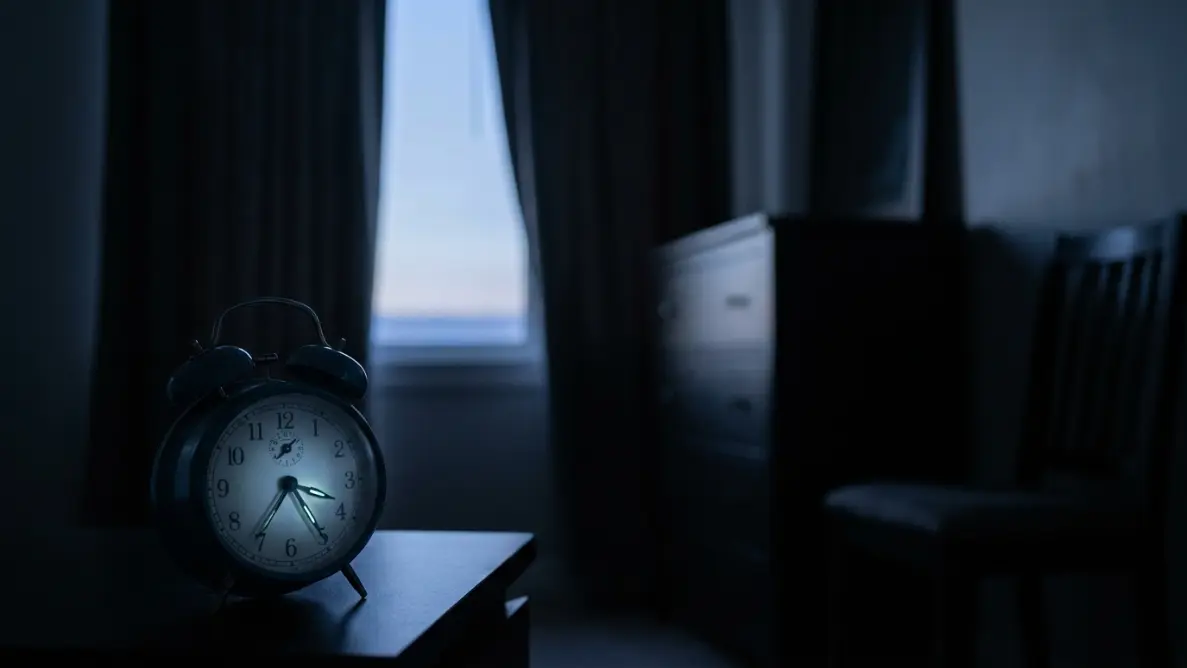
The Hour That Was Never Yours to Sleep Through
The entire frame of this conversation assumes the waking is an interruption. That sleep is the default state and anything that breaks it requires an explanation — emotional, spiritual, medical.
But there is another way to read the 3–5 AM window.
In classical Chinese medicine, the lung meridian opens the daily cycle because breath opens life. In Ayurvedic reckoning, the Brahma Muhurta is not an interruption of rest — it is a separate state entirely, one that the body is designed to access. Both systems, developed independently on different continents, arrived at the same structural conclusion: the hours before dawn are not failed sleep. They are a different category of consciousness.
Maybe the body is not waking you up. Maybe the sleep was the preparation, and the waking is the arrival.
That does not mean every 4 AM opening of the eyes is sacred. Some of it is cortisol. Some of it is a bladder. Some of it is the neighbor’s dog. But when the waking is consistent, unexplained, and accompanied by either emotional weight or unusual clarity — when the body seems to know something the mind has not caught up to — it may be worth considering that the interruption is not the waking. The interruption was trying to sleep through an hour the body never intended to spend unconscious.
The perspectives shared here reflect interpretive and symbolic readings from Traditional Chinese Medicine and Ayurvedic tradition, not clinical diagnosis. If early morning waking is accompanied by persistent distress, mood changes, or physical symptoms, consulting a healthcare professional remains the clearest next step. This article explores meaning — not medicine — and the difference between the two matters most at the hours when both feel equally real.