Zodiac Elements Explained: What Fire, Earth, Air, and Water Mean
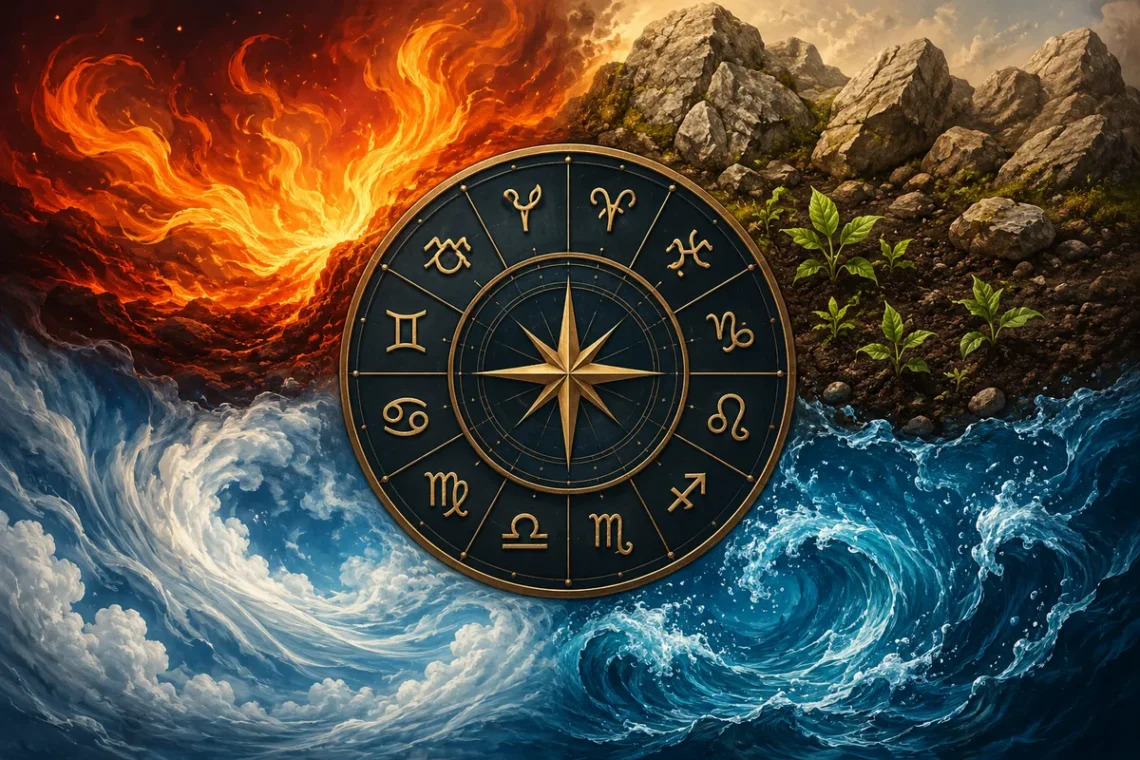
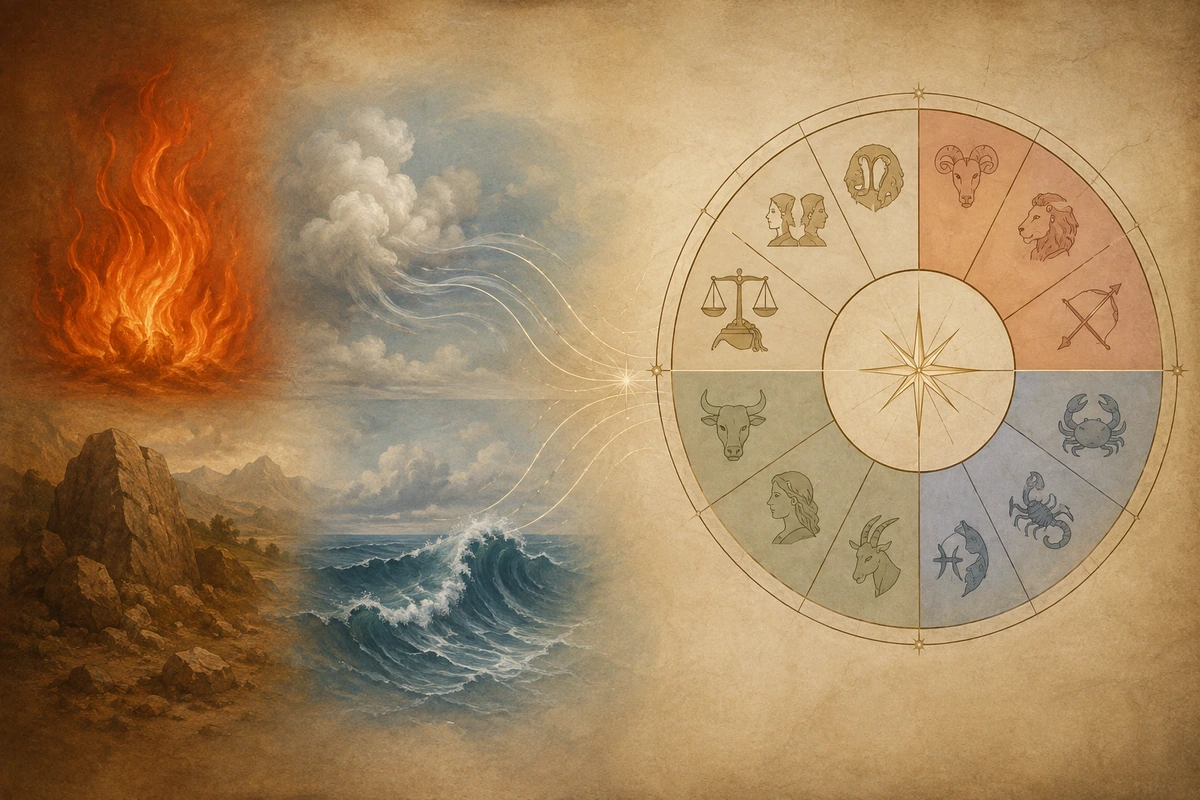
Western astrology groups the 12 zodiac signs into four elements: Fire, Earth, Air, and Water. Fire includes Aries, Leo, and Sagittarius; Earth includes Taurus, Virgo, and Capricorn; Air includes Gemini, Libra, and Aquarius; and Water includes Cancer, Scorpio, and Pisces. In astrology, these groups are used as a symbolic way to organize signs and describe recurring themes. They are not scientifically established personality types.
That distinction matters because “zodiac elements meaning” can sound more factual than the tradition actually allows. Saying that astrology associates Fire with dynamism or Water with emotion describes an astrological convention. Saying that people born under those signs have been proven to possess those traits would be a different claim, and there is no scientific evidence that horoscope categories determine personal characteristics.
The Four Zodiac Elements at a Glance
The four-element structure is also called a system of triplicities because each element contains three zodiac signs. Modern Western astrology also classifies every sign by a modality—cardinal, fixed, or mutable—so no two signs share both the same element and the same modality.
| Sign | Element | Modality | Traditional elemental theme |
|---|---|---|---|
| Aries | Fire | Cardinal | Initiation, movement, drive |
| Taurus | Earth | Fixed | Stability, form, material continuity |
| Gemini | Air | Mutable | Exchange, thought, movement of ideas |
| Cancer | Water | Cardinal | Feeling, receptivity, emotional response |
| Leo | Fire | Fixed | Sustained expression, vitality, creative force |
| Virgo | Earth | Mutable | Practical adjustment, application, detail |
| Libra | Air | Cardinal | Connection, exchange, relational thinking |
| Scorpio | Water | Fixed | Intensity, depth, concentrated feeling |
| Sagittarius | Fire | Mutable | Expansion, direction, enthusiasm |
| Capricorn | Earth | Cardinal | Structure, construction, practical direction |
| Aquarius | Air | Fixed | Ideas, systems, intellectual continuity |
| Pisces | Water | Mutable | Fluidity, sensitivity, dissolution of boundaries |
This table should be read as a map of astrological vocabulary, not as a psychological test. “Traditional elemental theme” means a theme astrologers have associated with the sign’s element. It does not mean everyone with that Sun sign will display the theme in the same way—or at all.
The groupings themselves are standard in Western astrology: Aries, Leo, and Sagittarius form the Fire triplicity; Taurus, Virgo, and Capricorn the Earth triplicity; Gemini, Libra, and Aquarius the Air triplicity; and Cancer, Scorpio, and Pisces the Water triplicity.
Where the Four-Element System Comes From
The history has two layers that are easy to collapse into one.
The first is the ancient Greek theory of four basic constituents of the natural world. In the fifth century BCE, Empedocles of Acragas described four “roots” that later writers identified as fire, air, earth, and water. The Stanford Encyclopedia of Philosophy notes that Aristotle credited Empedocles with clearly distinguishing these four. That philosophical system was not the same thing as the modern zodiac-element chart, and Empedocles was not writing a personality guide for Aries or Pisces.
The second layer is astrological organization. In the second century CE, Ptolemy’s Tetrabiblos describes the 12 zodiac signs as divided into four equilateral triangles. The first runs through Aries, Leo, and Sagittarius; the second through Taurus, Virgo, and Capricorn; the third through Gemini, Libra, and Aquarius; and the fourth through Cancer, Scorpio, and Pisces.
Those are the same four groups that Western astrology later recognizes as the four elemental triplicities. But an important historical limit belongs here: in the chapter verified for this article, Ptolemy describes the groups as triangles or triplicities and discusses their planetary rulers and directional associations. He does not label the four groups Fire, Earth, Air, and Water in that passage.
So the safest historical summary is not “Ptolemy invented the zodiac elements.” It is this: Greek philosophy had a four-element model, ancient astrology had four three-sign triplicities, and Western astrological tradition came to join the familiar sign groups with Fire, Earth, Air, and Water. Astrodienst documents the modern Western classification while also placing the four-element idea within its Greek philosophical background.
A more precise date for that merger would require a dedicated historical source rather than a guess.
That distinction may seem technical, but it protects the article from turning a long, layered tradition into a single origin story that the sources do not support.
Fire Signs: Aries, Leo, and Sagittarius
In Western astrology, Fire is the element of Aries, Leo, and Sagittarius. Astrodienst’s Astrowiki associates Fire with dynamism, energy, power, action, and change. Those ideas form a traditional symbolic vocabulary rather than an experimentally established description of people born under Fire signs.
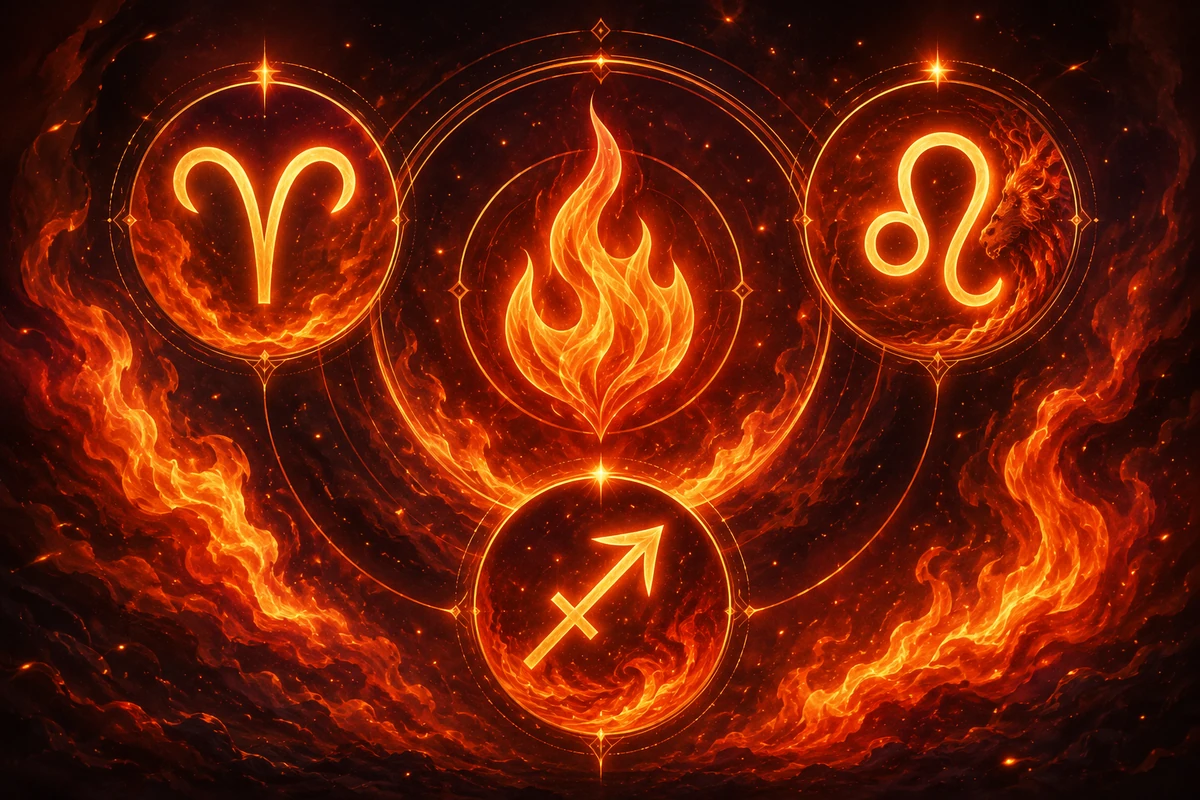
The three signs are not treated as interchangeable. Their shared element supplies a broad theme, while their modalities distinguish how that theme is organized.
Aries is cardinal Fire. In astrological language, cardinal signs are associated with initiating or setting something in motion. That makes Aries the Fire sign most readily linked with beginnings and direct action.
Leo is fixed Fire. Fixed signs represent continuity or concentration within the modality system, so Leo is traditionally read as Fire that holds, sustains, or radiates rather than simply starts.
Sagittarius is mutable Fire. Mutable signs are associated with change and adaptation, which gives Sagittarius a more mobile or expansive version of the same elemental symbolism.
This is a useful example of how to read the system without turning it into a personality verdict. “Fire” is the common category. Cardinal, fixed, and mutable are the differentiators. An astrologer may then build more interpretation on top of those categories, but the classification itself is not evidence that a particular Aries, Leo, or Sagittarius must be energetic, bold, extroverted, impulsive, or ambitious.
Earth Signs: Taurus, Virgo, and Capricorn
Earth includes Taurus, Virgo, and Capricorn. Astrodienst describes Earth in relation to materiality and the physical basis of life. In modern astrological shorthand, that often becomes language about practicality, structure, form, or what can be built and maintained.
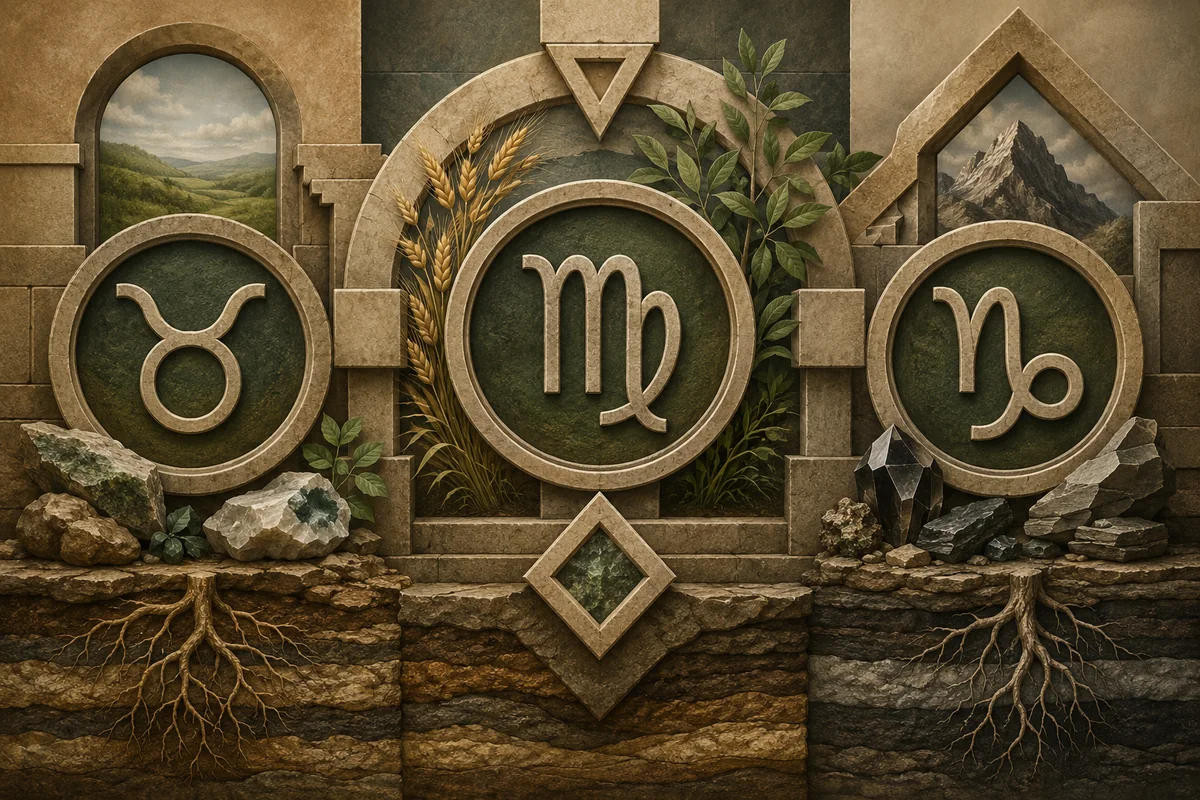
Again, the modality prevents the three signs from becoming copies of one another.
Taurus is fixed Earth. The combination is traditionally associated with preserving form, stability, or continuity. The symbolism is less about beginning a structure than about holding or consolidating one.
Virgo is mutable Earth. Here the Earth theme is paired with adjustment and application. That is why astrological descriptions often connect Virgo with refinement, practical adaptation, or attention to how something functions.
Capricorn is cardinal Earth. Cardinal symbolism adds initiation to Earth’s emphasis on structure, creating the traditional image of building, organizing, or directing something tangible.
None of those descriptions proves that Taurus people are inherently stable, Virgo people inherently meticulous, or Capricorn people inherently disciplined. They explain how astrologers combine two categories—element and modality—to create a symbolic reading.
Air Signs: Gemini, Libra, and Aquarius
Air is assigned to Gemini, Libra, and Aquarius. Astrodienst associates the element with contact, intellectual activity, thought, and communication. In astrological writing, Air therefore often serves as shorthand for movement between ideas or between people.
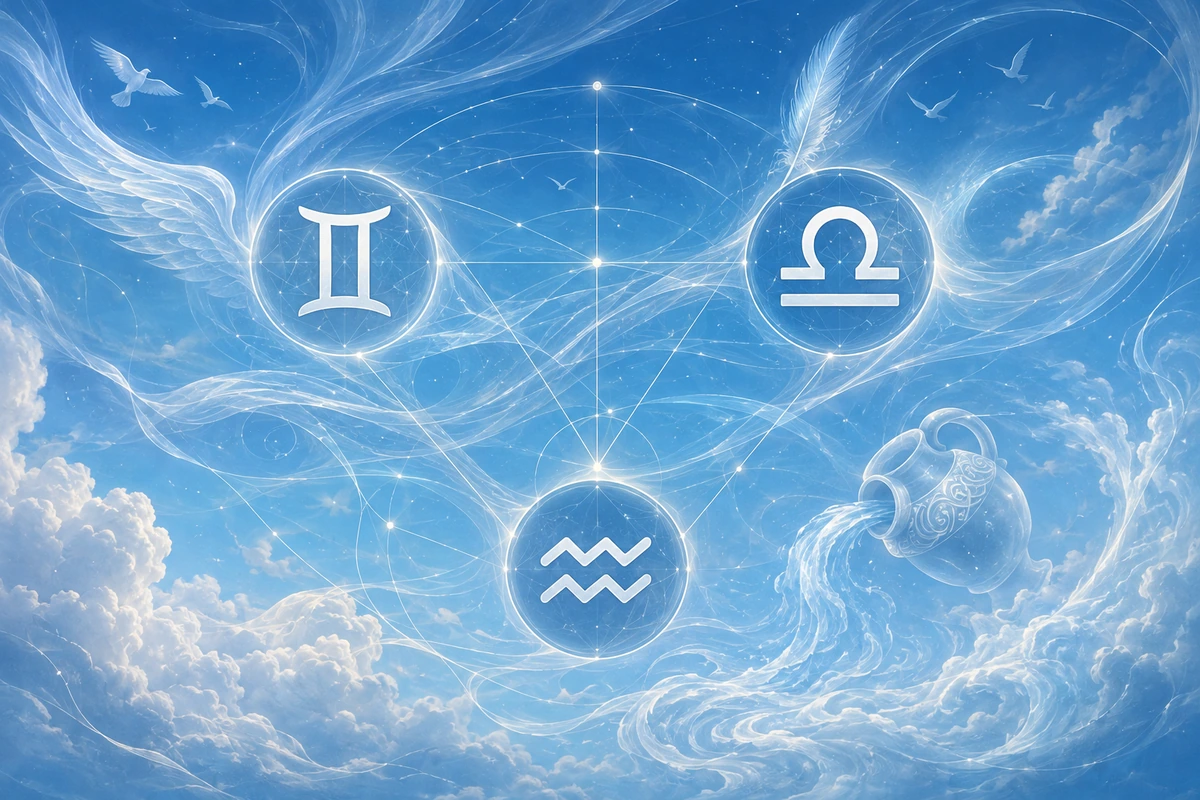
Gemini is mutable Air. Its modality introduces variation and movement, so the combination is commonly interpreted through exchange, flexibility, language, or shifting perspectives.
Libra is cardinal Air. Cardinal Air brings initiation into the realm of contact and ideas. Traditional readings therefore tend to emphasize creating connections, opening dialogue, or establishing a relational framework.
Aquarius is fixed Air. Fixed modality gives the Air theme continuity and concentration, which is why astrologers often read Aquarius in terms of sustained ideas, systems, principles, or conceptual structures.
Aquarius is also a useful reminder that zodiac element does not come from the most obvious image attached to a sign. Aquarius is the Water Bearer, but in Western astrology it belongs to Air, not Water. The classification follows the traditional triplicity system, not a literal reading of the sign’s name or iconography.
That is one reason the four-element table is more useful than guessing from symbols. Scorpio is Water without being represented by a water creature, while Aquarius carries water in its imagery but is Air. The categories belong to an inherited astrological structure.
Water Signs: Cancer, Scorpio, and Pisces
Water includes Cancer, Scorpio, and Pisces. Astrodienst associates the element with emotion and intuition. Those are among the most familiar Water keywords in modern astrology, but they still need the same qualification: they are traditional associations, not findings that establish how emotionally sensitive or intuitive a person actually is.
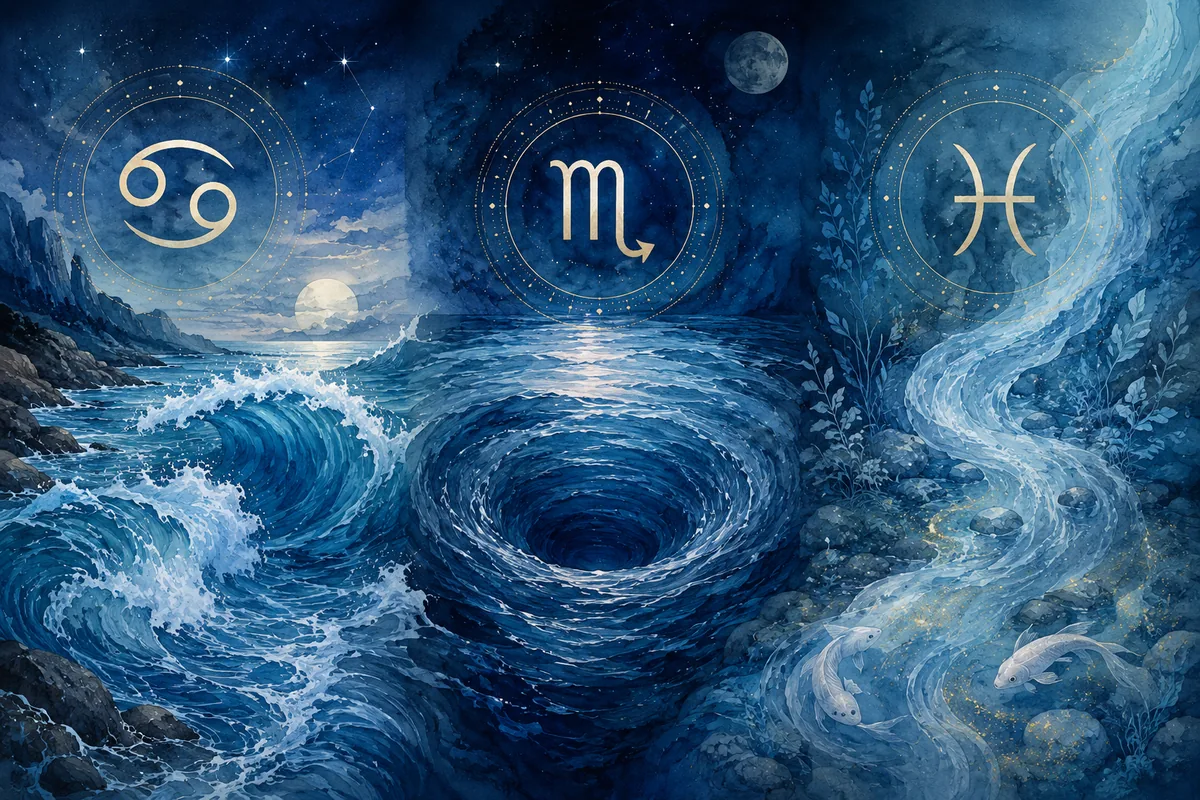
Cancer is cardinal Water. In the modality framework, cardinal energy begins or initiates, so Cancer is often interpreted as feeling that moves into response, care, protection, or connection.
Scorpio is fixed Water. The fixed quality concentrates the element, producing traditional imagery of emotional depth, intensity, persistence, or contained feeling.
Pisces is mutable Water. Mutable symbolism adds movement and permeability, which is why astrologers often describe Pisces through fluidity, adaptability, sensitivity, or the blurring of clear boundaries.
The important point is not whether every person “matches” those descriptions. The point is how the symbolic grammar works. Water supplies one family of themes; cardinal, fixed, or mutable changes the form that family takes.
If a description of your sign does not resemble you, that mismatch does not require inventing a new birth sign or treating the element as hidden truth.
Why Signs of the Same Element Still Differ
The cleanest way to understand the 12-sign structure is as a 4-by-3 matrix.
There are four elements:
- Fire
- Earth
- Air
- Water
There are three modalities:
- Cardinal
- Fixed
- Mutable
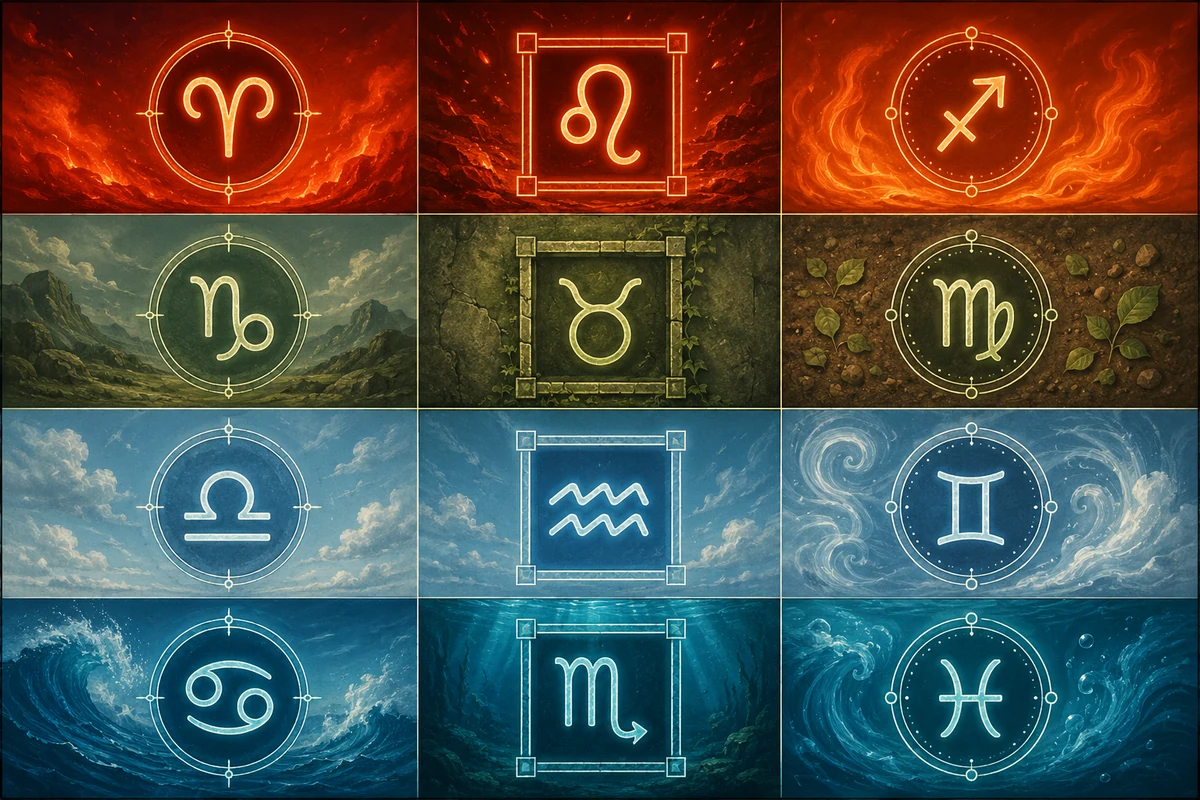
Each zodiac sign occupies one unique combination. Aries is cardinal Fire; Leo is fixed Fire; Sagittarius is mutable Fire. Taurus is fixed Earth, while Capricorn is cardinal Earth. Gemini and Pisces are both mutable, but one belongs to Air and the other to Water.
Astrodienst describes the cardinal, fixed, and mutable groups as quadruplicities or modalities. Cardinal signs are Aries, Cancer, Libra, and Capricorn; fixed signs are Taurus, Leo, Scorpio, and Aquarius; mutable signs are Gemini, Virgo, Sagittarius, and Pisces.
This second axis matters because a one-word element description is intentionally broad. If an astrology guide says “Fire means energy,” it has not yet explained why Aries, Leo, and Sagittarius are treated differently within astrology. Modality supplies one of the structural reasons.
It also prevents a common misunderstanding: sharing an element does not mean three signs are supposed to have the same personality. Even inside astrology, element is only one category among several. Outside astrology, there is an additional limit: the categories themselves have not been scientifically established as determinants of personality.
That means a responsible reading can hold two ideas at the same time. The element system has a real history and a coherent internal structure within Western astrology. Its personality claims should still be presented as interpretations belonging to that tradition.
What Your Zodiac Element Does—and Does Not—Say About You
Your zodiac element tells you where your Sun sign sits inside one traditional classification system. If your Sun is in Aries, Leo, or Sagittarius, the classification is Fire. If it is in Taurus, Virgo, or Capricorn, it is Earth. Gemini, Libra, and Aquarius are Air; Cancer, Scorpio, and Pisces are Water.
Within astrology, that classification gives astrologers a vocabulary for interpretation. Fire may stand for dynamism; Earth for materiality or form; Air for thought and contact; Water for emotion and intuition. Combining the element with a modality produces a more specific symbolic pattern.
What it does not provide is scientific proof of your personality.
The American Psychological Association’s Dictionary of Psychology classifies astrology as a pseudoscience and states that evidence does not support the belief that horoscopes determine personal characteristics. That distinction is especially important in self-knowledge content. An astrological symbol can be used as a prompt for reflection without being presented as an objective assessment of temperament, mental health, compatibility, ability, or destiny.
The same separation is useful elsewhere in astrology. Signs of Universe applies a similar approach when distinguishing the real astronomical appearance called Mercury retrograde from symbolic astrological interpretations attached to it. Mercury Retrograde: Real or Fake, and What Is Actually Happening?
So if you read “Water is emotional” and it resonates, the careful interpretation is not “my element proves I am emotional.” It is “emotion is one of the themes Western astrology traditionally attaches to Water.” If it does not resonate, nothing in the classification requires you to reshape your self-understanding until it does.
That is also why elemental categories should not be used as shortcuts for judging other people. Calling someone “too emotional because they are Water” or “unreliable because they are mutable” takes a symbolic system and turns it into a claim about a real person. The source material does not justify that leap.
The four elements are most defensible when treated for what they are: a durable organizing convention within Western astrology, with a historical background and an inherited set of symbolic associations.
Fire: Aries, Leo, Sagittarius.
Earth: Taurus, Virgo, Capricorn.
Air: Gemini, Libra, Aquarius.
Water: Cancer, Scorpio, Pisces.
Knowing that map lets you read astrological material more clearly. It tells you what the tradition means when it calls a sign fiery, earthy, airy, or watery—and just as importantly, what those words do not establish as fact.
Related reading: The Shadow Side of Your Zodiac Sign and Why Don’t I Relate to My Zodiac Sign? 3 Honest Reasons.


Alex Turner
Alex Turner is the editorial pen name used for articles published on Signs of Universe. The website covers dreams, symbolism, and cultural interpretations for informational and reflective purposes. Alex Turner is not a medical, mental health, scientific, or spiritual authority.