666 Angel Number Meaning: Why It’s the Number of the Beast — and an Angel Number
You saw 666 somewhere ordinary, maybe an address, a receipt total, a phone number, a license plate, or a line on television, and the first thing that surfaced was the Number of the Beast. The direct answer is this: 666 carries that name because Revelation 13:18 calls it the number of the beast and the number of a man. The same three digits get called an angel number for an unrelated reason, which is that contemporary numerology assigns the digit 6 ideas like balance, care, and responsibility. Seeing the number on a receipt or a door does not demonstrate danger, a curse, divine punishment, or anything about what happens next.
Both of those statements are true at the same time, and the collision between them is what sends most people searching for 666 angel number meaning. They are not two versions of one tradition. They come from different places, were written down roughly nineteen centuries apart, and answer different questions. What follows keeps them separate and shows which document each one rests on.
Why 666 Is Called the Number of the Beast

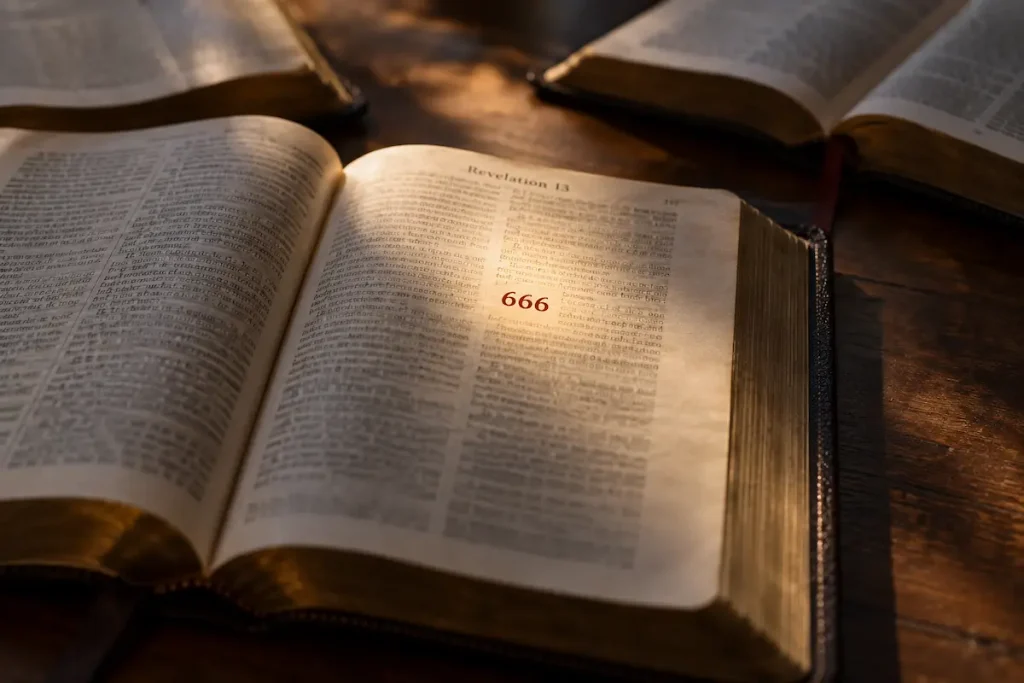
The name comes from a single sentence at the end of Revelation 13. The chapter describes a beast that demands worship and a mark that people must carry on the hand or the forehead, without which no one can buy or sell unless they have the mark, the name of the beast, or the number of its name. The chapter then closes by giving that number.
That is the whole basis for the reputation, and what the passage does with the number is narrower than the reputation suggests. It works as an identifier, a way of pointing at someone without writing out the name. The association runs between the number and one specific figure inside the text.
What Revelation 13:18 Actually Says
The verse is one sentence, and it asks for arithmetic. The King James Version reads: “Here is wisdom. Let him that hath understanding count the number of the beast: for it is the number of a man; and his number is Six hundred threescore and six.” Newer translations print the figure instead. The New International Version and the English Standard Version both give 666, and the NIV tells the reader with insight to calculate it.
Three details in that sentence do most of the work, and popular articles rarely mention any of them. The verse gives an instruction, calculate, rather than a warning. It says the number belongs to a man. And it treats the number as a puzzle with a solution, which only makes sense if its first readers stood a chance of solving it.
There is also a footnote. Printed alongside the text of the verse, the ESV records that some manuscripts read 616 instead. That single line turns out to matter, and it comes back later.
Why the Verse Asks You to Calculate a Man’s Number
The instruction sounds mystical in English. It was not. Ancient Greek and Hebrew had no separate set of digits. Letters did double duty as numbers, with values assigned by their order in the alphabet, so that the first letter stood for 1 and so on. Any written name therefore had a total, and you could arrive at it with simple addition.
That practice had names of its own: isopsephy in Greek, gematria in Hebrew. It was ordinary enough to turn up in street humor. The University of Chicago’s account of the period cites Suetonius on graffiti that appeared in Rome after the emperor Nero had his mother killed, joking about a new calculation, because in Greek the name Nero and the phrase for killing one’s own mother carry the same value of 1005.
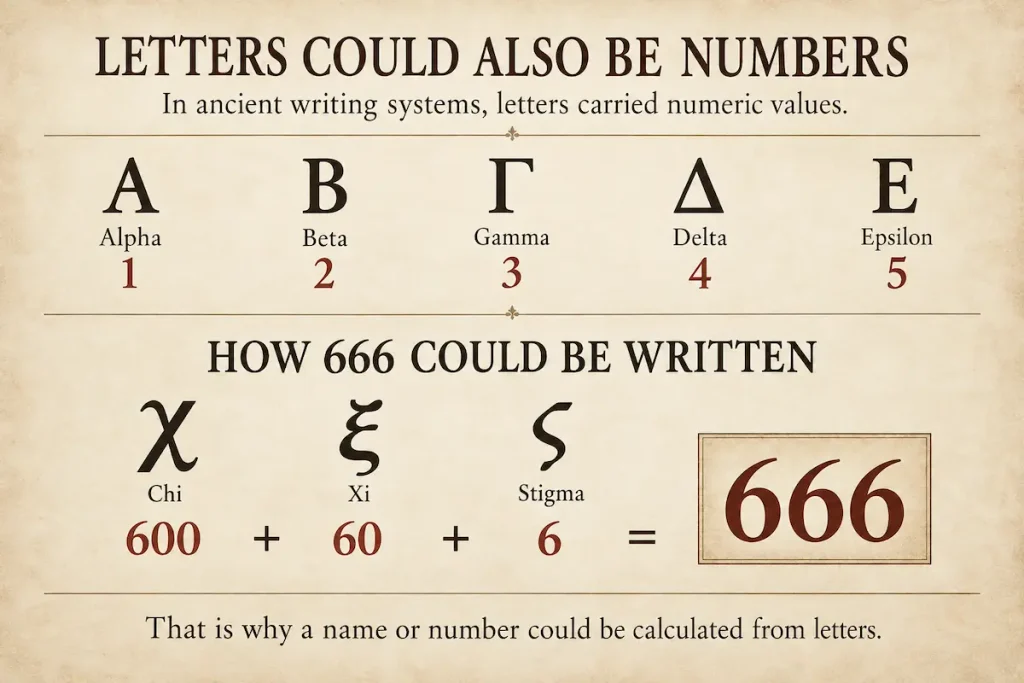
Two consequences follow for the verse. First, telling a reader to count the number of the beast is closer to saying the number is a name, add it up, than to anything esoteric. Second, the number itself could not have appeared as the string 666 in the way we print it, since discrete Arabic numerals would not exist for another five hundred years. A scribe could write it out in words, or write the three letters whose values are 600, 60, and 6.
How Nero Became the Leading Historical Answer
If the number is a name, the obvious question is whose. According to that same University of Chicago account of Nero as the Antichrist, the riddle was effectively forgotten almost as soon as it was written and was not solved until 1835, apparently because readers assumed the number had been calculated in Greek or Latin rather than in Hebrew.
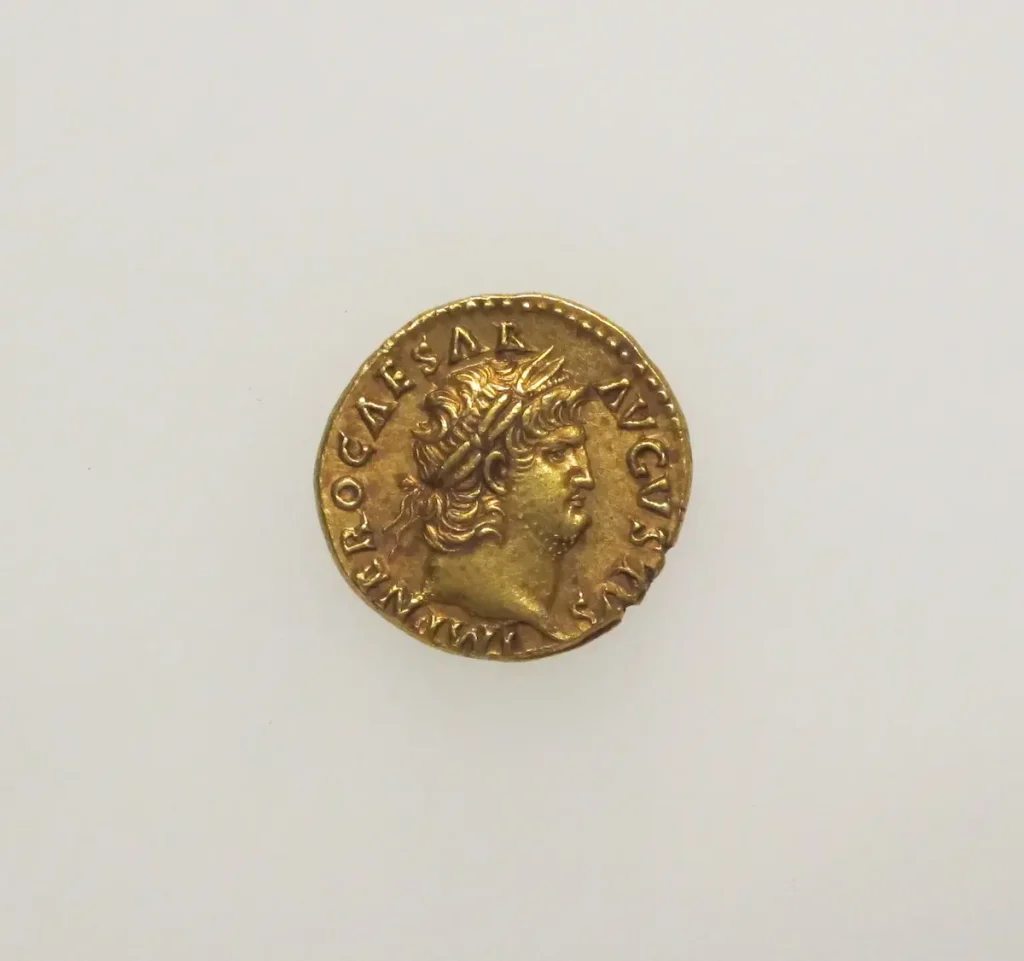
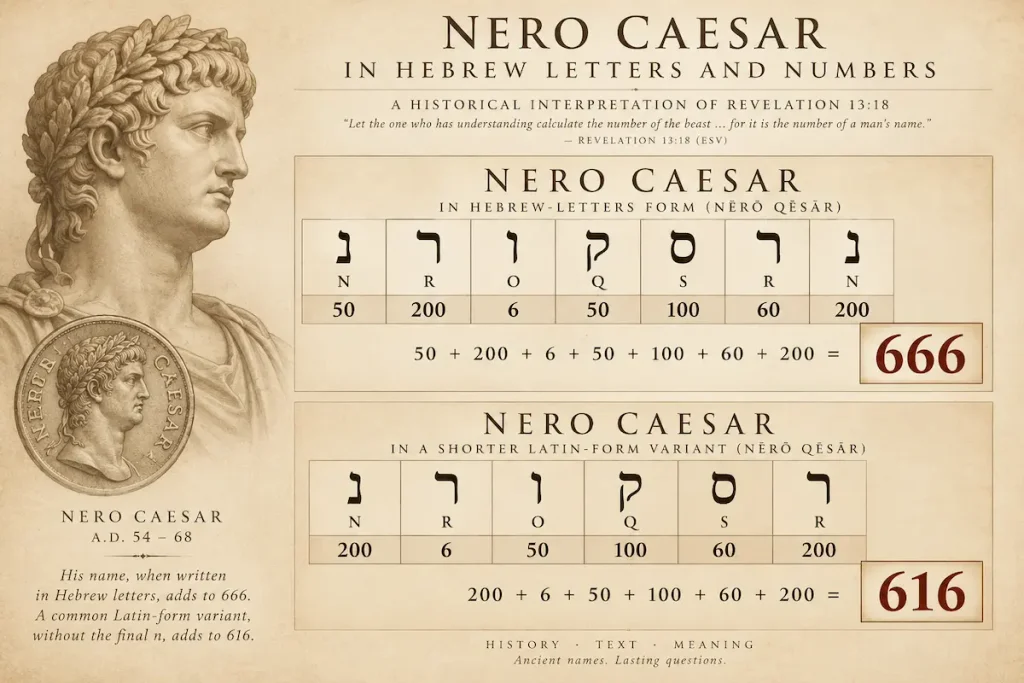
Worked the other way, the arithmetic is short. Take the Greek spelling of Nero Caesar, Neron Kaisar, transliterate it into Hebrew letters as nrwn qsr, and add the values: 50 + 200 + 6 + 50 + 100 + 60 + 200. The total is 666.
The name also fits the situation the text describes. Nero was remembered by early Christian writers as the first emperor to persecute them. After his suicide in AD 68 a widespread belief took hold, especially in the eastern provinces, that he had not really died or would return, and at least three impostors presented themselves as him. Over time he stopped being treated as a historical figure and became an end-times one. For a first-century reader, a number said to be the number of a man had to point at someone nameable in that century.
What the Nero Reading Cannot Prove
This is a documented historical interpretation with real evidence behind it. It is not a religious verdict, and the same source is careful about the limits.
Gematria runs in one direction only. Computing the value of a word is simple; working backward from a number to a word is not, because many different words share a total. A number on its own never determines a name.
That limit was noticed early. Irenaeus, writing in the second century, was the first church father to comment on the number, and he did not know what it encoded. He warned against casting about for names, since “many names can be found possessing the number mentioned,” which would leave the question unsolved anyway.
The Nero calculation carries a wrinkle of its own. It depends on a particular transliteration, nrwn rather than nrw and qsr rather than qysr, spellings that do appear in the Talmud and in an Aramaic scroll from Qumran but that would have made the puzzle harder to crack. And the reading belongs to one approach to Revelation, the preterist one, which treats the book as describing events of the century in which it was written rather than forecasting later ones. Other traditions read the same chapter differently, and this article does not ask you to settle that.
Why Some Ancient Copies Read 616 Instead
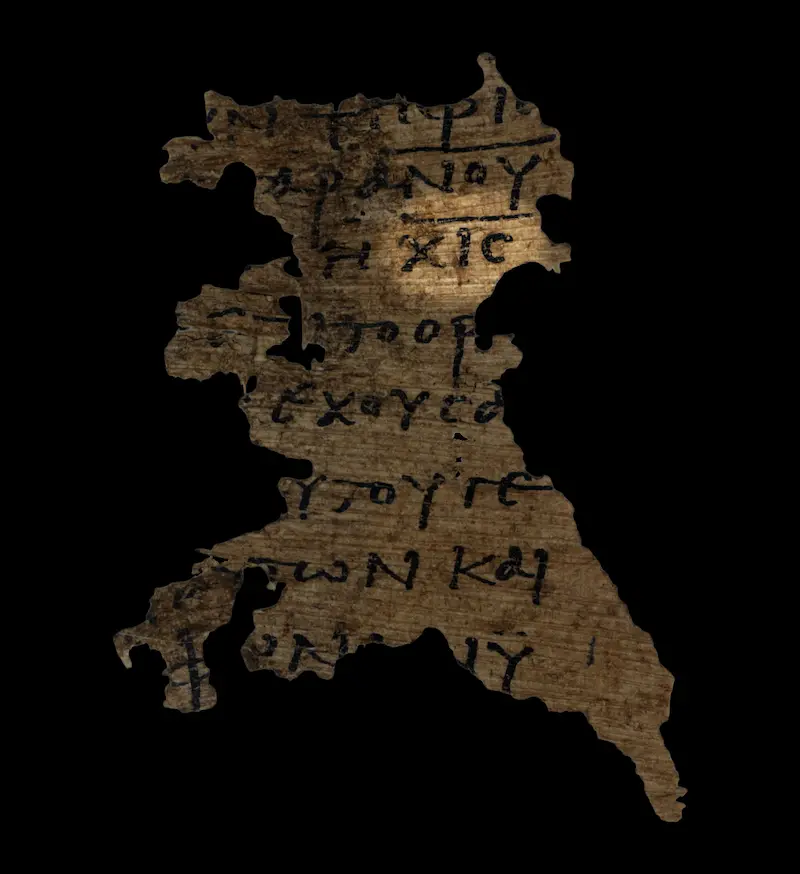
The footnote in the ESV is not a rumor. The University of Oxford’s Centre for the Study of Ancient Documents describes a fragmentary papyrus of Revelation dated to the late third or early fourth century and the earliest known witness to some sections of the book. In the Oxyrhynchus Papyri it is item 4499, and in the standard list of New Testament manuscripts it is P115. The number it gives for the beast is 616, written with the letters chi, iota, and stigma. The same page notes that 665 also turns up, and that Irenaeus had already cited the 616 reading and argued against it.
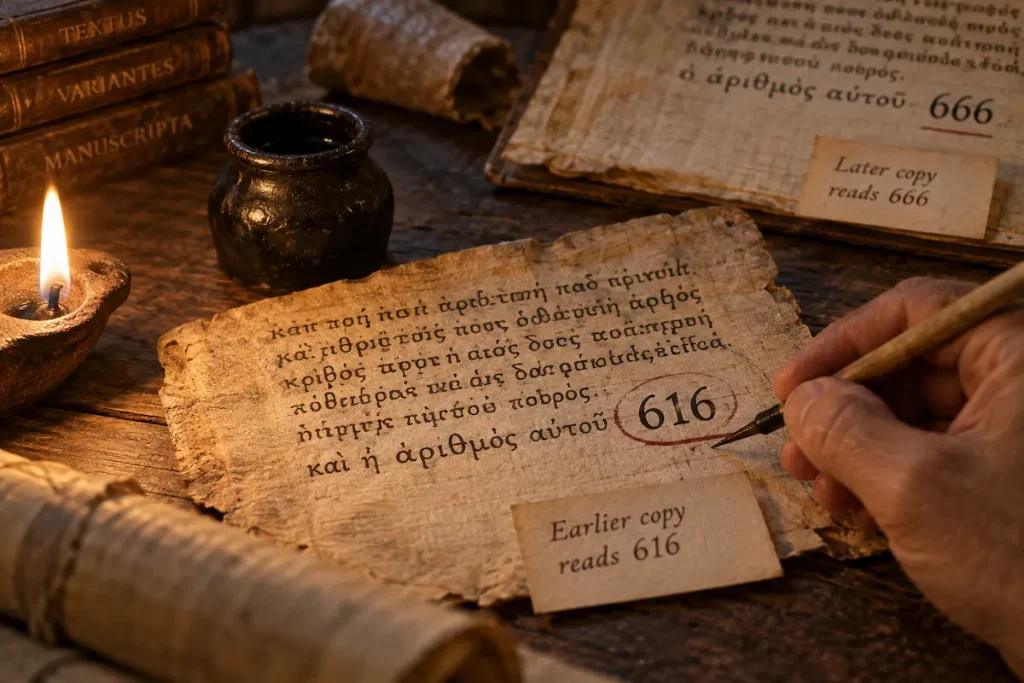
Here is where the variant becomes interesting rather than merely technical. The Latin spelling of the same name, Nero Caesar, transliterates into Hebrew as nrw qsr, dropping the final n and its value of 50. That total is 616. One name accounts for both numbers found in the manuscripts, which the Encyclopaedia Romana presents as the most compelling argument that Nero, rather than another emperor such as Caligula or Domitian, was the intended target.
The same source keeps that argument in proportion, and so should we. It also raises the possibility that a copyist produced 616 by transcribing the Latin form, and notes a competing pull toward 666, since each of its digits falls one short of seven. Ancient copies disagree with each other, too: Codex Sinaiticus and Codex Alexandrinus record 666, Codex Ephraemi Rescriptus records 616, Codex Vaticanus does not contain Revelation at all, and the oldest papyrus manuscript of Revelation, P47, reads 666.
One more detail is easy to check and rarely mentioned. In Codex Sinaiticus, which contains the earliest complete copy of the Christian New Testament, the leaf carrying Revelation 13 is folio 330 in the British Library volume, and there the number is spelled out in words rather than written with the three letters. The familiar string of three digits is a modern way of printing an ancient number.
What none of this settles is which reading came first. That argument belongs to the critical editions of the Greek text, and nothing here resolves it.
What Numerologists Mean When They Call 666 an Angel Number
If you searched for 666 angel number meaning, this is the layer most pages hand you first, and it is more specific than the phrase “numerologists say” suggests, because the readings belong to named people.
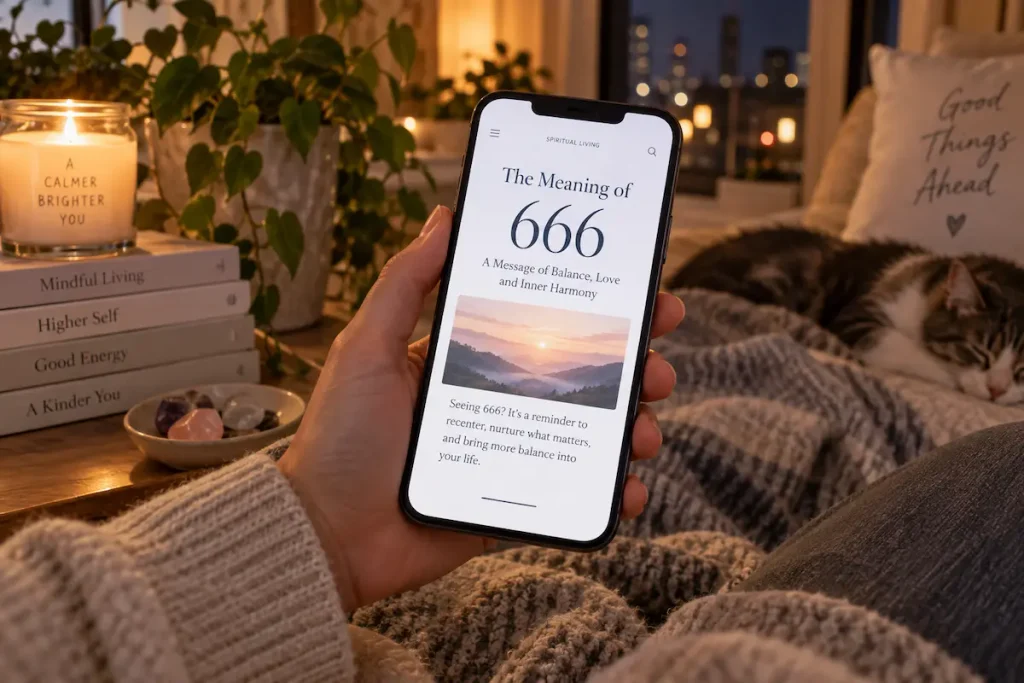
In mindbodygreen’s guide to the number, professional intuitive Tanya Carroll Richardson describes the sequence as steady and nurturing and reads it as a call for balance, including a prompt to stop overworking, over-worrying, or overdoing in any way. In the same article, numerologist Kaitlyn Kaerhart associates the single digit 6 with people who go to great lengths for those they care about and who have to learn to balance giving with receiving, and numerologist Michelle Buchanan is cited describing life path 6s as caregivers. Mental Floss frames it along the same lines, linking 6 to care, nurturing, and family, and treating the sequence as a cue to refocus rather than a bad omen.
Those are attributed interpretations inside a contemporary practice. They describe what a practitioner reads into the number. They are not properties of the number itself, none of them is presented with evidence, and none of them forecasts an event. The same two interpreters supply readings for other sequences as well. Richardson and Kaerhart are also the named sources behind the meanings attached to 555 after a life change, which is a useful reminder that these are individual readings rather than a collective inheritance.
One feature of that guide is worth noticing, because it explains why the fear survives. It never mentions the Bible, Revelation, or the beast. Someone who arrives frightened finds an article about balance and self-care in which the source of the fear is simply absent. Mental Floss does mention the association, in a single clause, before setting it aside.
Does the Angel-Number Reading Connect Back to the Bible?
Not by any line we were able to document, and the claim that such a line exists is published without support.
Numerologist.com tells readers that 666 has nothing to do with evil, that the reputation comes from one verse written long after the number’s meaning was already established, and that “In every older tradition, 6 means one thing: care.” No source is given for either half of that.
The oldest dated records about the number six point somewhere else. Six is the first perfect number, meaning it equals the sum of its divisors, 1 + 2 + 3. The University of St Andrews’ history of perfect numbers notes that 6, 28, 496, and 8128 were known from ancient times, and that the first recorded mathematical result about them appears in Euclid’s Elements around 300 BC. Pythagoras and his followers also studied perfect numbers, more for their mystical properties than their mathematical ones.
Around AD 100, Nicomachus built a whole classification of numbers on the idea. Centuries later Augustine gave it a theological form in The City of God, writing that God created all things in six days because the number is perfect.
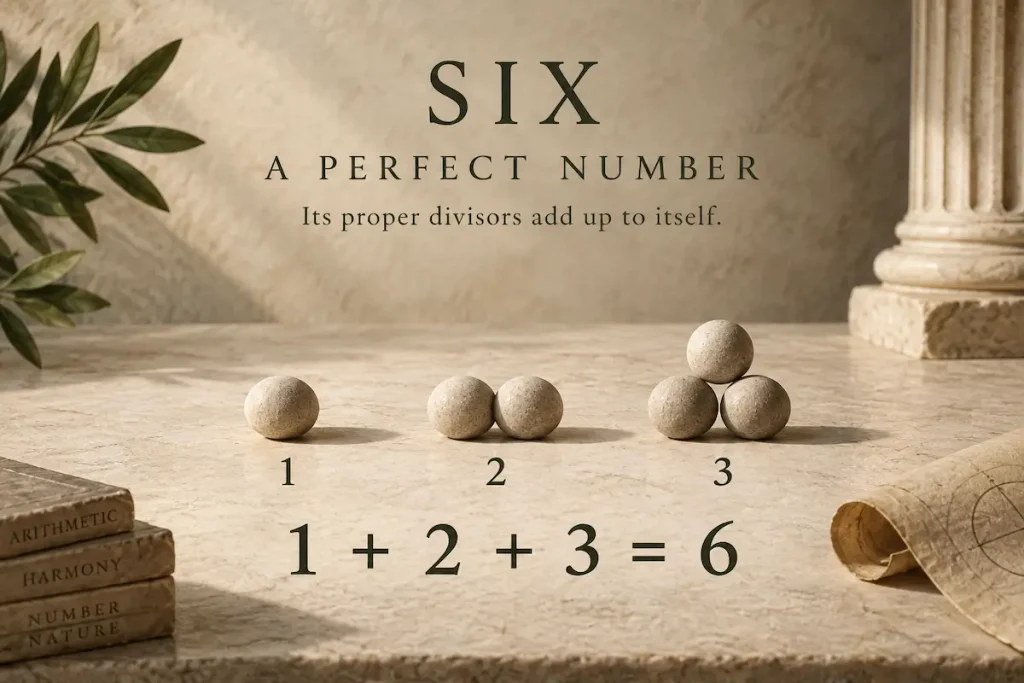
That is a documented older tradition about six, and it is not about caregiving. It treats six as complete and exact, a statement about arithmetic that later picked up religious weight. We could not locate a dated source placing a caregiving meaning for six earlier than Revelation, and the page asserting one names none. That does not prove no such tradition existed. It means the claim, as published, cannot be checked, and a reader has no reason to accept it as history.
The numerology-friendly sources concede part of this themselves. mindbodygreen tells readers that the older practice of numerology and the newer idea of angel numbers are not the same thing. Where that newer framework came from is a separate question with a traceable answer, and it runs through modern publishing rather than antiquity, as the record behind where the angel-number idea comes from shows.
Does Seeing 666 Mean Danger, a Curse, or a Prediction?
No, and neither system claims otherwise when you read it closely.
The verse is a riddle about identifying a figure in a first-century text. It says nothing about a person encountering the digits centuries later, and it does not describe the number as harmful in itself. The contemporary reading does not claim predictive power either. Its named sources describe it as a prompt to look at how much you are giving and how little you are keeping, which is an invitation to reflect, not a forecast.
Where the number reaches you is itself unusual. A clock can show 6:06 or 6:16 but never 6:66, so this sequence cannot arrive the way 11:11 or 3:33 does; it has to come through a price, an address, a phone number, a plate, or a total. That shifts the question people usually bring to it, which is less often what the digits mean than why they suddenly seem to be everywhere. The second question belongs to attention rather than to any document quoted above, and we take it up in noticing 11:11 on the clock.
Why the Beast and the Angel Number Never Meet
The confusion around 666 angel number meaning comes from three digits being used in two unrelated systems. It is called the Number of the Beast because one sentence in Revelation 13:18 assigns that number to a figure in the text and tells the reader to work out the name behind it. It is called an angel number because a contemporary practice assigns the digit 6 themes of balance, care, and responsibility, and treats a run of three as emphasis. The second reading does not correct, replace, or historically continue the first. It never engages it.
So what does a sighting allow you to conclude? That you noticed a number. Nothing in either system establishes that something good or bad will follow, and neither one was built to answer that question. What you can do instead is check the claims, which is unusually easy here: read the verse and its footnote, look at Oxford’s page on the papyrus that reads 616, and notice whether an article that tells you what numerologists believe bothers to name anyone at all.




Alex Turner
Alex Turner is the editorial pen name used for articles published on Signs of Universe. The website covers dreams, symbolism, and cultural interpretations for informational and reflective purposes. Alex Turner is not a medical, mental health, scientific, or spiritual authority.