When a Candle Goes Out by Itself: What the Timing Can Mean
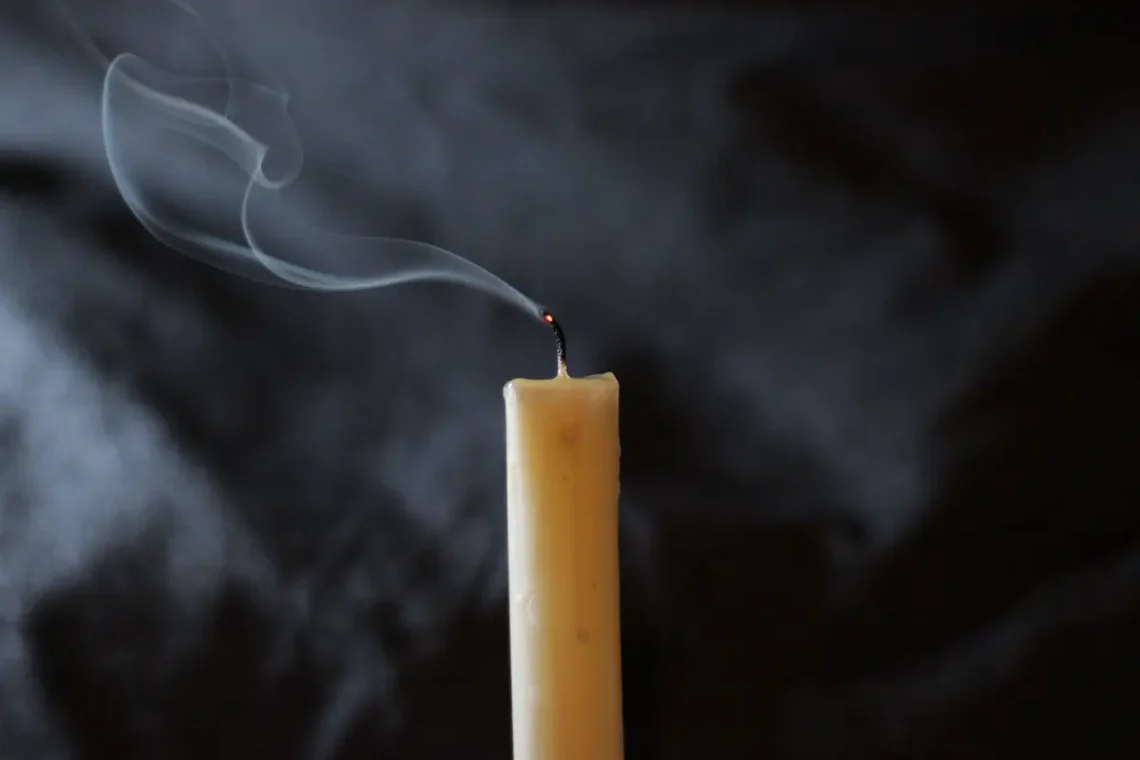
When a candle goes out by itself, the question gets two kinds of answers online, and both are organized around the same detail: how far into the burn it happened. Candle makers tie the physical causes to the stage — a short or flooded wick in the first hour, a tunnel wall partway down, almost nothing left in the container at the end. Ritual guides tie their reading to those same three moments. The honest short answer is that the stage tells you a great deal about the cause and nothing certain about meaning. A flame ending on its own is not evidence of a spirit, a curse, or an outcome.
What almost no page mentions is that the two symbolic answers collide. A widely shared practitioner guide treats a candle that goes out near the end of its burn as a working that closed naturally. The oldest authored record located for this question, a folklore collection published in 1920, ties a candle allowed to burn entirely out to a death, and treats a lamp that goes out on its own as bad luck rather than completion. Same part of the burn, opposite verdicts, and neither one predicts anything.
What follows gives each stage of the burn three answers side by side: what it usually indicates physically, how practitioners read it, and what the 1920 collection actually recorded. One rule holds across all three — none of them is a reason to relight a candle you cannot stay with.
Why a Candle Goes Out by Itself: What the Burn Stage Shows
Checking the object before the symbol is the same order that works for another household object that fails without being touched, and with a candle the check is unusually specific, because the flame depends on a balance that can fail in two opposite directions.
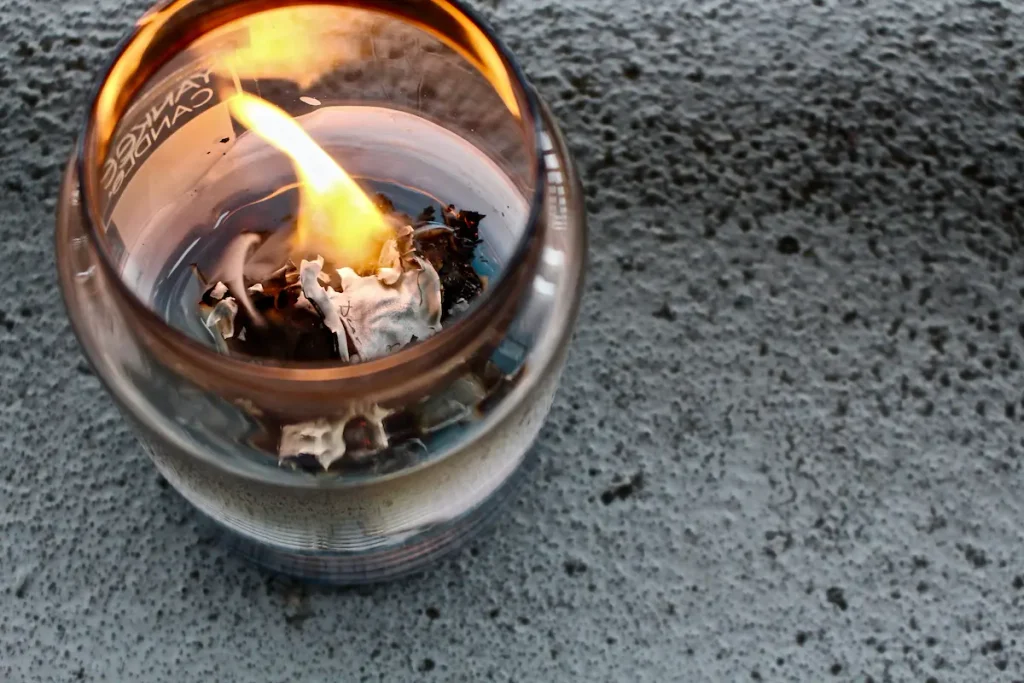
The National Candle Association describes the wick’s job in mechanical terms. It delivers wax to the flame, “acting like a fuel pump,” and the amount matters both ways: “Too much fuel and the flame will flare and soot; too little fuel and the flame will sputter out.”
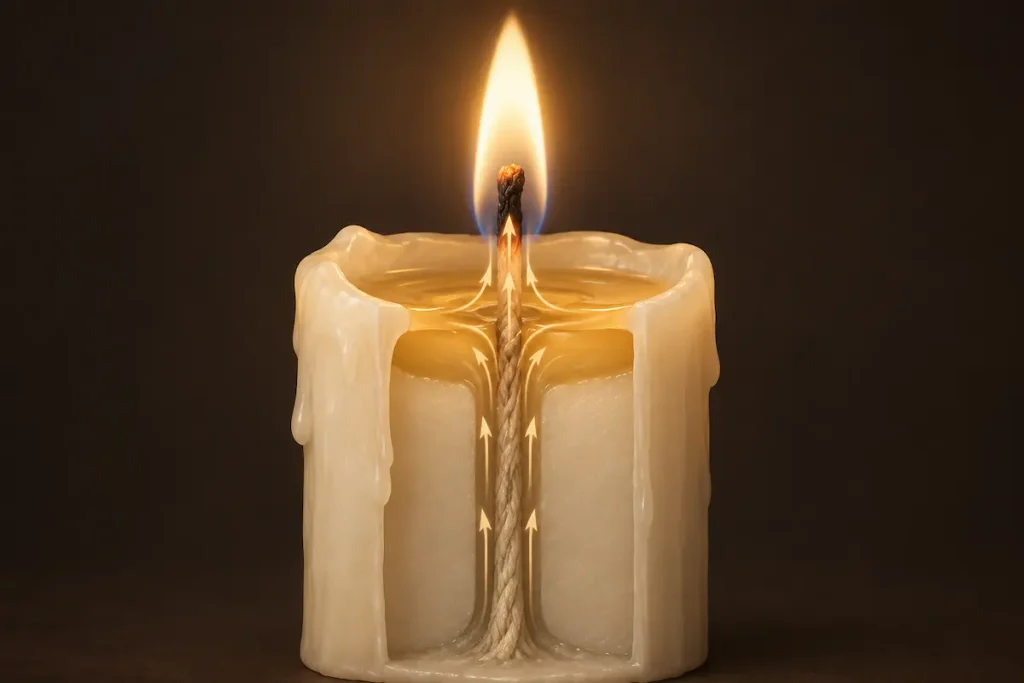
Michael Faraday explained the flooded half of that balance in detail. In his lectures on the chemical history of a candle, he described liquid fuel traveling up the wick “by what is called capillary attraction,” then stated the consequence of too much arriving at once: “the melted tallow extinguishes the flame,” which is why “a candle, if turned upside-down, so as to allow the fuel to run upon the wick, will be put out.” His reason is the part worth keeping, because it explains the whole category: the flame “has not had time to make the fuel hot enough to burn.”
A flame can therefore be starved out or flooded out. Which of the two you are looking at depends on where in the burn it stopped.
Out in the First Hour
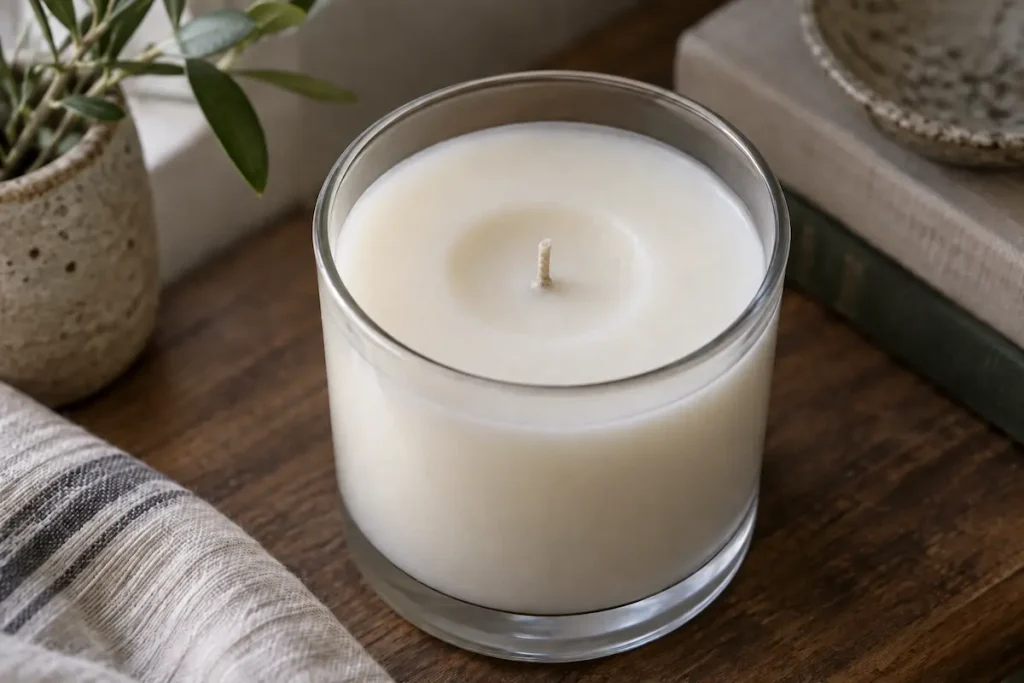
An early failure is usually a wick problem rather than a candle problem. The association’s candle safety guidance is to “trim the wick to ¼ inch before each use,” and a wick cut shorter than that, or one sitting beside a fragment of burnt wick left in the pool, has very little exposed length to work with while the wax around it liquefies.

That is the condition people usually describe as the wick drowning, and it is the flooded end of Faraday’s description rather than a separate phenomenon: enough liquid wax reaches the flame that the flame cannot heat it fast enough to keep burning. The practical signature is visible after the fact. A drowned wick is short and submerged, with wax that hardened over it. A starved one is usually intact but stubby, with a pool that never widened.
Out Partway Down the Candle
A candle that behaves for several burns and then quits partway down has often been tunneling since its first hour. The association’s guide to burning a candle correctly explains the mechanism: “If a candle is not burned for long enough to allow the wax to liquefy or to melt from edge to edge of the container, it will create a ‘memory ring.’ Once a candle has a ‘memory ring,’ it will continue to tunnel for the life of the candle.”
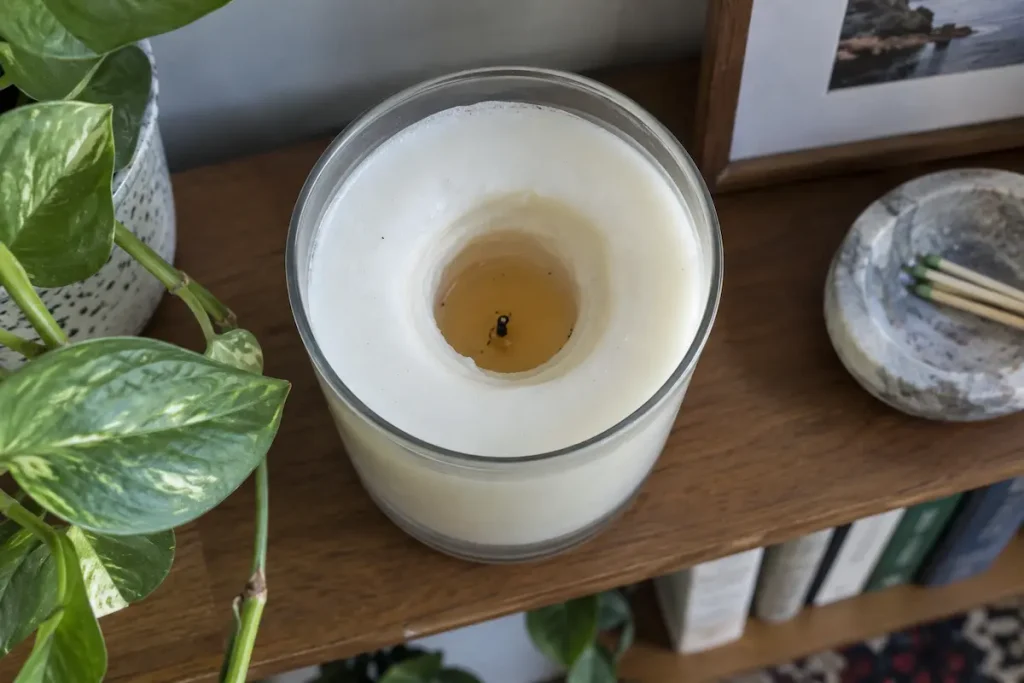
The same guide gives the preventive measure — candles “should burn one hour for every 1 inch in diameter of the actual candle size” — which is why a short first burn is the decision that determines how the candle ends weeks later.
Neither source describes your particular candle, but the two descriptions meet: a wick burning at the bottom of a narrow well, ringed by a wall of unmelted wax, is working inside the arrangement Faraday was describing when the melted fuel reaches the flame faster than the flame can handle it. That connection is a reading of the two sources together, not a claim either one makes on its own.
Out in the Final Half Inch
This is the stage people find most meaningful and the one with the least mystery attached to it. The safety guidance is to stop before it: “Don’t burn candles all the way down — stop when ½ inch of wax remains.” A candle allowed past that point is at the starved end of the balance, with almost no fuel left to draw up.
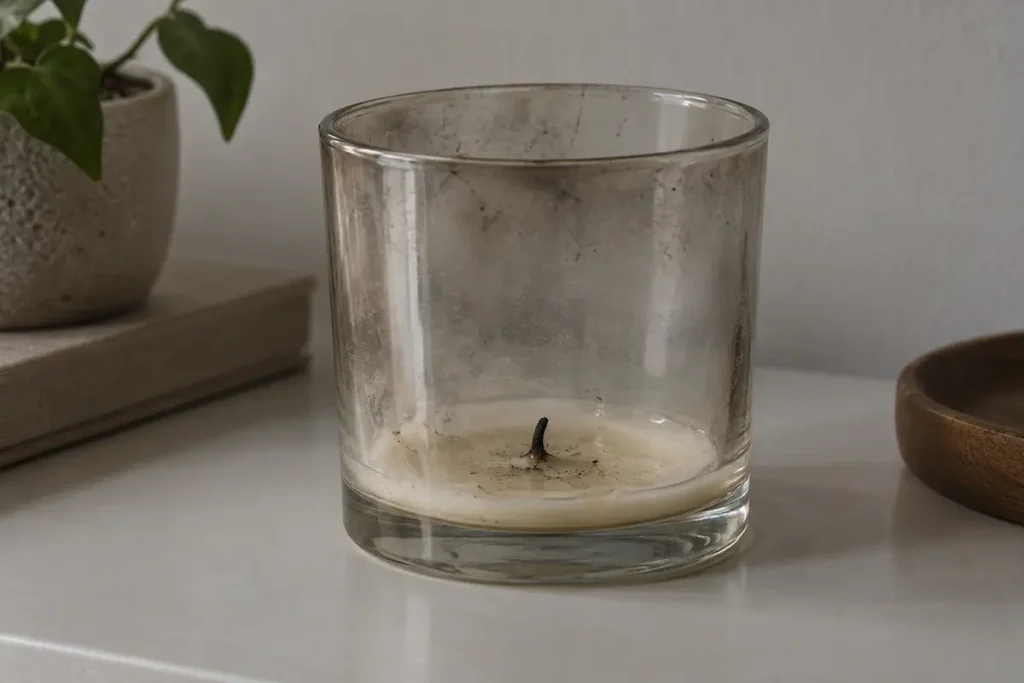
Put plainly, a flame that ends in its last stretch is doing the least surprising thing available to it. That does not make the moment meaningless to you. It does mean the event itself carries no information that the wax level did not already carry.
A Draft You Could Not Feel
Air movement is the one cause that can end a burn at any stage, and it is the one most often ruled out incorrectly, because the room felt still when the person went to look. Safety guidance is specific about the sources: “Avoid drafts — don’t place candles near open windows, fans, or air vents.” An air vent does not run continuously, so the current that tipped the flame may be gone by the time you notice the candle is out.
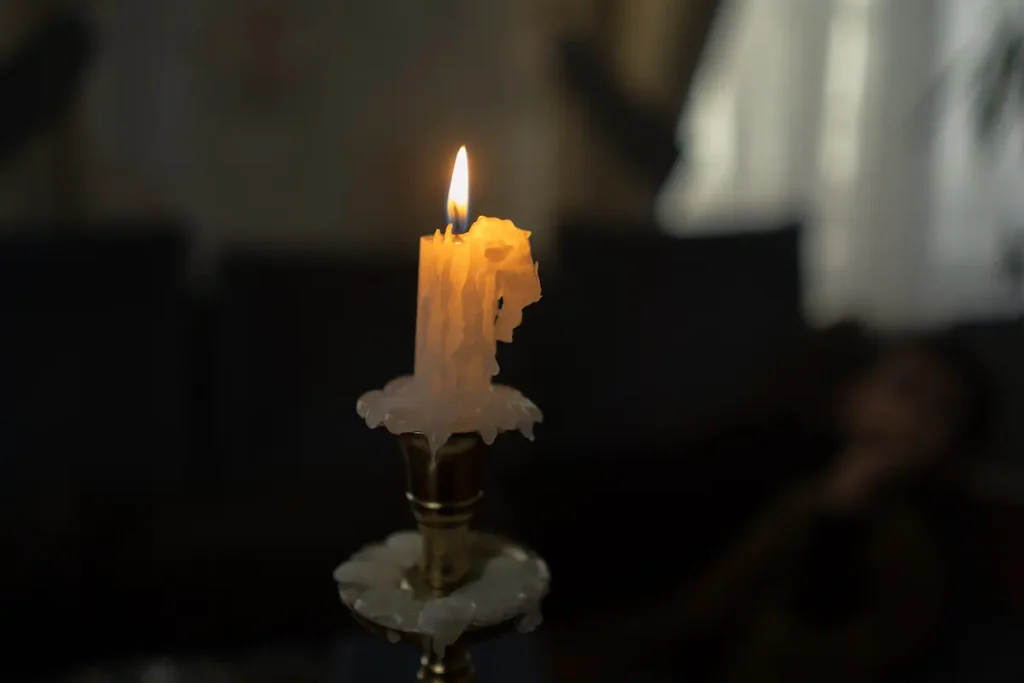
Faraday described what a current does to the pool of melted fuel that holds the flame upright: “if the cup be not horizontal, of course the fluid will run away in guttering.” A tilted cup, wax down one side, and a wick left sitting off-center are the marks a draft leaves behind. They are worth checking before the timing is.
How Practitioners Read the Same Three Moments
The idea that the stage of the burn changes what it means when a candle goes out by itself is not something modern ritual pages invented for search traffic. It is how one of the most widely circulated guides on the subject is organized. Original Botanica’s guide to reading ritual candles states the principle directly: “A candle that goes out on its own after burning normally for a while is read differently depending on how far along the burn was.”
Two readings follow from that. Near the end: “If it happened near the very end, many practitioners consider the working essentially complete and read it as a natural close rather than a bad sign.” Early on: “If it happens early and repeatedly, it more often points to resistance that needs to be addressed before continuing.”
What that source is, exactly, matters for how much weight it can carry. It is a blog page published by a religious-goods retailer, with no named author, drawing on Santería, Hoodoo, Espiritismo and folk Catholic vigil practice without separating them — and the page itself states that “None of these traditions agree on every detail.” It is good evidence that practitioners use this reading. It is not evidence that any one tradition teaches it as a rule, and it is not a finding about your candle.
The same move organizes the reading of a protective object that broke, except that there the question turns on how the object failed — cracked glass, a snapped cord, a clasp that opened — rather than on when. A candle is the version of that question sorted by time instead of by damage.
What a Named 1920 Collection Recorded About a Flame That Ends Itself
For a documented comparison, the useful source is not another modern page but a collection with named compilers and a date. Kentucky Superstitions, compiled by Daniel Lindsey Thomas and Lucy Blayney Thomas and published by Princeton University Press in 1920, records a consecutive block of candle and lamp beliefs in its household and domestic life section. The same collection supplied the recorded readings behind a picture falling off a wall.

Three entries bear on a flame that ends without being put out. Entry 1735 reads: “When a candle is allowed to burn entirely out, a death will follow.” Entry 1742: “It causes bad luck to let a lamp go out. You should blow it out.” Entry 1743: “If a lamp goes out in the room, there will be a death in the family.”
The surrounding entries show what these collectors thought was worth reading in a flame at all. Entries 1736 and 1737, both labeled Central Kentucky, read a short flame as a small stranger and a long, straight one as a tall stranger. Entry 1738 treats a flame that spreads around the tallow instead of standing straight as a winding sheet, and calls it prophetic of death. Entry 1739 makes a spark on the wick the sign of a letter. Entry 1740 says a guest who blows out a candle will come again.
What the book establishes is that these statements were collected and printed in Kentucky in 1920, several of them with regional labels. It does not establish how widely any of them were believed, how old they were, or that a single one of them came true. Read as a record, though, the pattern is clear enough: the deliberate act was the safe one, and the flame that stopped by itself was the one that carried weight.
The Same Moment, Three Different Answers
Laid side by side, the three layers answer the same question about a candle that goes out by itself, and they do not agree.
| When it went out | Most common physical explanation | How the practitioner guide reads it | What the 1920 collection records |
|---|---|---|---|
| In the first hour | Wick trimmed too short, debris in the pool, or wax flooding the flame faster than it can burn | Early and repeated extinction points to resistance to address before continuing | No entry corresponds to this stage |
| Partway down | Tunneling from a memory ring set by an early short burn | Not addressed as a separate case | No entry corresponds to this stage |
| In the final half inch | Almost no wax left to feed the flame; past the point where burning should have stopped | The working is essentially complete; a natural close, not a bad sign | A candle allowed to burn entirely out is followed by a death (1735) |
| At any stage, with air movement | A draft from a window, fan or vent, often gone by the time you look; guttering leaves wax down one side | Not treated as a stage; read by what the flame did | Letting a lamp go out is bad luck, so blow it out instead (1742); a lamp going out in the room means a death in the family (1743) |
The end of the burn is where the disagreement is sharpest. The practitioner guide reads a flame that stops near the end as completion. The 1920 entry attaches the worst possible outcome to a candle reaching that same end. The two are not describing identical events — entry 1735 concerns a candle permitted to burn until it is gone, while the guide concerns a flame that stops on its own before that — but they assign opposite weight to the same part of the candle’s life, and the older record is the one closest to the modern search, since entry 1743 describes a flame that simply goes out in the room.
That contradiction is the most useful thing on this page. Significance is not carried by the event. It is assigned by whoever is reading it, and two sets of readers assigned opposite values to the same moment roughly a century apart. So the answerable question is not which reading is correct. It is which record you are quoting, and whether you would still accept its verdict if it had landed the other way.
What to Check Before You Relight It
The checks that follow come from candle safety guidance and are specific to a candle that goes out by itself, not general advice.
- Let the wax harden, then trim the wick to ¼ inch and remove any debris left in the wax pool.
- Move the candle away from open windows, fans and air vents before relighting.
- Give it one hour of burning for every inch of diameter, so the wax melts edge to edge and no memory ring forms.
- Do not burn it longer than four hours, and let it cool for at least two hours before relighting.
- Stop using it once about half an inch of wax remains.
- Extinguish it with a snuffer, or blow it out gently — never with water, which can make hot wax splatter.
- Never leave it burning unattended, and keep it at least 12 inches from curtains, bedding, books and anything else that will catch.
That last point is the one place where the symbolic reading has to give way. A ritual that calls for a candle to finish its burn is not a reason to leave a flame alone in a room, and no reading on this page changes what an unattended candle can do.
So when a candle goes out by itself, the timing is worth paying attention to — just not for the reason most pages suggest. The stage of the burn is the best available clue to what physically happened, and it is also the exact detail both symbolic readings organize themselves around, which is why the two of them can look at one moment and reach opposite conclusions. What you are left with is a candle that needs its wick trimmed, and a choice about which record, if either, you want to keep.



Alex Turner
Alex Turner is the editorial pen name used for articles published on Signs of Universe. The website covers dreams, symbolism, and cultural interpretations for informational and reflective purposes. Alex Turner is not a medical, mental health, scientific, or spiritual authority.