Hiccups Spiritual Meaning: Gossip, Elves, and the Evil Eye in Folklore
If you search for hiccups spiritual meaning, one recurring answer is that someone is thinking about you. Folklore records show a more complicated picture. In some collections, the absent person is thinking of you affectionately. In others, someone is speaking badly about you. An Old English term was even interpreted by one lexicographer as a hiccup-like ailment caused by elves. The curse connection is weaker: one modern folklore archive links negative-thinking hiccups to the evil eye, but the sources do not support a universal belief that every hiccup was caused by a curse.
Treating those variants as one ancient rule would erase exactly what the archives show: the meaning changes with the source. These records document beliefs held or reported in particular places, families, and collections. They do not prove that a hiccup reveals what another person is doing.
The Hiccup Superstition Changes Depending on Who Is Supposedly Thinking About You
One of the clearest archival examples comes from the James T. Callow Folklore Archive at the University of Detroit Mercy. A record marked “Where learned: Hungary” and dated 1897 says that when a person hiccups, someone is thinking of them. It adds a small test: guess who the person is, and if the hiccups stop, the guess was supposedly correct.
The same basic idea can carry a much warmer meaning. A USC Digital Folklore Archives entry collected in 2012 records an informant being told by an Indian friend that hiccups mean somebody who loves you is thinking of you. The friend said he had learned the belief from his mother. That is useful evidence for a family-transmitted version of the superstition, but not evidence that everyone in India shared it.
Another Dartmouth record gets even closer to the “someone misses you” version. In a 2016 collection of Pakistani superstitions, an informant described sneezing as a sign that someone is missing you, then added in the recorded explanation that people also say someone is remembering you “if you hiccup.” That is a documented remembrance version, although one archive item still cannot establish a belief for an entire country.
A different family tradition points in the opposite direction. In a Dartmouth Folklore Archive entry collected in 2018, an informant described hiccups as a sign that someone close was thinking about the person negatively or remembering them “in a bad way.” She had learned the belief from her grandmother.
So the affectionate interpretation sometimes summarized online as “someone misses you” is better treated as one branch of a wider folklore pattern. The documented wording is often closer to thinking of you, remembering you, or someone who loves you is thinking of you. That is close to longing or affectionate remembrance, but it should not be rewritten as a universal promise that a specific person misses you.

When Hiccups Meant Someone Was Speaking Badly of You
The gossip version has clear historical documentation. Biren Bonnerjea’s 1927 A Dictionary of Superstitions and Mythology gives two different readings in the same entry. First, it records hiccups as a sign that someone is thinking of the sufferer, associating that version with Great Britain, Bohemia, and India. Then it records a Macedonian version in which hiccuping, or choking over food or drink, indicates that a “backbiter” is at work.
The older source Bonnerjea cites is G. F. Abbott’s 1903 Macedonian Folklore, a field-based collection from the Greek-speaking parts of Macedonia. The important point is not that “Macedonian culture believed X” in a universal sense. It is that a documented regional collection preserves a version in which the unexplained bodily interruption was read socially: someone absent was supposedly speaking ill of the person.
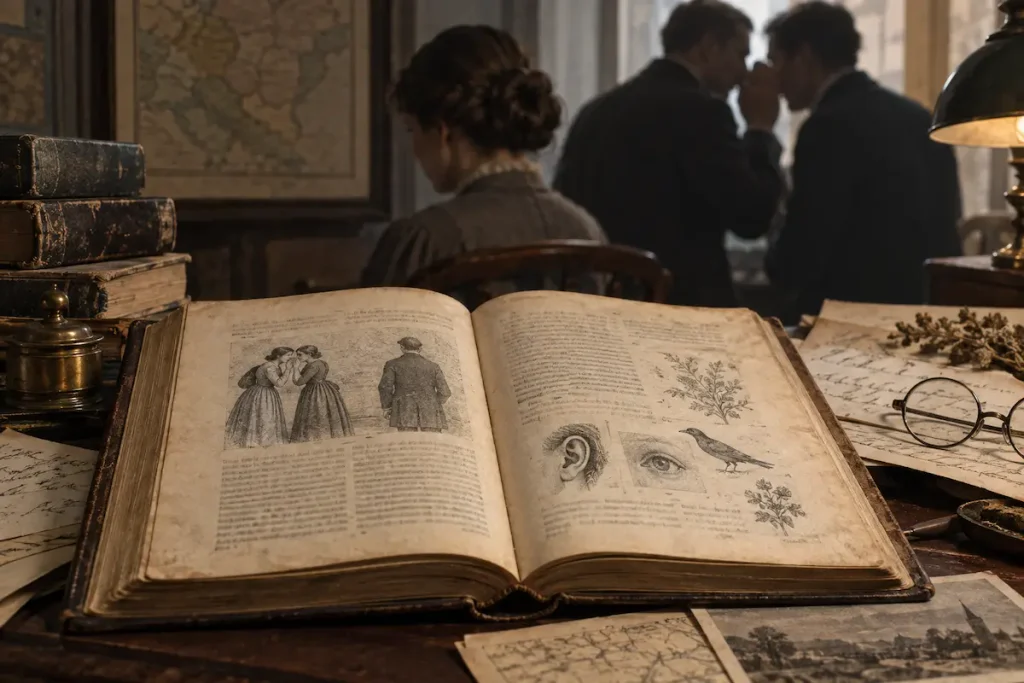
This makes the hiccup tradition unusually useful for comparison with the old belief that a burning ear means someone is talking about you. Both turn an involuntary body sensation into a story about unseen social attention. The details, however, change from source to source.
Why Guessing a Name Matters
The name-guessing ritual appears in more than one version, but it does not always identify the same kind of person. In the Hungarian archive record, the guessed name belongs to whoever is thinking of you. In Bonnerjea’s Macedonian entry, the name belongs to the supposed backbiter.
That contrast is more informative than simply listing “meanings.” The ritual structure stays similar while the social interpretation flips from attention to hostility. Folklore can preserve a recognizable pattern even when the explanation attached to that pattern changes.

Where Curses Enter the Story — and Where the Evidence Stops
The curse connection needs tighter wording than the gossip connection. The strongest verified bridge is the Dartmouth hiccup entry described above. The informant linked the negative-thinking superstition to the evil eye and said her grandmother had described the hiccup belief as an extension of it. In the same archive’s separate material on the evil eye, that belief is explicitly framed as a curse capable of bringing harm or bad luck.
That gives us a documented overlap between hiccup folklore and a curse tradition, but it does not justify the broader claim that hiccups were generally believed to be caused by curses. The hiccup record comes from one informant and one family transmission. Its collector also notes that the informant was uncertain about the origin of the association.
For that reason, “curses” belongs here as a qualified strand of the evidence, not as a universal third rule beside gossip and affectionate remembrance. The source documents a connection; it does not establish a widespread historical doctrine of cursed hiccups.
The Older Elf Connection Is Stranger — and Less Certain
An older linguistic trail leads to the Old English word ælfsogoða. John R. Clark Hall’s A Concise Anglo-Saxon Dictionary glossed the word as “hiccough” and added that it was thought to have been caused by elves.
That definition is striking, but it should not be treated as the final word. Medieval-language scholar Alaric Hall discusses the same term in research on elves in medieval England and notes that ælfsogoða has puzzled lexicographers. The Dictionary of Old English had offered a different interpretation, while Hall argues from the surrounding medical text that the term more likely referred to internal pains of some kind associated with elves.
So it is fair to say that Old English evidence connects an ailment called ælfsogoða with elves, and that Clark Hall specifically rendered it as a hiccup. It is not safe to say that scholars unanimously agree that the word meant the ordinary hiccup understood today.
This is a useful reminder of how folklore changes when dictionary glosses become modern internet facts. “The Anglo-Saxons called hiccups elf-hiccups” sounds memorable, but the surviving evidence is more complicated than that slogan.

What Each Source Actually Lets Us Claim
The most useful way to understand the documented hiccups spiritual meaning is to separate the record from the conclusion we want to draw from it. A single informant can prove that a version was reported; it cannot prove that an entire country believed it. A historical dictionary can preserve an older claim; it cannot automatically settle a disputed translation.
James T. Callow Folklore Archive — Hungary, date learned listed as 1897: Someone is thinking of you; guessing the person may stop the hiccups. This safely supports a documented Hungarian-linked archive variant, not a universal Hungarian belief.
USC Digital Folklore Archives — family-transmitted belief reported in 2012: Someone who loves you is thinking of you. This supports an affectionate family version of the superstition.
Dartmouth Folklore Archive — family traditions collected in 2016 and 2018: Someone remembers or misses you, or someone close thinks of you negatively. These are documented remembrance and negative-attention variants, not universal national rules.
Bonnerjea, 1927 — comparative superstition dictionary: Thinking of you in some entries; a backbiter in the Macedonian entry. This provides historical documentation that the meanings were not uniform.
Clark Hall and Alaric Hall — Old English lexical and medieval-text evidence: Ælfsogoða is associated with elves, while the exact ailment remains disputed. This gives us an elf-related historical layer that requires lexical caution.
This same source-first method is useful with other superstitions. The meaning of an itching left palm, for example, also changes with the cultural rule being cited, and a household omen like a picture falling off the wall splits into eight recorded variants in a single 1920 collection. Variation is not a problem to hide; it is part of the evidence.

Hiccups Spiritual Meaning in Folklore: What Do the Records Actually Say?
The best documented answer to hiccups spiritual meaning is not one message but a family of interpretations. Hiccups have been used in folklore as a sign of absent attention: somebody thinking of you, somebody remembering you, somebody who loves you thinking of you, or somebody speaking badly about you. Some versions add a name-guessing ritual. One modern archive record links a negative version to evil-eye belief, creating a limited bridge to curse folklore. Much older English material also connects an ailment called ælfsogoða with elves, although scholars do not agree that the term maps neatly onto the modern hiccup.
If you prefer the romantic “someone misses you” reading, the closest documented support is the affectionate and remembrance branch of the tradition. If you prefer the gossip reading, there is historical material for that too. What the sources do not give us is a reliable way to use the hiccup itself to determine which story, if any, applies to a real person or moment.
That is what makes the folklore interesting: the same tiny interruption of the body became, in different records, a sign of love, memory, gossip, supernatural harm, or an elf-related ailment. The evidence is richest when those differences are preserved rather than compressed into a single spiritual meaning.
Health note: This article discusses folklore, not medical causes or treatment. Mayo Clinic guidance recommends contacting a health care provider if hiccups last more than 48 hours or are severe enough to interfere with eating, sleeping, or breathing.




Alex Turner
Alex Turner is the editorial pen name used for articles published on Signs of Universe. The website covers dreams, symbolism, and cultural interpretations for informational and reflective purposes. Alex Turner is not a medical, mental health, scientific, or spiritual authority.