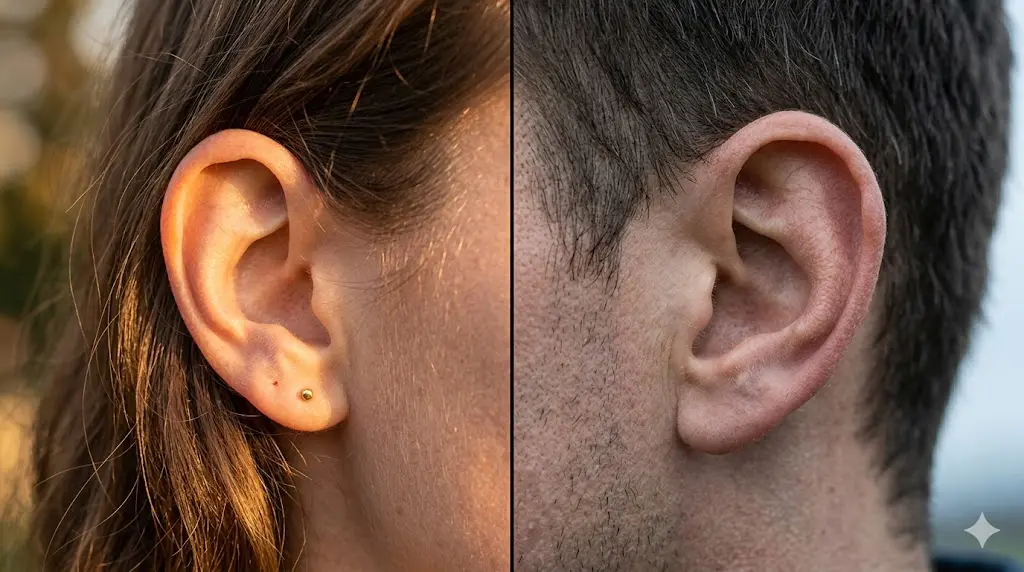
Right or Left Ear Burning: Spiritual Meaning and Whether Someone Is Talking About You
A suddenly hot or burning ear can feel unusually specific. The useful first question is not whether the sensation is “only physical” or “definitely spiritual,” but what can actually be observed: which ear is affected, whether the skin is red, how long the episode lasts, what happened immediately before it, and whether pain, discharge, hearing changes, headache, or jaw discomfort occur with it.
The right-versus-left interpretation belongs to folklore and symbolic practice. It can be explored as cultural meaning, but it is not a diagnostic rule and cannot identify what another person is saying, thinking, or planning.
That specificity is what most articles miss.
This article separates two different kinds of information. Medical evidence can help explain symptoms and guide decisions about care. Folklore can show how people have interpreted the experience, but it does not establish a supernatural cause. Keeping those categories separate makes the article more useful and reduces the risk of treating a health symptom as a message.
It is also worth noting that several physical conditions can produce an ear burning sensation that perfectly mimics the spiritual one. Knowing the difference between the two really matters before you start drawing any conclusions.
Timing, frequency, visible changes, associated symptoms, and possible triggers are more informative than a single episode. Those details can help a healthcare professional evaluate a recurring problem. Emotional context may still be useful for personal reflection, but it cannot determine the physical cause.
The Physical Side First: What Medicine Actually Says About Ear Burning
The sensation is real. That’s the starting point — because dismissing ear burning as “just nerves” or jumping straight to spiritual explanations without acknowledging the physical layer produces incomplete answers either way.
Medically, ear burning is well-documented. It has specific triggers, specific patterns, and specific characteristics that distinguish it from other ear sensations.
When It’s Just Your Body Doing Body Things
The ear and the surrounding tissue are heavily vascularized — meaning they’re full of blood vessels that respond quickly to temperature changes, emotional states, and hormonal shifts.
Blushing, for example, doesn’t just affect the face. The ears flush simultaneously in most people, producing a burning sensation that has nothing to do with who’s talking about you and everything to do with your autonomic nervous system reacting to embarrassment, anxiety, or sudden temperature change.
The same mechanism fires when you go from a cold environment into a warm one, when your blood pressure spikes, or when you’re physically exerting yourself. The sensation in these cases is bilateral — both ears at once — and it fades within minutes as circulation normalizes.
One-sided symptoms can feel meaningful, but asymmetry does not make an episode intentional or supernatural. A unilateral pattern is still a physical detail worth recording, especially if it recurs.
The Specific Conditions That Cause Ear Burning — And How to Recognize Them
Several medical conditions produce localized ear burning that isn’t connected to general flushing:
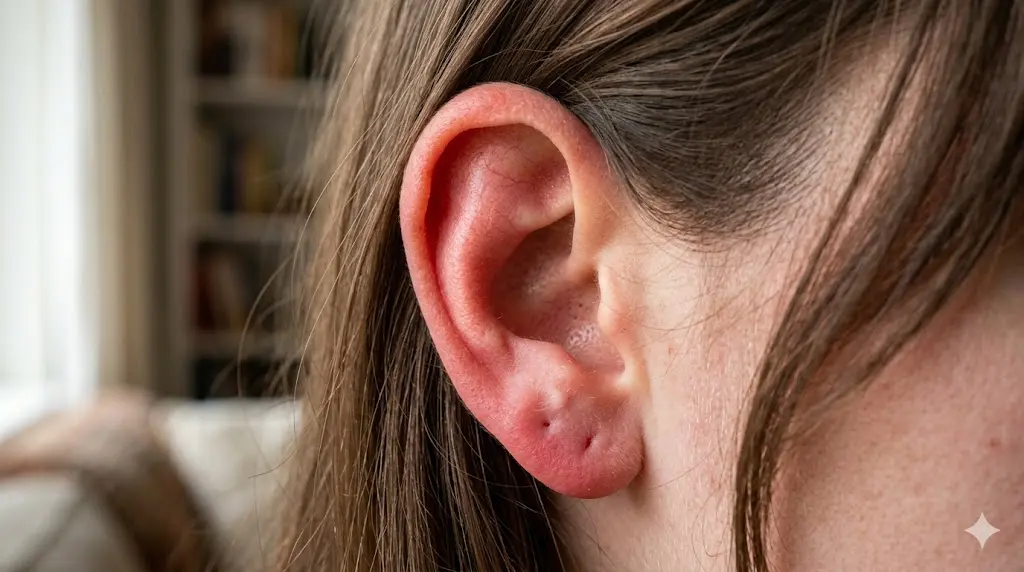
Red ear syndrome is a reported condition involving attacks of burning pain and reddening of one or both external ears. Reviews describe primary and secondary forms and associations that can include migraine or upper-cervical and temporomandibular disorders; diagnosis belongs to a clinician because similar symptoms can have other causes. The condition is uncommon and the published evidence is largely based on case reports and case series. See the 2024 review indexed by PubMed.
Auriculotemporal nerve irritation — caused by jaw tension, TMJ dysfunction, or dental issues — routes through the ear and can create burning sensations that seem to come from nowhere. People with chronic jaw clenching often experience this without connecting it to the jaw.
Rosacea can extend to the ears, producing episodic burning without visible redness that’s detectable from the outside.
Hormonal fluctuations — particularly during perimenopause or during the luteal phase of the menstrual cycle — cause the ears to become temporarily hypersensitive.
Physical causes should be considered even when no trigger is immediately obvious. The absence of an explanation after one episode does not establish a spiritual cause; it usually means that more observation is needed.
💡 The Spiritual Side: Why This Sensation Has Been Interpreted for Centuries
A physical explanation can account for the sensation without explaining why a person chooses a particular cultural meaning for it. The cultural interpretation is part of the history of the belief; it is not evidence that isolated cultures detected the same external signal.
The repeated use of body sensations in folklore is worth studying as culture and psychology. Repetition across retellings does not, by itself, validate a supernatural mechanism.
Right Ear Burning Spiritual Meaning
In some Western esoteric systems, the right side symbolizes outward action, conscious expression, or traditionally “masculine” qualities. These associations vary by source and community, so they are better treated as symbolic vocabulary than universal rules.
In a common folk interpretation, a burning right ear is associated with favorable attention or praise. This describes the tradition; the sensation itself cannot verify that a conversation is taking place.
Some modern retellings narrow that symbolism further and associate the right ear with being praised or defended. There is no reliable way to infer a distant conversation from an ear sensation, so this reading is safest as a reflection prompt: “Am I seeking reassurance about how others see me?”
Some numerology and energy-oriented sources frame right-ear warmth as encouragement or alignment. That can be used as a personal symbol, but it should not be presented as confirmation from a higher source or as proof that a current decision is correct.
The sensation tends to be brief, warm rather than sharp, and it often arrives when you’re already in a positive or neutral emotional state.
Left Ear Burning Spiritual Meaning
Some symbolic systems assign the left side a different role, but the meanings are not consistent across every tradition.
Within those systems, the left may symbolize receptivity, intuition, the subconscious, or traditionally “feminine” qualities. These are interpretive associations, not facts about anatomy or a method for reading another person’s intentions.
The same “what comes in” logic explains why an itchy left palm has been read for centuries as money arriving on the receiving hand.
A familiar folk saying links a burning left ear with criticism or gossip. It is a story people use to explain the experience, not evidence that someone is speaking negatively.
European folklore often gives the left side a cautionary meaning; the English word “sinister” also came through Latin language associated with the left. That historical association helps explain later symbolism, but it does not establish what caused an individual episode.
Some contemporary energy-based interpretations call left-ear warmth a warning about an interpersonal situation. Because the sensation cannot reveal another person’s intentions, a grounded response is to evaluate actual behavior, direct communication, and boundaries rather than assume hidden hostility.
As a reflection prompt, the left-ear story may invite someone to ask whether there is a real, observable concern in a relationship. It should not be used as a report of what another person feels or plans.
What the Side Tells You — and Why It Changes Everything
The side distinction is central to this particular folk framework, but it remains a feature of the story rather than a validated detection system.
In the simplified folk version, right is associated with favorable attention and left with caution or criticism. Other sources reverse or modify these meanings, which is one reason not to treat the rule as objective.
Recording which side is affected can be medically and practically useful. Assigning a positive or negative outcome solely from that side is not reliable; look for physical triggers and observable interpersonal facts instead.
In the folk story, side changes the symbolism. In real-world evaluation, side is one data point among duration, redness, pain, triggers, and associated symptoms.

The “Someone Is Talking About You” Theory: Folklore, Fact, or Something In Between?
The saying that a hot or burning ear means someone is talking about you is best understood as folklore, much like documented hiccup folklore. Its persistence can be culturally interesting without turning the claim into a testable fact about a conversation happening elsewhere.
Where This Belief Actually Comes From (It’s Older Than You Think)
Ancient and later European writings include beliefs that sensations in the ears relate to absent people speaking about someone. A frequently cited passage associated with Pliny the Elder concerns ringing ears and absent speech; it should not automatically be treated as proof of the modern burning-ear formula or its fixed right-positive and left-negative rule.
Similar sayings occur in more than one community, but claims that every version developed independently or used an identical left/right rule require evidence that is rarely supplied. Cultural repetition shows that a story travels and persists; it does not prove the proposed mechanism.
What Different Traditions Say — and Where They Agree
Versions of the saying do not form one universal rule. A careful comparison should record differences instead of claiming agreement that has not been demonstrated:
- Some versions distinguish right from left, while others mention only ringing, itching, warmth, or a generally “burning” ear.
- Positive and negative assignments can change by region, family, language, or modern online retelling.
- The supposed source may be spoken words, thoughts, praise, criticism, or undefined attention, depending on the version.
- A ritual response—such as touching the ear—belongs to the custom; it does not test whether the claim is true.
Where traditions diverge is in the specifics of who’s talking. Some traditions suggest it’s always someone you know personally. Others extend it to anyone who knows of you — including people you’ve never met who’ve heard your name or encountered your work. A few traditions connect it specifically to people who are thinking about you intensely without necessarily speaking aloud.
Different retellings disagree about whether the story concerns spoken words, thoughts, praise, criticism, or general attention. That variation is evidence that this is an evolving symbolic tradition, not a reliable way to identify a specific event.

⚠️ Physical vs. Spiritual: How to Tell Which Explanation Actually Fits Your Situation
A useful framework is observational rather than “diagnostic”: document the episode, look for ordinary triggers, note accompanying symptoms, and decide whether medical assessment is warranted. Symbolic reflection comes after safety, not in place of it.
Keeping Medical Evidence and Symbolic Meaning Separate
A burning ear can follow flushing, temperature changes, skin irritation, pressure, jaw activity, or other physical factors. An emotionally loaded moment may make the event more memorable, but timing alone cannot identify its cause.
These are not competing diagnoses to score at home. If the sensation is frequent, painful, one-sided, or accompanied by redness, hearing changes, pressure, discharge, swelling, rash, severe headache, weakness, or other concerning symptoms, contact a qualified healthcare professional. Personal symbolism may be considered afterward, but it cannot replace assessment.
When a Physical Sensation Also Feels Personally Meaningful
This category gets almost no coverage, and it’s probably the most common situation.
Heightened body awareness, or interoceptive attention, can make subtle physical sensations more noticeable. That does not demonstrate that the nervous system is receiving information about distant conversations or another person’s energy.
A person may choose an energetic metaphor to describe the experience, but a metaphor should not be confused with a biological mechanism. The autonomic nervous system responds to many internal and environmental factors; it has not been established as a translator of spiritual messages.
This doesn’t require believing in anything supernatural. It only requires acknowledging that human beings pick up on social and interpersonal information through channels that aren’t fully mapped by current science — and that the body communicates that information in ways the conscious mind hasn’t learned to decode yet.

What to Do When Your Ear Burns — Specific Actions for Each Scenario
Generic advice doesn’t work here because the correct response depends entirely on which category applies. These actions are specific to this experience — they wouldn’t make sense in any other context.
If It’s Physical
Track the pattern before assuming a cause. For two weeks, note the affected side, start and end time, visible redness, pain level, activity, room or outdoor temperature, recent exercise, food or alcohol, skincare or hair products, stress, headache, jaw clenching, and any hearing change. A record will not diagnose the problem, but it gives a clinician more useful information than memory alone.
Check for jaw tension as a hidden driver. Most people don’t connect ear sensations to the jaw, but the auriculotemporal nerve runs directly from the jaw joint to the ear. If you wake up with jaw soreness, headaches, or tooth sensitivity — and your ear burns unpredictably — a dentist or physical therapist assessment of TMJ function may resolve the sensation entirely.
If episodes are frequent, painful, prolonged, or associated with headache, neck pain, or jaw symptoms, ask a healthcare professional how they should be evaluated. Red ear syndrome is uncommon and should not be self-diagnosed from an online description.
If You Choose a Symbolic Interpretation
Note the context without turning it into proof. What were you doing, feeling, eating, applying to the skin, or exposed to immediately before the sensation? This information may reveal a trigger or a pattern; it is not the hidden “content” of a message.
Pay attention to which ear and to verifiable context. For interpersonal concerns, rely on what people actually say and do, ask direct questions when appropriate, and set boundaries based on evidence—not on an ear sensation.
Avoid chasing confirmation. Asking leading questions or waiting for a predicted event can make almost any later conversation feel like proof. Write down the prediction before checking it, include occasions when nothing follows, and consider alternative explanations; this is a simple way to reduce confirmation bias.

A Practical Decision Guide Before Interpreting the Sensation
1. Check what is visible. Use a mirror or ask someone you trust whether the outer ear is red, swollen, irritated, blistered, or affected by a rash. Do not put objects or unprescribed remedies into the ear canal. Visible skin changes can be useful information for a pharmacist or clinician, and a photo taken during an episode may help if the appearance resolves before an appointment.
2. Check associated symptoms. Record pain, tenderness, itching, discharge, reduced hearing, ringing, dizziness, headache, facial weakness, jaw pain, neck pain, fever, or a recent injury. The point is not to match yourself to a diagnosis online; it is to notice details that change how urgently professional advice may be needed.
3. Review plausible triggers. Consider sun and heat exposure, a hot shower, exercise, alcohol, spicy food, stress, tight headphones, hats, pillows, hair products, cosmetics, new jewelry, insect bites, jaw clenching, and recent dental work. Note what happened before several episodes rather than building a conclusion from one occurrence.
4. Decide on the next safe action. A brief isolated episode without other symptoms may only need observation. Repeated, worsening, painful, or prolonged episodes—and episodes involving hearing changes, discharge, swelling, significant headache, neurological symptoms, or signs of infection—should be discussed with an appropriate healthcare professional. If symptoms are sudden or severe, use local urgent-care guidance.
5. Keep symbolism in its proper lane. If the folklore is meaningful to you, turn it into a question you can answer without pretending the sensation proved anything: “Do I have an unresolved communication concern?”, “Am I depending too much on imagined approval?”, or “Is there a conversation I can approach directly?” A useful reflection produces a concrete, reality-based action; it does not encourage suspicion about unnamed people.
6. Test patterns honestly. Include episodes that do not match the story, not only memorable coincidences. If you believe right-ear warmth predicts praise, write that prediction before learning what happened and record occasions when no praise appears. This does not disrespect the tradition; it helps distinguish a personally useful symbol from a claim about the outside world.
What a Symptom Log Can—and Cannot—Show
A log is most useful when it is descriptive. “Left ear became visibly red for 18 minutes after a hot shower; no pain; new hair product used” is more actionable than “a warning arrived.” Concrete notes make triggers easier to compare and reduce the temptation to reconstruct the event around a later coincidence.
The record can show frequency, duration, repeated exposures, and associated symptoms. It cannot prove that another person was thinking about you, and it cannot rule out a medical issue. If a pattern worries you, bring the record and, when appropriate, a photo of visible changes to a qualified professional.
For a symbolic reading, keep a separate column labeled “personal reflection.” This preserves the meaning the experience has for you without mixing belief with health evidence. A reflection such as “I feel uncertain about a friendship and need a direct conversation” is useful because it identifies your own concern and a responsible next step; “someone is secretly attacking me” is not supported by the sensation.
❓ FAQ — Right or Left Ear Burning Spiritual Meaning
What does it mean when your right ear burns suddenly? Physically, the sensation has many possible causes and cannot be identified from the side alone. In folklore, the right ear is often associated with favorable attention, praise, or being defended. That is a symbolic tradition, not evidence that someone is currently discussing you. Recurrent or painful episodes deserve medical attention.
What does it mean when your left ear burns? Folklore often associates the left ear with criticism, gossip, or caution, although versions differ. A burning left ear cannot reveal another person’s words or intentions. Check for visible changes and triggers, and seek professional advice if the symptom persists or comes with other symptoms.
Can ear burning really mean someone is thinking about you? There is no reliable evidence that an ear sensation detects another person’s thoughts or speech. The saying has cultural and symbolic value, but a coincidence is not enough to establish a connection. Use direct communication for relationship questions and medical evaluation for recurring symptoms.
How do I know if my ear burning is physical or spiritual? No feature—one-sidedness, timing, intensity, or absence of an obvious trigger—can prove a spiritual cause. A symptom diary and clinical assessment can help investigate physical causes. A spiritual interpretation is a personal belief and should remain separate from decisions about care.
Does the time of day affect the meaning of ear burning? Folk systems sometimes assign meanings to particular hours, but those schedules are inconsistent and not diagnostic. Time of day is more useful for identifying routines and exposures, such as heat, exercise, products, meals, stress, sleep, or medication timing.
Conclusion
A Grounded Third Option
This subject does not require a false choice. Physical symptoms can be evaluated with evidence, while folklore can be discussed as folklore. The categories can coexist in one article without treating them as equally reliable explanations of cause.
They’re not.
The more careful position is that medical explanation and symbolic interpretation answer different questions. Medicine asks what may be producing the sensation and what action is safe. Symbolism asks what the experience prompts a person to reflect on. Only the first can support a health diagnosis.
What the right or left ear burning tradition offers — much like the right eye twitching as omen belief — isn’t proof of anything supernatural. It offers a structured way of paying attention — to which side, to the timing, to what was occupying your mind in the moment before. That attention is useful regardless of whether you believe in the mechanism behind it.
The ear burned. Something reached you. What matters now is whether you noticed what it was pointing at — and what you’re going to do with that information.
Before you start analyzing your symptoms, please keep in mind that the spiritual, folkloric, and symbolic perspectives we’ve explored here are meant for your own personal reflection and cultural understanding.
While it is fascinating to dive into these traditions alongside the relevant physical explanations, they should never be taken as absolute claims or medical advice.
If you find yourself experiencing persistent, painful, or frequently recurring ear burning, please consult a qualified healthcare provider to rule out any underlying physical conditions.
Related reading: The Emotional Meaning of Physical Pain.




Alex Turner
Alex Turner is the editorial pen name used for articles published on Signs of Universe. The website covers dreams, symbolism, and cultural interpretations for informational and reflective purposes. Alex Turner is not a medical, mental health, scientific, or spiritual authority.