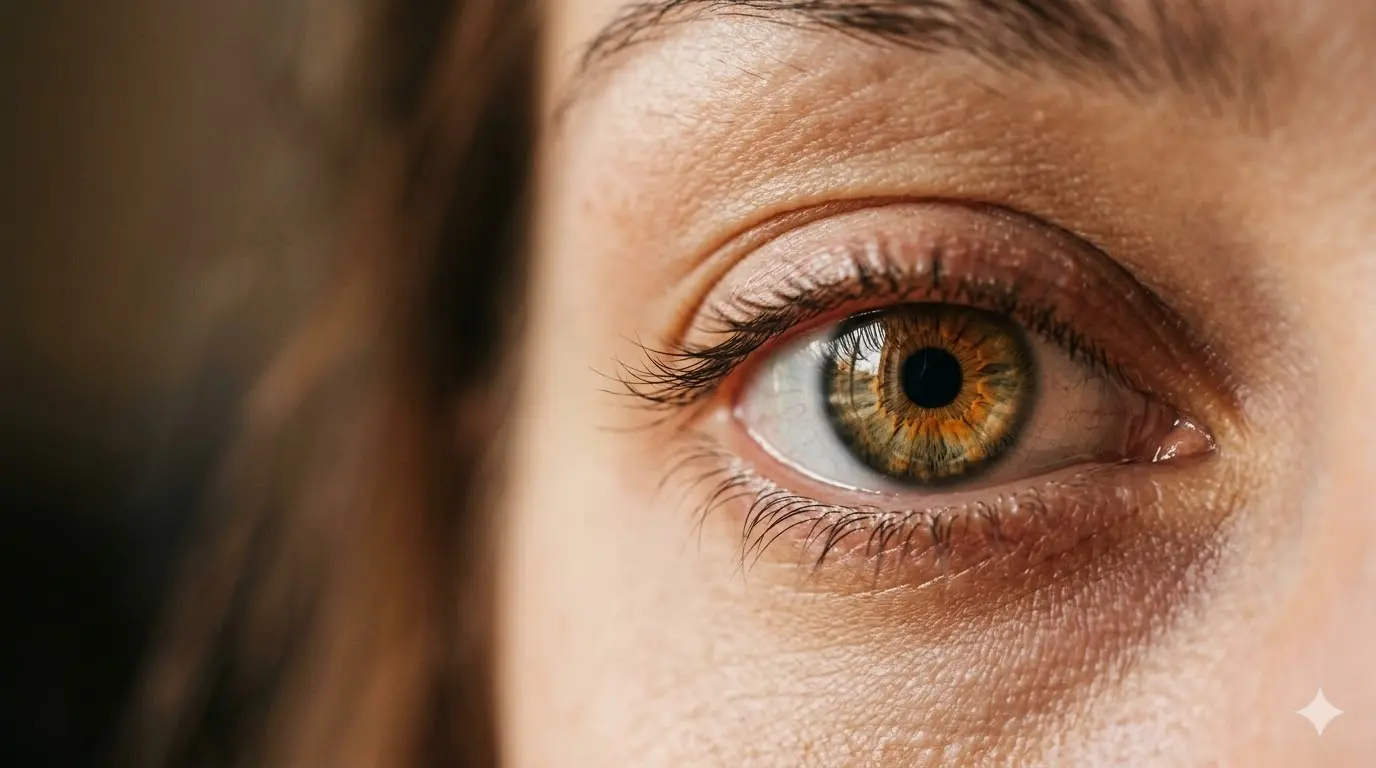

I’ll admit something. The first time my left eye started twitching — not a single flutter, but a relentless, rhythmic spasm that lasted three days — I didn’t Google the spiritual meaning. I pressed my finger against the eyelid and told it to stop, the way you’d scold a malfunctioning appliance.
It didn’t stop. It got worse. And by the second night, I was staring at a screen at 1 AM reading about omens, bad luck, and whether someone I’d wronged was somehow sending this through the ether.
That search led nowhere useful. Every result said the same thing in a different font.
The left eye twitching spiritual meaning that circulates online is either a vague superstition dressed up as ancient wisdom, or a clinical one-liner about caffeine and sleep deprivation that explains the mechanism but ignores the timing entirely.
Neither version accounts for why the twitch started on that specific day, during that specific week, while you were absorbing that specific situation you hadn’t fully processed yet.
The real signal lives in the gap between what the superstition claims and what the nerve is actually doing — between the mythology your search results handed you, the biological alarm your orbicularis oculi muscle is firing, and the emotional input your left eye has been absorbing without your conscious permission. That’s where the answer is. Not in a superstition. Not in a pamphlet. In the intersection.
What Most People Believe About Left Eye Twitching (And Why It’s Incomplete)
The orbicularis oculi is a paper-thin ring of muscle surrounding your eye. It contracts thousands of times a day during normal blinking — and you never notice. When it starts firing involuntarily, producing that rhythmic, uncontrollable twitch, the muscle is doing something it wasn’t asked to do. That distinction between voluntary and involuntary contraction is where every shallow explanation falls apart.
People land on one of two stories. The spiritual one or the medical one. Both are half-built houses.
The Superstition Layer
In traditional Chinese physiognomy — not a vague “Eastern belief” but a specific diagnostic system called Mian Xiang dating to the Han Dynasty — the left eye is classified as the receiver. Left-side signals relate to incoming energy: what’s arriving, what’s being delivered to you, what’s approaching without your initiation.
A left eye twitch in this system doesn’t mean “bad luck.” It means something is coming toward you that your conscious mind hasn’t registered yet. The nature of what’s coming depends on the hour of the twitch — a system called Shi Chen divides the day into twelve two-hour blocks, each carrying a different interpretation for left versus right eye spasms.
That’s specific. That’s a framework with internal logic. And it’s been flattened by the internet into “left eye twitching = bad omen,” which is about as useful as saying “fever = sick.” Technically not wrong. Practically useless.
The Quick-Fix Medical Label
The clinical explanation is myokymia — involuntary fasciculation of the eyelid muscle, typically attributed to fatigue, caffeine, alcohol, dry eyes, or stress.
All of those are real triggers. None of them explain the selectivity.
If caffeine caused eye twitching, both eyes would twitch. If sleep deprivation were the sole driver, the twitch would correlate with your worst nights, not with emotionally loaded weeks where you slept fine but absorbed something your system couldn’t metabolize.
Myokymia describes what is happening. It doesn’t touch why it’s happening now, to this eye, during this specific period of your life. The medical label is the floor, not the ceiling.
⚡ What Left Eye Twitching Actually Signals
Here’s what the superstition doesn’t know and the medical pamphlet doesn’t care about: the left eye and the right eye are not neurologically identical in their relationship to the autonomic nervous system.
The left side of the face is predominantly innervated by the right hemisphere of the brain — the hemisphere associated with emotional processing, spatial awareness, nonverbal communication, and the reception of sensory-emotional input. When the left eyelid twitches involuntarily, the signal is traveling through a neural pathway that’s more emotionally loaded than its right-side counterpart.
That’s not mysticism. That’s lateralized brain function.
The Nervous System Alarm You’re Misreading
Fasciculation — the clinical term for involuntary muscle twitching — occurs when a motor nerve fires without a voluntary command. In the eyelid, this happens when the facial nerve (cranial nerve VII) becomes hyperexcitable.
What makes a nerve hyperexcitable? Sustained activation without adequate discharge.
Your autonomic nervous system has two branches. The sympathetic branch accelerates — fight or flight. The parasympathetic branch decelerates — rest and digest. When you’re absorbing emotional input continuously without processing it (scrolling through distressing news, sitting in a toxic work environment, carrying someone else’s emotional weight without acknowledging your own response), the parasympathetic system struggles to complete its discharge cycle.
The twitch is a discharge attempt. The nerve is firing because the system is overloaded and the energy has to go somewhere. The eyelid — thin, superficial, highly innervated — becomes the path of least resistance.
Your left eye isn’t predicting your future. It’s reporting on your present.
The Emotional Residue Angle
The left eye receives. Not metaphorically — optically. Visual input enters both eyes, but the processing bias of the right hemisphere (connected to the left visual field) skews toward emotional and relational content.
What have you been seeing lately?
Not looking at. Seeing. Absorbing. Witnessing without filtering.
Left eye twitching tends to cluster around periods of passive emotional intake. You watched someone you care about make a destructive decision and said nothing. You sat through a conversation that violated a boundary you didn’t enforce. You’ve been consuming content — visual, emotional, relational — at a rate your processing system can’t match.
The twitch isn’t random. It’s the eye’s version of a full inbox notification. The organ responsible for receiving visual-emotional input is spasming because the input queue is backed up and nothing is being filed.
How to Test What Your Left Eye Twitch Is Actually About
Generic advice says “reduce stress.” That’s like telling someone with a leak in their ceiling to “reduce water.” The question that matters is where the water is coming in.
Left eye twitching has a source. Finding it requires specificity, not relaxation platitudes.
The 48-Hour Tracking Method
The next time the twitch starts, note three things immediately. Not later. Not when you “get a chance.” In the moment the spasm fires.
One: What time is it? Left eye twitches are not randomly distributed across the day. They cluster. Morning twitches (6-10 AM) correlate with anticipatory stress — something you’re dreading that hasn’t happened yet. Afternoon twitches (1-4 PM) correlate with accumulation — you’ve been absorbing input all day and the system just hit capacity. Evening twitches (7-11 PM) correlate with unprocessed residue from the day — what you witnessed but never reacted to.
Two: What were you looking at — literally — in the five seconds before the twitch fired? Screen content, a person’s face, a document, a message, a physical environment. The twitch is a response to input. The input that preceded it by seconds is almost always the trigger your conscious mind dismissed as irrelevant.
Three: What emotional tone were you absorbing passively? Not feeling. Absorbing. Were you in a meeting where tension was present but unaddressed? Reading a message that bothered you but that you responded to with “lol ok”? Watching someone else’s crisis unfold while pretending you were unaffected?
Track these three data points for 48 hours. The pattern will surface faster than you expect — because the twitch isn’t random and neither are its triggers.
The Input Audit
Once you have 48 hours of data, look for the common denominator. It won’t be caffeine. It’ll be a specific category of input you’re consuming in excess without metabolizing.
For some people, it’s visual overstimulation — eight hours of screen time processing information that demands emotional response but receives none.
For others, it’s relational absorption — carrying the emotional state of someone close to you as if it were your own, without any boundary separating their distress from your nervous system’s response to it.
For a smaller group, it’s witnessing without acting — repeatedly seeing something that conflicts with your values or your sense of safety and doing nothing about it because the situation “isn’t your problem.”
The left eye twitch points at the category. The 48-hour data tells you which one. And the response isn’t generic — it’s specific to cutting the supply line of whatever input your system is choking on.
What Happens When You Keep Ignoring It
The twitch is polite at first. A flutter. Easy to dismiss. Easy to press your finger against and pretend it stopped.
It doesn’t stop. It downgrades from a request to a demand.
Persistent myokymia that lasts beyond two weeks without resolution can progress to blepharospasm — sustained, forceful involuntary closure of the eyelid that’s no longer a twitch but a spasm strong enough to interfere with vision. Blepharospasm recruits neighboring muscle groups. The eyebrow. The cheek. The temple.
From there, the tension migrates. Periorbital muscle tension feeds directly into the temporalis muscle — the large flat muscle covering the side of your skull. Chronic temporalis tension is one of the most common origins of tension-type headaches. The headache you’ve been blaming on screen time may have started as the eye twitch you’ve been ignoring for a month.
The escalation ladder is mechanical, not mystical: fasciculation → sustained spasm → muscle group recruitment → referred tension → headache pattern → chronic facial tension.
At each rung, the signal is the same: unprocessed input is accumulating and the discharge pathway is overloaded.
When to seek medical evaluation: If the twitch persists daily for more than three weeks, spreads to other facial muscles, causes the eyelid to close completely, or is accompanied by facial drooping or weakness, stop reading articles and see a neurologist. Benign fasciculation is overwhelmingly the most common cause. But hemifacial spasm, blepharospasm, and rarely, early cranial nerve pathology present with the same initial symptom. The spiritual meaning of a persistent twitch might be “go get an MRI.”
❓ FAQ — Left Eye Twitching Spiritual Meaning
Does left eye twitching mean someone is talking about you? This belief is widespread but unsupported by any consistent interpretive framework. In some folk traditions, left eye twitching for women means someone is speaking well of them, while for men it means the opposite — and other traditions reverse this entirely. The inconsistency across systems suggests the belief is a projection: the twitch is uncomfortable, and assigning it a social cause (gossip, attention, being observed) gives the sensation a story that feels more manageable than “your nervous system is overloaded.” The twitch is about your input, not someone else’s output.
Is left eye twitching a warning of something bad coming? In the Shi Chen system of Chinese physiognomy, the interpretation depends entirely on the time of day the twitch occurs — some hours are considered favorable, others unfavorable. Stripped of that specificity, the internet reduced the entire system to “left = bad.” That’s a corruption, not a tradition. The more useful interpretation: the twitch is warning you that something in your current pattern of emotional input is unsustainable. That’s not a prediction about the future. It’s a report on the present.
Why does my left eye twitch more at night? Evening twitching correlates with accumulated, unprocessed input from the day. Your sympathetic nervous system ran at an elevated level for hours — meetings, screens, conversations, emotional exchanges — and the parasympathetic system is attempting to discharge the excess activation as you wind down. The eyelid, being the thinnest and most superficially innervated muscle in the face, becomes the discharge point. Night twitches are the nervous system’s version of a computer running background updates it couldn’t process during active use.
Can left eye twitching be spiritual and medical at the same time? Yes — and framing them as mutually exclusive is the most common mistake. The muscle is twitching because of a real physiological mechanism (nerve hyperexcitability from sustained activation). The question of why that activation is happening now, in response to this specific period of your life, is where the spiritual and somatic interpretations converge. The biology explains the how. The timing and context explain the why. Both layers are present simultaneously.
How long does left eye twitching usually last? Benign myokymia typically resolves within a few days to two weeks once the contributing factors are addressed. If the twitch persists beyond three weeks of daily occurrence, medical evaluation is warranted. In the somatic-spiritual framework, duration correlates with how long the triggering input continues unaddressed — the twitch rarely outlasts the resolution of whatever emotional or sensory overload initiated it.
The Eye That Won’t Stop Asking
Left eye twitching is not an omen. It’s not a curse. It’s not your body malfunctioning for no reason.
It’s a question your nervous system is asking because your conscious mind refused to.
The question is always the same: what are you receiving that you’re not processing? What are you seeing, absorbing, witnessing, carrying — and pretending isn’t affecting you?
The superstition gives you a story. The medical label gives you a mechanism. Neither gives you the answer. The answer is in the data — the specific hour, the specific input, the specific emotional residue your system flagged and your awareness skipped over.
Next time your left eye twitches, don’t ask what it means. Ask what you were looking at. The eye already knows. It’s been trying to tell you.
The perspectives in this article treat left eye twitching as a convergence point — where involuntary nerve firing meets emotional pattern and where somatic experience meets symbolic interpretation. None of this replaces an ophthalmologist’s exam or a neurologist’s assessment. An eyelid spasm that persists, worsens, or recruits other muscles is a clinical event first and a symbolic one second. Let the body get its medical answer before you ask it for a spiritual one.
Deepen your understanding of your body’s energetic signals:
- Explore the emotional side of energy shifts and read Sudden Wave of Sadness for No Reason: Are You Absorbing Empathic Energy?
- Learn how to protect your personal space and discover Can Someone Manifest You Against Your Will? The Truth About Energetic Boundaries