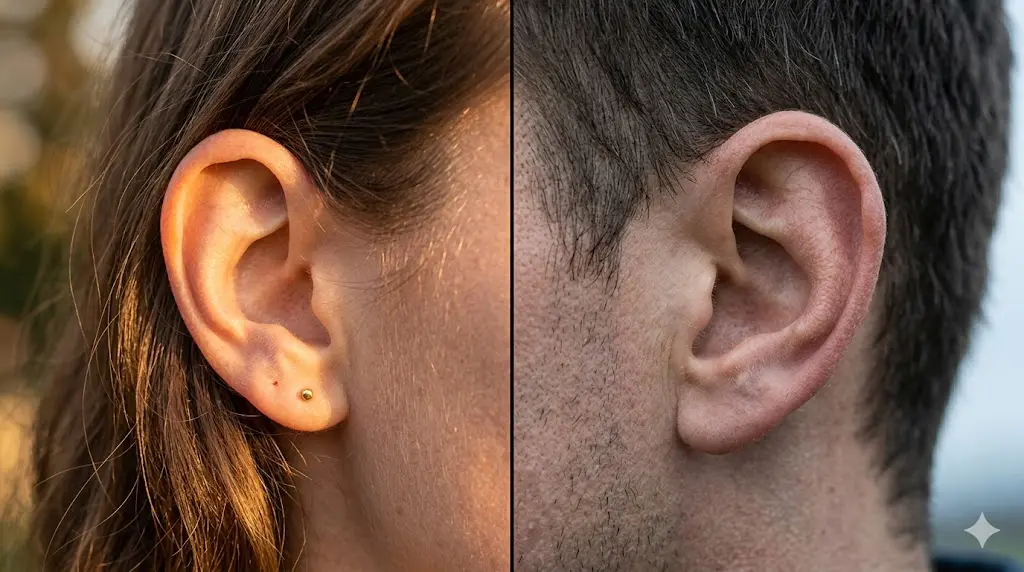
Right or Left Ear Burning: Spiritual Meaning and Whether Someone Is Talking About You
Nearly 62% of people who experience sudden ear burning report searching for an explanation within minutes — not because they’re superstitious, but because the sensation feels specific in a way that generic “it’s just your body” explanations don’t quite satisfy.
The right or left ear burning spiritual meaning is one of those topics that sits at an unusual crossroads: ancient enough to appear in Roman folklore, persistent enough to survive into the age of WebMD, and specific enough that the side of the body actually changes the interpretation.
That specificity is what most articles miss.
Here is exactly what the physical and spiritual explanations each get right, and where they tend to fall short without one another. For starters, right ear burning and left ear burning actually carry entirely distinct meanings in most spiritual traditions, and treating them as interchangeable will usually lead you to the wrong interpretation. Interestingly, the old belief that someone is talking about you predates Christianity and appears independently in cultures that had absolutely no historical contact.
It is also worth noting that several physical conditions can produce an ear burning sensation that perfectly mimics the spiritual one. Knowing the difference between the two really matters before you start drawing any conclusions.
Ultimately, the timing, frequency, and emotional context of the sensation will shift the interpretation more than the sensation itself. Luckily, there are specific, concrete ways to respond to each scenario, whether the cause turns out to be physical, spiritual, or a mix of both simultaneously.
The Physical Side First: What Medicine Actually Says About Ear Burning
The sensation is real. That’s the starting point — because dismissing ear burning as “just nerves” or jumping straight to spiritual explanations without acknowledging the physical layer produces incomplete answers either way.
Medically, ear burning is well-documented. It has specific triggers, specific patterns, and specific characteristics that distinguish it from other ear sensations.
When It’s Just Your Body Doing Body Things
The ear and the surrounding tissue are heavily vascularized — meaning they’re full of blood vessels that respond quickly to temperature changes, emotional states, and hormonal shifts.
Blushing, for example, doesn’t just affect the face. The ears flush simultaneously in most people, producing a burning sensation that has nothing to do with who’s talking about you and everything to do with your autonomic nervous system reacting to embarrassment, anxiety, or sudden temperature change.
The same mechanism fires when you go from a cold environment into a warm one, when your blood pressure spikes, or when you’re physically exerting yourself. The sensation in these cases is bilateral — both ears at once — and it fades within minutes as circulation normalizes.
What people tend to notice and interpret is the unilateral version: one ear burning while the other is completely unaffected. That asymmetry is what makes the experience feel intentional rather than physiological.
The Specific Conditions That Cause Ear Burning — And How to Recognize Them
Several medical conditions produce localized ear burning that isn’t connected to general flushing:
Red Ear Syndrome is the most directly relevant. First described by neurologist B.T. Lance in 1994, it produces episodes of unilateral ear redness and burning that last anywhere from seconds to hours. The cause is still not fully understood — it appears connected to trigeminal nerve activation, upper cervical spine issues, or migraine variants. It’s rare, but it exists, and it produces exactly the sensation most people associate with spiritual significance.
Auriculotemporal nerve irritation — caused by jaw tension, TMJ dysfunction, or dental issues — routes through the ear and can create burning sensations that seem to come from nowhere. People with chronic jaw clenching often experience this without connecting it to the jaw.
Rosacea can extend to the ears, producing episodic burning without visible redness that’s detectable from the outside.
Hormonal fluctuations — particularly during perimenopause or during the luteal phase of the menstrual cycle — cause the ears to become temporarily hypersensitive.
The physical explanation covers a significant percentage of cases. But it doesn’t cover all of them — and it doesn’t explain the timing patterns that people consistently report.

💡 The Spiritual Side: Why This Sensation Has Been Interpreted for Centuries
The physical explanation accounts for the mechanism. It doesn’t account for why this particular sensation — unilateral, sudden, and often timed to emotionally loaded moments — has been interpreted as meaningful across cultures that developed their beliefs in complete isolation from each other.
That convergence is worth taking seriously.
Right Ear Burning Spiritual Meaning
In most Western esoteric traditions, the right side of the body is associated with masculine energy, outward expression, and the conscious, rational dimension of existence. It’s the side connected to action, willpower, and external reality.
When the right ear burns, the traditional interpretation points to positive external attention. Someone is speaking about you — and the content is favorable. Praise, admiration, or a conversation where your name is being invoked in a supportive context.
a burning right ear specifically means someone is defending you — a bit like sensing a person’s attention from far away. Not just complimenting you in passing, but actively standing up for you in a conversation where you’re not present. The right ear burning, in this reading, is the body’s antenna picking up energy directed at your reputation or wellbeing from outside your immediate environment.
There’s a secondary interpretation in numerological and energy-based frameworks: right ear burning can signal that you’re aligned with the correct path and receiving confirmation from a higher source — not a person talking about you, but a kind of energetic acknowledgment that something in your current direction is sound.
The sensation tends to be brief, warm rather than sharp, and it often arrives when you’re already in a positive or neutral emotional state.
Left Ear Burning Spiritual Meaning
The left side carries different energy across virtually every tradition that distinguishes between the two.
In Western esoteric systems, the left side connects to feminine energy, intuition, the subconscious, and receptive modes of being. It’s the side associated with what comes in rather than what goes out.
The same “what comes in” logic explains why an itchy left palm has been read for centuries as money arriving on the receiving hand.
Left ear burning, in most folk traditions, is the less comfortable interpretation: someone is speaking negatively about you. Criticism, gossip, or a conversation where your name appears in an unflattering light.
This interpretation appears independently in Roman superstition — where the left side was associated with bad omens (the word “sinister” derives from the Latin for “left”) — and in Eastern European folk traditions where a burning left ear was a prompt to reconsider your surroundings and who you’d recently trusted with personal information.
Some practitioners in energy-based frameworks interpret left ear burning differently: not as gossip, but as a psychic warning. The left ear as an intuitive receptor picking up on an energetic shift in your environment — someone’s intention or energy changing toward you, which may or may not be expressed in spoken words.
In this reading, left ear burning is less a report of what’s being said and more a heads-up about what someone is feeling or planning.
What the Side Tells You — and Why It Changes Everything
The side distinction isn’t decorative detail — it’s the interpretive axis the entire spiritual framework rotates around.
Right: external, positive, someone speaking well of you or aligned energy confirming your direction. Left: receptive, cautionary, negative speech or a shift in someone’s energy toward you.
Treating them as identical — the way most search results do — collapses the most specific and useful information the tradition offers. If your right ear burns repeatedly during a period when you’re building something new, that carries different weight than repeated left ear burning during a period of interpersonal tension.
The side is the signal. Everything else is context.

The “Someone Is Talking About You” Theory: Folklore, Fact, or Something In Between?
The most widely searched component of this topic deserves its own examination — because the belief that ear burning signals someone talking about you is older, more geographically widespread, and more internally consistent than most people realize.
Where This Belief Actually Comes From (It’s Older Than You Think)
The Roman author Pliny the Elder documented the ear burning belief in Naturalis Historia in 77 AD — making it at minimum a 2,000-year-old idea in the Western tradition. But Pliny wasn’t recording something new. He was cataloging a superstition that was already established enough to be common knowledge.
The specific mechanism — right ear for positive speech, left ear for negative — appears in nearly identical form in British Isles folklore documented in the 17th century, in Slavic folk traditions, in Middle Eastern cultural practices, and in various Indigenous American belief systems. These traditions didn’t share texts. The parallel development of the same specific belief, including the left/right distinction, across disconnected cultures is the detail that makes dismissing it as “just superstition” harder than it first appears.
What Different Traditions Say — and Where They Agree
The convergence points are striking. Across traditions with no documented contact:
- The left/right distinction appears in virtually all of them, with right consistently positive and left consistently cautionary
- The sensation is described as sudden and localized — not a gradual warmth but a specific, often surprising heat
- The belief connects to interpersonal energy — specifically to spoken words and social attention, not to random events
- Several traditions include a counter-response: touching or pulling the affected ear to either acknowledge the energy or redirect it
Where traditions diverge is in the specifics of who’s talking. Some traditions suggest it’s always someone you know personally. Others extend it to anyone who knows of you — including people you’ve never met who’ve heard your name or encountered your work. A few traditions connect it specifically to people who are thinking about you intensely without necessarily speaking aloud.
The spoken-word interpretation is the most common, but the energetic-attention interpretation is the more coherent one — because it doesn’t require someone to be literally speaking your name for the sensation to be triggered.

⚠️ Physical vs. Spiritual: How to Tell Which Explanation Actually Fits Your Situation
This is where generic ear burning articles fail entirely — by presenting the physical and spiritual as mutually exclusive options and leaving you to guess. The more honest framework is a diagnostic one: what are the specific characteristics of your experience, and what do they point toward?
Why the Two Explanations Aren’t Rivals
A burning ear can have an ordinary physical cause — a flush of blood vessels, jaw tension routing through the auriculotemporal nerve, a warm room. It can also arrive at an emotionally loaded moment that folklore has always read as meaningful.
These aren’t competing verdicts you’re meant to score at home. If the sensation is frequent, painful, one-sided, or comes with redness, ringing, or pressure, that’s a conversation for a doctor, not a checklist — and only a healthcare provider can actually tell you what’s physical. The symbolic reading is for reflection afterward, never a substitute for that.
That last point is harder to quantify but consistently reported. People describe the “spiritual” version of ear burning as feeling received, not generated — as if the warmth is coming from outside rather than from within the body.
When Both Explanations Are True at the Same Time
This category gets almost no coverage, and it’s probably the most common situation.
The body and the energetic field aren’t separate systems with a clear firewall between them. A person who is highly sensitive to interpersonal energy — what researchers studying interoception call having high “body awareness” — may experience genuine energetic shifts as physical sensations precisely because their nervous system is calibrated to register subtle environmental information.
In this model, the physical sensation isn’t instead of the spiritual one — it’s the physical form the spiritual information takes when it enters your awareness. The autonomic nervous system becomes the translator.
This doesn’t require believing in anything supernatural. It only requires acknowledging that human beings pick up on social and interpersonal information through channels that aren’t fully mapped by current science — and that the body communicates that information in ways the conscious mind hasn’t learned to decode yet.

What to Do When Your Ear Burns — Specific Actions for Each Scenario
Generic advice doesn’t work here because the correct response depends entirely on which category applies. These actions are specific to this experience — they wouldn’t make sense in any other context.
If It’s Physical
Track the pattern before assuming the cause. Keep a brief log for two weeks: which ear, time of day, what you were doing immediately before, what you’d eaten or consumed, your stress level. Patterns emerge quickly. If the burning correlates reliably with food, stress, or temperature — you have your answer, and it points toward a medical conversation rather than a spiritual one.
Check for jaw tension as a hidden driver. Most people don’t connect ear sensations to the jaw, but the auriculotemporal nerve runs directly from the jaw joint to the ear. If you wake up with jaw soreness, headaches, or tooth sensitivity — and your ear burns unpredictably — a dentist or physical therapist assessment of TMJ function may resolve the sensation entirely.
Rule out red ear syndrome if the episodes are frequent and prolonged. It’s rare, but it’s real, and it’s underdiagnosed because most people either dismiss the sensation or attribute it to non-medical causes. A neurologist familiar with trigeminal neuralgia variants can evaluate it properly.
If It’s Spiritual or Energetic
Note the exact moment — not afterward, but when it happens. The information the spiritual interpretation points to lives in the 30-60 seconds before and during the sensation. What were you thinking about? Who had just crossed your mind? What situation were you mentally processing? That context is the actual content of the message.
Pay attention to which ear and what’s currently happening in your interpersonal landscape. Right ear burning during a period of professional visibility — a project launch, a public move, a social media post gaining traction — carries specific weight: people are engaging with your work or name in ways that are largely positive. Left ear burning during a period of interpersonal tension or after sharing personal information with someone new warrants a quieter kind of attention — not paranoia, but calibrated awareness.
Don’t chase confirmation. One of the most common mistakes people make after an ear burning episode is asking around — “has anyone been talking about me?” That approach almost always produces ambiguous answers that confirm the belief regardless of what’s actually true. Instead, watch for what naturally surfaces over the following 24-48 hours. If someone was genuinely talking about you, it tends to reveal itself without prompting.

❓ FAQ — Right or Left Ear Burning Spiritual Meaning
What does it mean when your right ear burns suddenly? In most spiritual traditions, sudden right ear burning signals that someone is speaking positively about you — praising you, defending you, or discussing you in a favorable light. The right side is associated with outward energy and conscious expression, which is why positive speech is attributed to it. If you’re in a period of professional or social visibility, right ear burning tends to align with that external attention.
What does it mean when your left ear burns? Left ear burning traditionally points to negative speech or gossip — someone talking about you critically or in a way you wouldn’t endorse. Some energy-based frameworks interpret it more broadly as a warning about a shift in someone’s energy or intention toward you, even if it hasn’t been expressed in words yet. The left side’s connection to intuition and receptive energy makes it the more cautionary signal in most traditions.
Can ear burning really mean someone is thinking about you? The idea overlaps with thinking of a person right before they reach out. The “someone talking about you” belief is one of the oldest and most geographically widespread superstitions documented — appearing in Roman records from 77 AD and independently in multiple cultures with no historical contact. Whether the mechanism is literal spoken words or energetic attention varies by tradition, but the core belief is remarkably consistent. Whether you accept it as literal or treat it as a prompt for interpersonal awareness, the belief has a coherent internal logic.
How do I know if my ear burning is physical or spiritual? The clearest physical indicators are: bilateral burning (both ears), visible redness, correlation with food or temperature, and accompanying symptoms like ringing or pressure. The spiritual interpretation is more plausible when the burning is strictly unilateral, arrives without physical triggers, and happens during emotionally neutral moments. When the timing later correlates with interpersonal events you learn about, the spiritual framework gains credibility in that specific case.
Does the time of day affect the meaning of ear burning? Some folk traditions do assign significance to timing — burning in the morning versus evening, for example — but this isn’t consistent across traditions the way the left/right distinction is. The timing matters more for practical purposes: ear burning during sleep or immediately upon waking is more likely physical (circulation changes during rest), while burning during waking hours in calm states more closely fits the spiritual pattern.
Conclusion
The Third Option Nobody Offers You
Most content on this topic forces a choice: either your ear burning is a medical symptom you should Google, or it’s a spiritual sign you should interpret. The framing treats those as competing conclusions.
They’re not.
The more honest position is that the physical and spiritual aren’t rivals — they’re two different resolutions of the same experience. The body picks something up. The nervous system reports it. Whether you call that signal “autonomic response” or “energetic awareness” depends on your framework, not on what’s actually happening.
What the right or left ear burning tradition offers — much like the right eye twitching as omen belief — isn’t proof of anything supernatural. It offers a structured way of paying attention — to which side, to the timing, to what was occupying your mind in the moment before. That attention is useful regardless of whether you believe in the mechanism behind it.
The ear burned. Something reached you. What matters now is whether you noticed what it was pointing at — and what you’re going to do with that information.
Before you start analyzing your symptoms, please keep in mind that the spiritual, folkloric, and symbolic perspectives we’ve explored here are meant for your own personal reflection and cultural understanding.
While it is fascinating to dive into these traditions alongside the relevant physical explanations, they should never be taken as absolute claims or medical advice.
If you find yourself experiencing persistent, painful, or frequently recurring ear burning, please consult a qualified healthcare provider to rule out any underlying physical conditions.




Alex Turner
Alex Turner is the author behind Signs of Universe, a website focused on dreams, spiritual meanings, and symbolic signs. His approach combines research and intuitive interpretation to help readers understand the subtle messages that appear in everyday life.