Evil Eye Bracelet Broke: Does It Mean It Fulfilled Its Protection Mission?
The nazar boncuk — that blue glass eye you’ve been wearing on your wrist — has survived over 5,000 years of human history. Glass beads designed to deflect envy have been unearthed in Mesopotamian excavations dating back to 3,300 B.C. Entire civilizations rose and fell while this specific symbol endured.
And yours just broke.
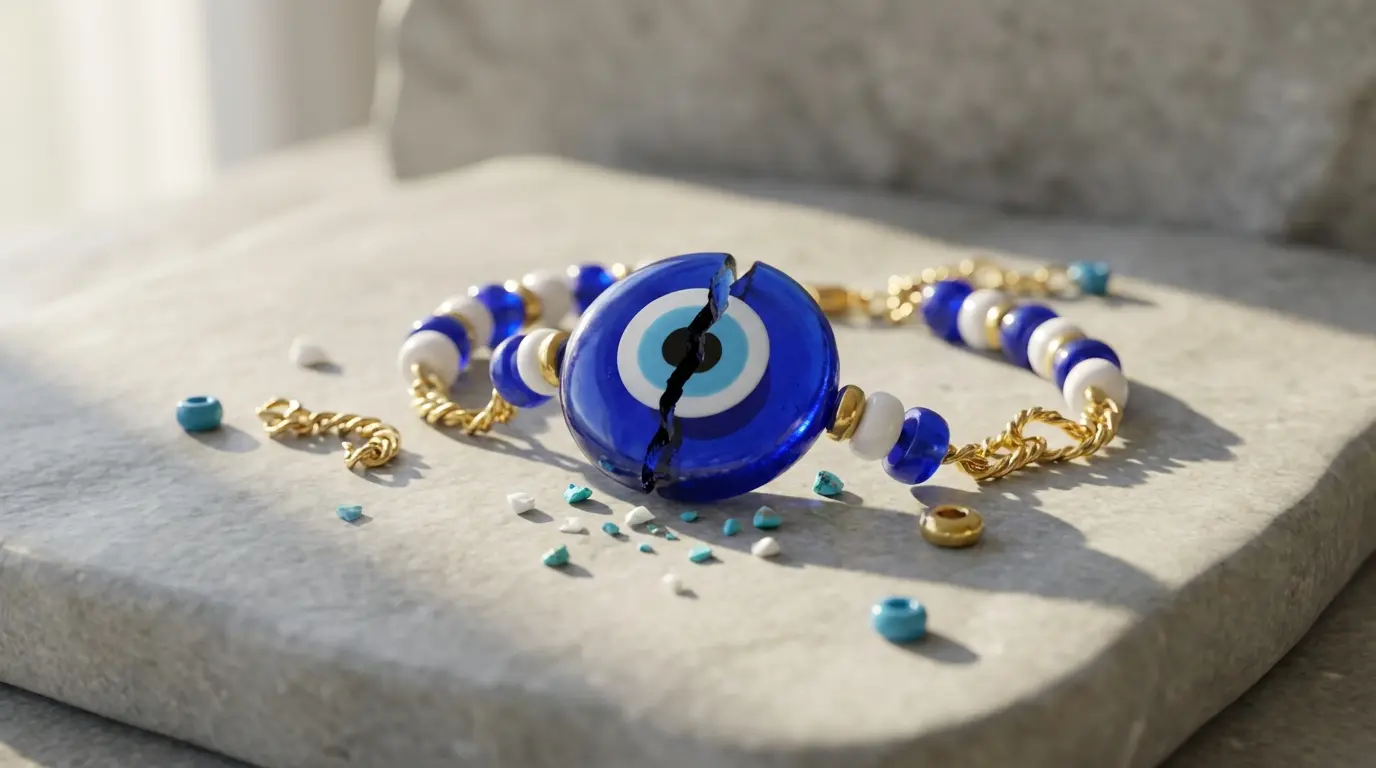
You looked down at your wrist and the bracelet was gone — or worse, you found the pieces scattered on your bathroom floor with no memory of when it happened. The blue glass cracked clean through. Maybe the string snapped and beads rolled under the couch. Maybe the clasp simply opened and the whole thing slid off without a sound.
The internet will hand you a single answer for all of these: “It absorbed negative energy! You were protected!” That’s a third of the story at best. What your evil eye bracelet broke actually means depends on something most articles skip entirely — the specific way it broke, the exact moment it happened, and what was going on in your life when the glass gave out.
If your evil eye bracelet just broke, the real explanation is likely much more diagnostic than most people expect. Rather than settling for a generic answer, it helps to understand that the interpretation shifts dramatically depending on exactly how it broke. A piece of cracked glass, a snapped string, or a fallen clasp each point to completely different things.
The exact moment of the break—whether it happened during a heated conflict, while you were completely alone, or even while you were sleeping—narrows down the meaning even further.
However, it is also important to remember that not every broken piece of jewelry is a spiritual event. Cheap materials often fail on their own, and ruling out simple wear and tear changes everything about how you read the situation.
If it turns out to be spiritual, the original nazar tradition actually has highly specific rules about disposal, replacement, and timing that the social media version of this symbol completely ignores. And if your bracelets keep breaking repeatedly? At that point, the message probably isn’t about the jewelry at all.
What Actually Happens When an Evil Eye Bracelet Breaks
Most people don’t catch the exact moment. You’re at your desk, driving home, standing in line at the grocery store — and something shifts on your wrist. A subtle looseness. A faint clink on tile. Or nothing at all until you notice the bare skin where blue glass used to sit.
The way the bracelet fails falls into three distinct categories, and lumping them together is the first mistake people make when searching for meaning.
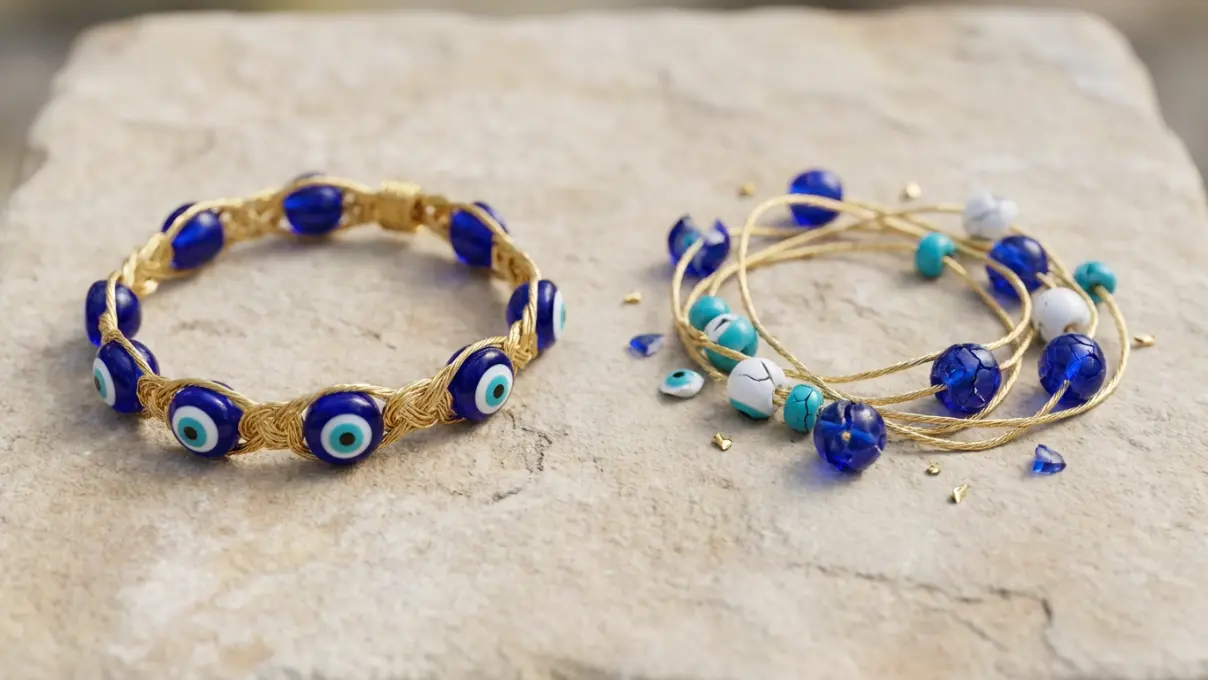
The glass eye itself cracks or shatters. The string or elastic snaps and beads scatter. The clasp opens and the bracelet drops off intact.
Each carries a different weight in the nazar tradition — and the difference isn’t cosmetic.
The Glass Eye Cracked or Shattered
This is the form that stops people mid-step.
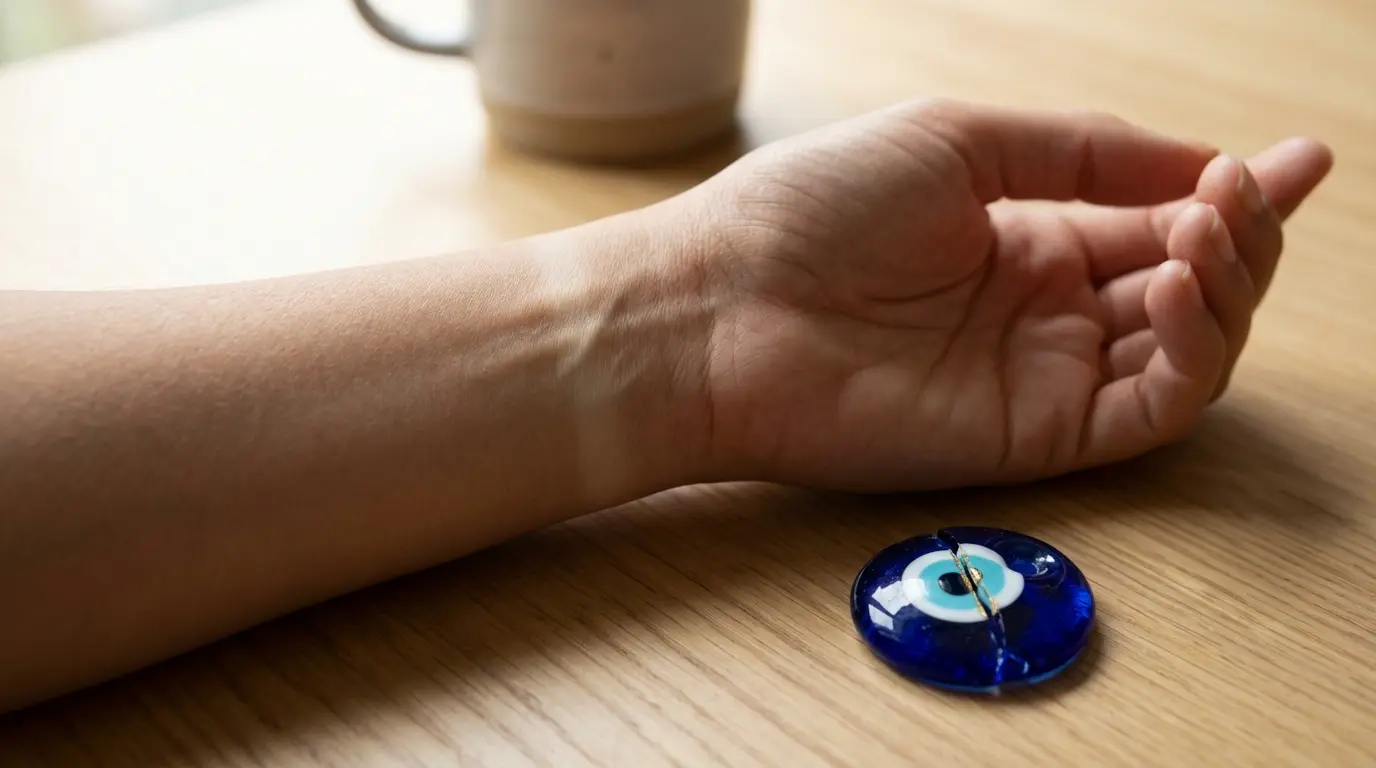
The glass component of a nazar isn’t decorative. In the original Turkish tradition, the eye is the functional element — the part designed to “see” incoming negative attention and absorb it before it reaches you. When that glass fractures, the traditional reading is direct: it took something on your behalf.
But there’s a distinction within this category that matters. A hairline crack and a full shatter carry different intensities.
A crack suggests the eye intercepted something and held. The protection activated, the glass absorbed the impact, and the structural damage was contained. Think of it as a shield that blocked a blow but stayed in one piece.
A shatter — where the glass breaks into multiple fragments — suggests a larger energetic event. The amuleto didn’t just absorb; it overloaded. Whatever it deflected exceeded the capacity of the glass to hold, and the release was total.
Turkish artisans who still produce traditional nazar boncuk by hand describe this distinction casually, the way a mechanic distinguishes between a cracked windshield and one that caved in. Same category, very different severity.
The String Broke and Beads Scattered
Here the glass eye may be completely intact. What failed was the connection between the amulet and you.
This form of breaking gets misinterpreted constantly — people assume any broken evil eye bracelet means the same thing. It doesn’t.
When the cord snaps, several Mediterranean and Middle Eastern traditions read it differently from a cracked eye. The string represents the bond between the wearer and the protection. Its breaking can signal the completion of a protection cycle rather than the absorption of a specific attack.
The amuleto finished its shift. Not because something hit it, but because the period of vulnerability it was covering has passed.
Think of it less like a bodyguard taking a bullet and more like a security contract expiring.
The Clasp Opened and It Fell Off Intact
This one confuses people the most — because technically, nothing broke.
The bracelet released itself. The evil eye bead is whole. The string is fine. It simply… left your wrist.
Some traditions don’t consider this a spiritual event at all. A loose clasp is a loose clasp. But practitioners who take the nazar seriously offer a different reading: the energetic bond between you and the amulet weakened to the point where it could no longer maintain physical attachment.
This can happen when the bracelet has been worn so long without energetic “renewal” that the protective charge has faded. The amulet isn’t broken — it’s depleted. And a depleted nazar sitting on your wrist is, in some traditions, no different from wearing a dead battery.
Before You Assume It’s Spiritual — Rule Out the Obvious
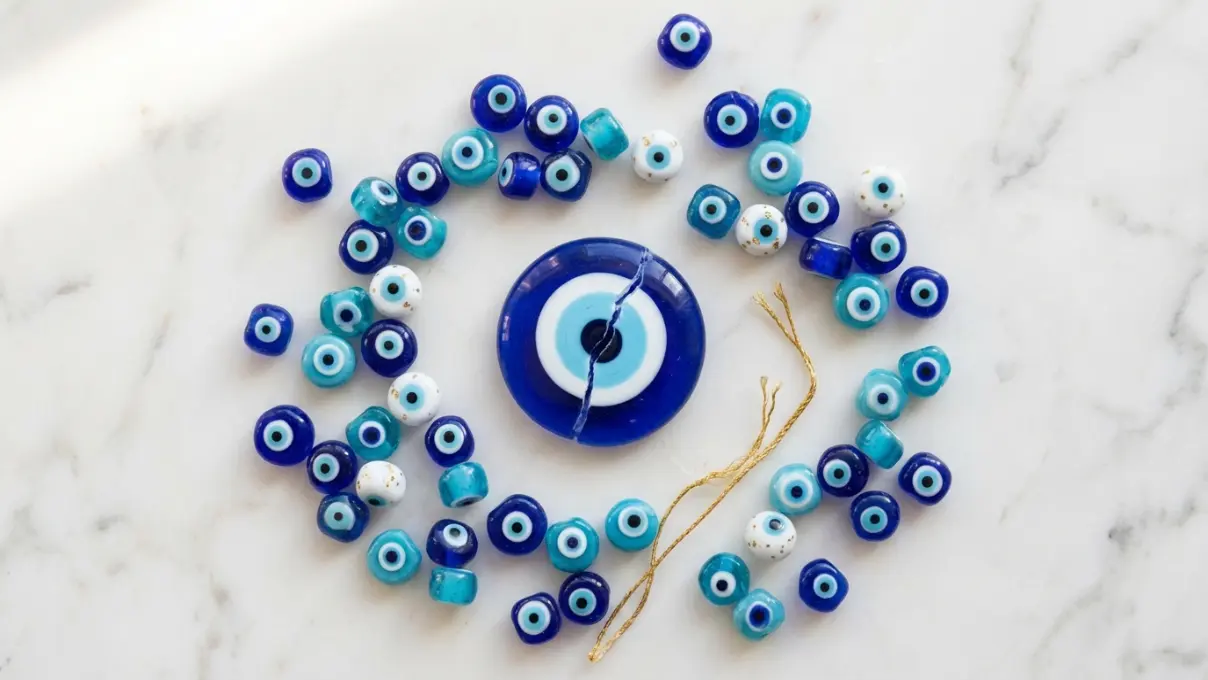
When was the last time you actually checked the material quality of your bracelet? Because a $3 mass-produced evil eye bracelet from a fast fashion retailer and a handmade glass nazar from a Turkish workshop are not the same object in any meaningful sense.
Glass evil eye bracelets sold in bulk online are typically made from soda-lime glass — the cheapest and most thermally sensitive type of glass available. This material expands and contracts with temperature shifts. Wear it in a hot car, then walk into an air-conditioned building, and the repeated thermal stress alone will crack it within weeks. That’s not spiritual. That’s materials science.
Elastic cords degrade fast when exposed to water, sweat, chlorine, and UV light. If you shower with your bracelet, swim with it, or wear it in direct sunlight daily, the string has a mechanical lifespan that’s much shorter than you’d expect. Six months is generous for cheap elastic under those conditions.
Ruling out the physical explanation first isn’t dismissive. It’s respectful — to the tradition and to yourself.
Signs the Break Was Purely Physical
Run through this quickly:
Was the bracelet inexpensive and mass-produced? Had you been wearing it in water regularly? Was it exposed to extreme heat or cold recently? Was the elastic already showing signs of stretching or discoloration? Did the glass feel paper-thin compared to artisanal versions?
If most of those land as yes, start with the material explanation before reaching for the spiritual one. Cheap glass breaks because it’s cheap glass.
Signs the Break Might Carry Meaning
The spiritual interpretation gains weight under different conditions.
The bracelet was handmade, good quality, and had been intact for months or years. It broke without any physical impact, temperature change, or observable stress. The timing aligned with an interpersonal event — an argument, a tense meeting, a visit from someone who leaves you drained.
And there’s one more marker that people describe consistently but rarely see discussed: you felt something at the moment of the break. A sudden chill. An odd wave of relief. A pressure in the chest that lifted. If the physical sensation preceded your awareness that the bracelet was broken, the experience moves out of coincidence territory.
The Diagnostic Guide — What Your Specific Situation Means
The meaning isn’t in the break itself. It’s in the context wrapped around it.
The nazar tradition — rooted in Turkey, Greece, and across the Middle East — never treated every broken amulet as identical. The “diagnosis” depends on three variables working together: HOW it broke, WHEN it broke, and WHAT was happening in your life at that exact moment.
The scenarios below cover the situations people report most frequently. Find the one that matches yours.
Scenario 1 — It Broke During or Right After a Conflict With Someone
You were in an argument. A tense phone call. A meeting where someone’s hostility was barely concealed beneath professional language. Or you’d just left the presence of someone who consistently makes you feel smaller. And within minutes — sometimes during the interaction itself — the bracelet gave out.
This is the interpretation most aligned with the nazar’s original function.
The evil eye isn’t a vague concept in Mediterranean and Middle Eastern traditions. It’s specific: the harm that travels through the gaze of someone experiencing envy, resentment, or ill will toward you. The nazar was engineered to intercept exactly that — to catch the hostile attention before it landed on you and absorb it into the glass.
When the bracelet breaks in close proximity to interpersonal conflict, the traditional reading is that it did precisely what it was made to do. The glass took what was aimed at you.
What to do: Collect all the pieces. Don’t leave fragments behind. Wrap them in dark cloth or paper. Discard them outside your home — not in your kitchen trash. Thank the amulet for doing its job. Replace it after 24-48 hours, not immediately.
Scenario 2 — It Broke While You Were Alone and Calm
No argument. No tension. You were cooking dinner, watching TV, reading — completely neutral — and the bracelet simply broke.
This scenario carries a subtler interpretation, and it’s the one most blogs handle poorly.
Some Turkish and Greek traditions suggest the nazar can detect energy directed at you from a distance. Someone speaking about you with envy. Attention you’re receiving without your knowledge — professional jealousy, social comparison, resentment that never gets expressed directly to your face.
The bracelet breaking during calm moments may indicate it intercepted something you weren’t consciously aware of. The absence of an obvious trigger doesn’t mean the absence of a cause — it means the cause wasn’t in the room with you.
A second reading exists: accumulated saturation. The nazar absorbed low-level negative attention over weeks or months — small doses, nothing dramatic — until the glass reached its structural limit. Not a single event, but a slow fill that finally overflowed.
What to do: Rather than focusing on a specific incident, look at the broader landscape. Has someone new entered your orbit recently? Has your visibility increased — a promotion, a social media post that gained traction, a success that others witnessed? The answer often surfaces within days without you needing to hunt for it.
Scenario 3 — It Broke While You Were Sleeping
You went to bed wearing the bracelet. You woke up and it was broken — on the pillow, on the floor, pieces in the sheets.
Sleep holds a specific position in Middle Eastern and Mediterranean protective traditions. The sleeping body is considered energetically open — your conscious defenses are offline, and whatever shields you maintain during waking hours are temporarily lowered.
A nazar breaking during sleep is traditionally read as active protection during your most vulnerable window. Something approached while your awareness was down, and the bracelet intercepted it.
People who experience this frequently report one additional detail: the dreams that night were unusually vivid, disturbing, or involved someone specific they hadn’t been thinking about. Whether you interpret that as coincidence or data depends on your framework, but the correlation is reported often enough to be worth noting.
What to do: Pay attention to what you dreamed. If a specific person appeared, that detail may be relevant. Dispose of the broken bracelet using the standard method (wrapped, discarded outside the home). When replacing, consider wearing the new one specifically at night for the first week if nighttime breaking has happened more than once.
Scenario 4 — It Broke on a Significant Date or During a Life Transition
The bracelet survived months without issue. Then it breaks on your birthday. Or the week you started a new job. Or three days after ending a relationship. Or the morning of a move to a new city.
Transitional periods carry a specific reading in the nazar tradition: the end of one protection cycle and the beginning of another.
The amulet that covered you through one chapter of your life may not be calibrated for the next one. Your circumstances changed. Your exposure to different people, different environments, different energies shifted. The old bracelet completed its assignment — not because it failed, but because the territory it was designed to protect no longer exists in the same form.
What to do: This scenario calls for intentional replacement rather than casual substitution. Treat the new bracelet as a deliberate act marking the new phase. Choose it with care. If possible, have it given to you as a gift — the Turkish tradition holds that a nazar received is more powerful than one purchased for yourself.
Scenario 5 — It Broke Repeatedly (This Keeps Happening)
Second bracelet. Third bracelet. Maybe fourth. Every few weeks or months, another one goes.
This pattern shifts the conversation away from the bracelet entirely.
Repeated breaking suggests persistent exposure to a source of negativity that hasn’t been addressed. The nazar is a filter. It intercepts what’s aimed at you and absorbs it. But if the filter keeps saturating no matter how often you replace it, the issue isn’t the filter’s capacity — it’s the volume coming in.
Common sources people identify when they finally investigate: a workplace where envy or hostility is constant and normalized. A relationship — romantic, familial, or friendship — where someone consistently directs resentment or possessiveness toward you. An online presence that generates regular attention from people you don’t know.
There’s also an internal version. The nazar deflects external gaze. It doesn’t protect against what you direct at yourself. Persistent self-criticism, self-sabotage, or deep-seated belief that you don’t deserve good things — these generate an energy the nazar wasn’t built to filter, because the source is inside the perimeter it guards.
What to do: Stop replacing the bracelet for now. Take that money and invest it in the harder question: what in your environment — or in your own internal patterns — is generating this volume? The nazar is showing you the smoke. Find the fire.
What the Nazar Tradition Actually Says (Not the Instagram Version)
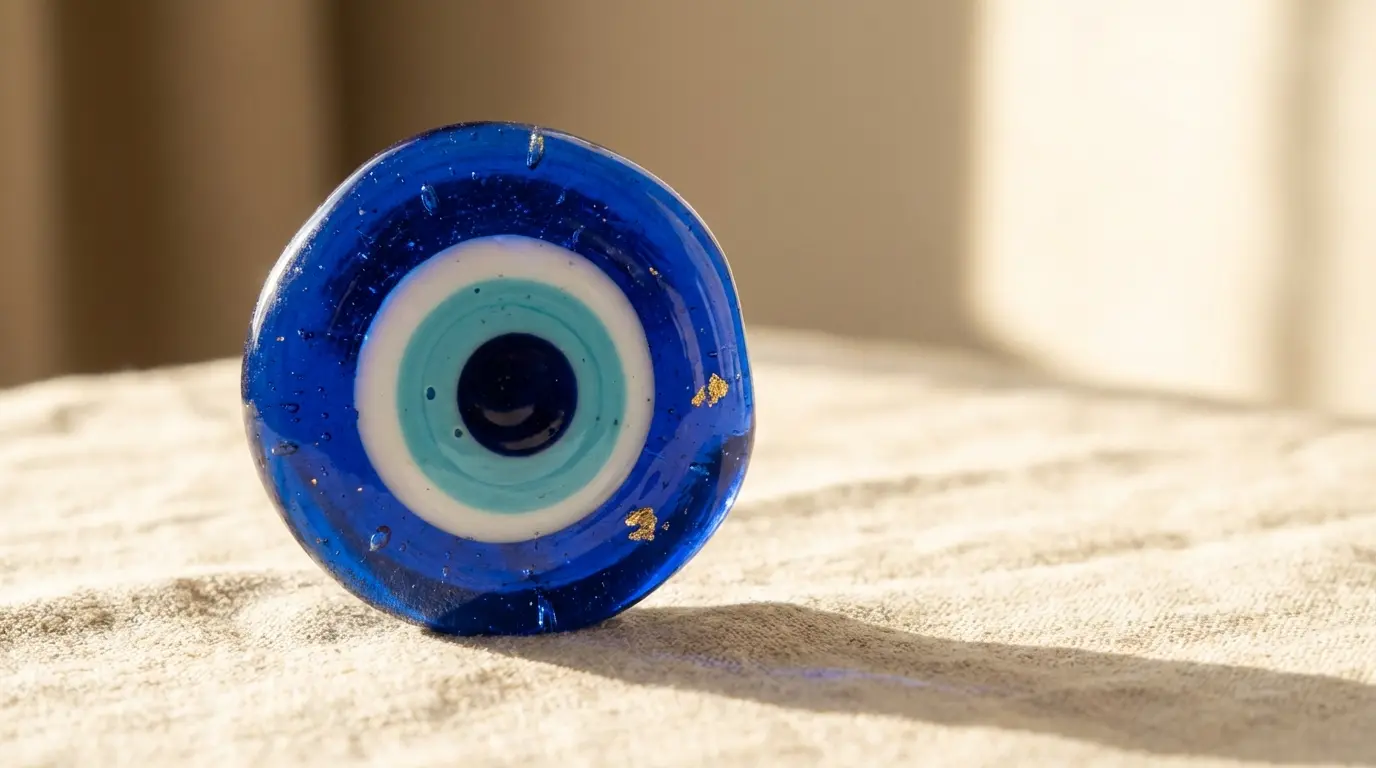
The nazar boncuk isn’t a trendy symbol that popped up on Etsy five years ago. Glass beads shaped as eyes were found in archaeological sites across Mesopotamia, some dating to 3,300 B.C. The ancient Egyptians, Greeks, Romans, and Ottoman Turks all produced variations of the same amulet — each civilization arriving independently at the same idea: a glass eye that watches back.
The original concept has nothing to do with “good vibes” or aesthetic spirituality. It’s a defensive technology. The eye on the amulet doesn’t represent your eye — it represents the eye of the person looking at you with harmful intent. The nazar mirrors the hostile gaze back at its source, forcing the negative energy to return to the sender rather than landing on you.
That’s a fundamentally different concept from what most people understand when they buy one at a souvenir shop.
Why the Color Blue Matters More Than You Think
Cobalt blue wasn’t a design choice. It was a functional one.
Across Mediterranean, Turkish, and Middle Eastern traditions, blue is the color most consistently associated with protection against envy. The theories about why vary — some connect it to the sky’s perceived protective canopy, others to the rarity of blue eyes in the region (which were considered powerful and therefore appropriate for a counter-gaze amulet).
What’s harder to dismiss is the consistency. Cultures with minimal historical contact — from the Aegean coast to the mountains of Afghanistan — independently converged on blue as the color for eye-based protective amulets. That kind of parallel development suggests something deeper than aesthetic preference.
If your bracelet used a different color — red, black, pink — the nazar tradition would consider it decorative rather than protective. The cobalt blue glass isn’t optional in the original framework. It’s the active ingredient.
The Rule About Not Repairing a Broken Nazar
This is the rule most people break — literally and figuratively.
In the Turkish tradition, gluing a broken nazar back together is the spiritual equivalent of sweeping dirt out the door and then carrying it back inside. The amulet absorbed negative energy and fractured to release it. Repairing the glass theoretically traps that energy back into the object — and keeps it in close physical proximity to you.
The tradition on this point is unanimous across every variation: collect the pieces, express gratitude, and discard them away from your living space.
Keeping broken nazar pieces as souvenirs, jewelry components, or decorative items is specifically discouraged. The fragments are considered spent — energetically discharged. Holding onto them is sentimental, but from the tradition’s perspective, it defeats the entire purpose of the amulet’s design.
What to Do After Your Evil Eye Bracelet Breaks — By Scenario
What you do in the first hour after the break matters more than what you research over the following week. And the generic “just buy a new one” response that dominates most articles ignores everything the tradition actually recommends.
How to Properly Dispose of a Broken Evil Eye Bracelet
The traditional Turkish method is straightforward but specific.
Gather every piece — every bead, every fragment of glass, every section of cord. Don’t leave shards behind. Wrap them in dark fabric or opaque paper. Say thank you — out loud or silently, however feels natural. Then discard the wrapped pieces outside your home. Public trash, not your kitchen bin. Some Greek traditions recommend burying the pieces in earth or dropping them into flowing water. The unifying principle: the broken amulet leaves your personal space completely.
Don’t photograph the broken pieces for social media before disposing of them. This might sound oddly specific, but it’s worth mentioning because the impulse is extremely common — and several practitioners note that keeping the image of the broken nazar in your phone or feed keeps you energetically tethered to whatever the amulet absorbed.
When and How to Replace It
Not immediately. The tradition recommends a gap of at least one to two days between disposal and replacement.
The reasoning is practical within the energetic framework: your personal field just had a layer of protection removed. A brief period without the amulet allows whatever residual energy was being held to fully dissipate before you attach a new protective layer. Installing new protection on top of energetic residue is considered counterproductive.
When you do replace: quality matters more than speed. A handmade glass nazar from a reputable source outperforms a mass-produced alternative in both physical durability and, according to practitioners, energetic capacity. If possible, receive the new bracelet as a gift rather than purchasing it yourself — the nazar tradition consistently holds that gifted amulets carry stronger protective charge.
When placing the new bracelet on your wrist, do it with deliberate awareness. Not while scrolling your phone or watching TV. The moment of attachment is, in the tradition, the moment the bond between you and the new amulet forms.
What to Do If Bracelets Keep Breaking
If you’re on your third or fourth replacement, the bracelet isn’t the problem.
Stop buying new ones for a while. Redirect the energy and money you’ve been spending on replacement toward an honest audit of your current environment.
Where in your daily life are you most consistently exposed to hostility, jealousy, or draining dynamics? Which relationships leave you feeling depleted after every interaction? Is there a professional situation where competition has crossed into resentment?
And the harder question: is any of the negativity you’re experiencing self-generated? The nazar guards against external gaze. Chronic self-doubt, relentless inner criticism, and the habit of believing you don’t deserve what you have — those don’t come from outside. No amulet can intercept what originates within.
The bracelet keeps breaking because it keeps filling up. Find what’s filling it.
❓ FAQ — Evil Eye Bracelet Broke
Does a broken evil eye bracelet mean someone was jealous of me?
That’s the most common interpretation within the nazar tradition — specifically when the glass eye itself cracks or shatters. The amulet was designed to intercept envious or hostile attention directed at the wearer. A broken eye suggests it intercepted something. Whether the source was jealousy specifically, or a broader form of negative attention, depends on your circumstances at the time of the break.
Can I glue my evil eye bracelet back together?
The tradition strongly advises against it. A broken nazar is considered energetically spent — it absorbed something and broke to release it. Repairing the glass theoretically seals that absorbed energy back into the object and keeps it near you. The consistent recommendation across Turkish, Greek, and Middle Eastern traditions: thank the amulet and discard the pieces outside your home.
Is it bad luck if my evil eye bracelet breaks?
The opposite, actually. Within the nazar framework, a broken bracelet indicates the protection worked. The bad luck — whatever was heading toward you — was intercepted by the glass. The break is evidence of successful defense, not a sign of incoming misfortune. The only concern is replacing the protection before new exposure occurs.
What if only the string broke but the eye bead is intact?
This carries a different interpretation than a cracked glass eye. An intact bead with a broken cord often signals the completion of a protection cycle rather than the absorption of a specific attack. The amulet’s connection to you ended, but the eye itself wasn’t overwhelmed. Some practitioners restring the original bead; others recommend starting fresh entirely. The tradition is less unanimous on this scenario than on cracked glass.
How often should you replace an evil eye bracelet even if it hasn’t broken?
There’s no universal timeline, but several practitioners recommend replacing annually regardless of condition — especially if the bracelet is worn daily. The rationale: even without dramatic breakage, the nazar accumulates low-level energetic absorption over time. A yearly replacement prevents gradual saturation. Some Turkish families replace all household nazar amulets during Nowruz (new year) as a matter of routine.
Conclusion
The evil eye bracelet on your wrist was never a fashion accessory that happened to have spiritual side effects. It’s one of the oldest protective technologies in human history — a piece of glass engineered across fifty centuries to do exactly one thing: stand between you and whatever someone else’s gaze was carrying.
When it broke, it wasn’t random. The glass, the string, the clasp — each failure mode tells a different story. The timing narrows it further. The context makes it specific.
But here’s the question most people never get to, because they stop at “what does this mean?” and never reach “what does this reveal?”:
What was aimed at you that the bracelet had to intercept? Who was looking? And what changes in your life, your relationships, or your own patterns would make the next bracelet last longer — not because it’s better glass, but because there’s less for it to absorb?
That question is worth more than any replacement bracelet you’ll ever buy.
Before you start analyzing your broken jewelry, please keep in mind that the spiritual, cultural, and traditional perspectives we’ve discussed here are meant for your own personal reflection.
While these interpretations are deeply rooted in Mediterranean, Turkish, Greek, and Middle Eastern folklore, they shouldn’t be taken as absolute scientific claims or professional advice.
At the end of the day, simple physical wear and cheap materials are still incredibly valid reasons for why a bracelet might snap. Always use your own best judgment and common sense when interpreting your personal experiences.



Alex Turner
Alex Turner is the author behind Signs of Universe, a website focused on dreams, spiritual meanings, and symbolic signs. His approach combines research and intuitive interpretation to help readers understand the subtle messages that appear in everyday life.