Song Playing at the Right Time Spiritual Meaning: Coincidence or a Sign from the Universe?
You’re driving home after one of those days — the kind where everything felt heavy and you weren’t sure which direction your life was heading. You turn on the radio without thinking, and suddenly that song comes on. The one that perfectly captures exactly what you’re feeling. The one with lyrics that sound like someone reached into your chest and wrote what they found there.
You get chills. You laugh a little. Maybe you even cry.
And then the thought sneaks in: Was that a coincidence? Or was something trying to tell me something?
If you’ve ever had that experience, you’re not alone — and you’re not imagining things. The song playing at the right time spiritual meaning is something millions of people search for, wonder about, and quietly believe in.
In this article you’ll discover:
- What it really means when a song plays at exactly the right moment
- The science and psychology behind musical synchronicities
- 7 powerful spiritual interpretations from different traditions
- How to tell if a song is genuinely a sign — or just your algorithm
- Practical steps to take when a song feels like a message from the universe
- Answers to the most common questions people search on this topic
Is It Just a Coincidence? The Science Behind Musical Synchronicities
A three-layer explanation
Layer 1: exposure. Where did the song come from? Radio programming, recommendation systems, a public playlist, or your own listening history can explain why it appeared.
Layer 2: salience. What word, melody, person, or memory was already active? Research shows that music can retrieve autobiographical memories. One study found familiar songs evoked memories and emotion for many listeners; another found music-evoked memories can be especially vivid. See the PubMed record on music-evoked autobiographical memories.
Layer 3: personal meaning. After checking exposure and salience, you may still choose a spiritual interpretation. State it as “I received this as encouragement,” not “this proves the universe approved my decision.”
Before the spiritual interpretations, start with what research can support. Music can cue emotion and autobiographical memory, and timing can make a familiar lyric feel unusually relevant. Research does not determine whether a particular song was externally “sent.”
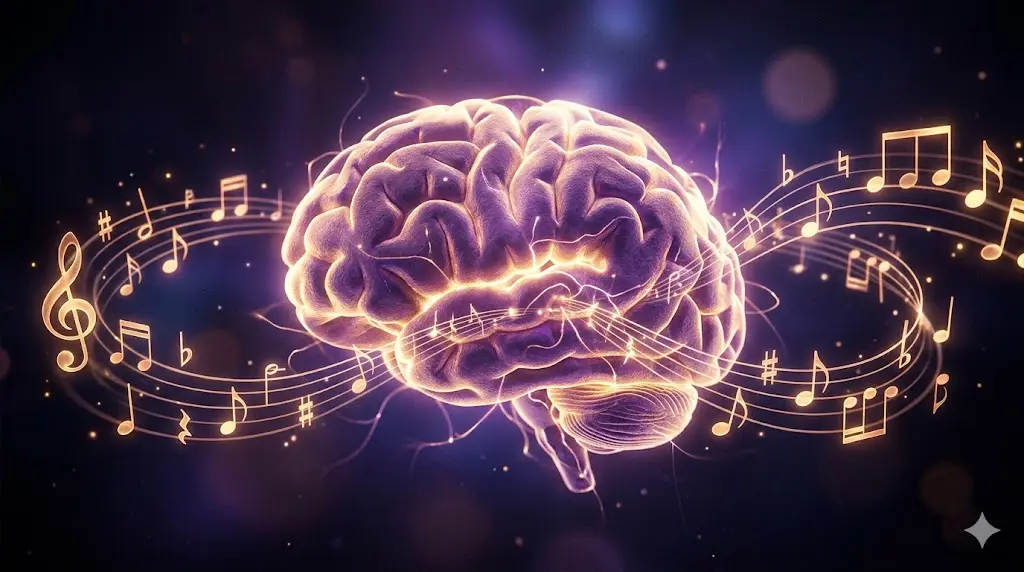
How the brain recognizes patterns in music
The brain continually links current input with memories, expectations, and emotional context. When a song matches an active concern, those associations can make the fit feel immediate and personal.
Music engages distributed systems involved in sound, memory, emotion, and reward. A neuroimaging study indexed by PubMed examined how familiar music can evoke autobiographical memories, supporting a memory-based explanation for why one song can suddenly carry an entire period of life.
The psychology of meaningful coincidences
Apophenia describes perceiving meaningful connections among events that may be unrelated. The term should not be used to dismiss every meaningful experience; it is a reminder to distinguish personal significance from evidence of an external cause.
Jung’s synchronicity describes coincidence experienced as meaningfully connected without an ordinary causal explanation. It is a philosophical-psychological framework, not a scientific finding that chance has been ruled out.
A song playing at the right time often falls squarely into that territory.
Why our brains assign meaning to songs
Songs are deeply personal containers. A melody can hold a decade of memories, a smell, a face, a version of you that no longer exists. When a meaningful song appears unexpectedly, your brain flags it as significant — because for you, it is significant.
That doesn’t make the experience less real. In many ways, it makes it more so.
Song Playing at the Right Time Spiritual Meaning: What It Really Means
Music has sacred, ceremonial, and communal roles in many traditions, but not every religion or ritual uses sound in the same way. Those practices show that humans often use music to focus attention, coordinate groups, remember, mourn, and worship; they do not prove that a particular playlist event was divinely arranged.
The concept of synchronicity (Carl Jung explained simply)
Jung used synchronicity to discuss meaningful acausal connections. The concept can help describe the experience, but it cannot show that two events share an invisible thread outside the observer’s interpretation.
When lyrics mirror grief, joy, or a decision, call it a personally meaningful coincidence unless there is independent evidence of causation. “The universe rhyming” can remain poetic language, not a factual claim.
The universe communicating through vibration and frequency
Music is literally vibration in the physical sense of pressure waves. Spiritual systems may also use “vibration” metaphorically for mood or consciousness. Mixing those meanings does not prove that thoughts and events operate at a measurable spiritual frequency.
A person may experience resonance between a song and an emotion. That describes a fit in meaning; it does not establish that their frequency attracted the song.
Music as a spiritual language across cultures and traditions
Religious and ceremonial uses of music are widespread, but traditions differ in theology, purpose, and practice. A drum ceremony, Gregorian chant, Sufi devotional music, and gospel worship should not be presented as evidence for one universal mechanism.
Music can be entertainment, ritual, memory cue, identity marker, and emotional language. Which role applies depends on the listener and setting.

7 Common Spiritual Interpretations of a Song Playing at the Perfect Moment
These seven interpretations are common contemporary readings, not a verified or universally recognized classification. Use them as questions to compare with your own context.
1. A message from a loved one who passed away
A song associated with someone who died can evoke a vivid continuing bond, especially around grief, anniversaries, or milestones. The experience may be comforting; the song cannot verify that the deceased selected the timing.
Across some spiritual and grief narratives, a personally associated song may be received as a sign from someone who died. The shared memory explains why that song carries weight; it does not establish that the deceased selected the timing.
2. Confirmation from your spirit guides or angels
If you believe in spirit guides, guardian angels, or higher beings, you may receive a timely song as reassurance. State that as a personal interpretation, not confirmation that a being spoke or approved a decision.
Songs tied to themes of courage, love, or perseverance often appear in moments when you’re questioning yourself. That’s rarely coincidence — it’s confirmation.
3. A sign you’re on the right path
A resilience song may function as encouragement while you are deciding what to do. Let it prompt a review of reasons and evidence rather than treating it as a green light supplied by the universe.
Pay attention to the theme of the song — not just the emotion, but the actual message it carries.
4. A reminder to pay attention to your emotions
Music can draw attention to feelings that were easier to avoid in silence. If a song stops you and emotion rises, ask what memory or concern it activated. The intensity shows that the material is important to you, not that an external sender chose the track.
Not every sign is pointing forward. Sometimes it’s pointing inward.
5. A signal to let go or move forward
Songs about endings, release, or new beginnings often appear at transition points — right before a breakup, a move, a job change, or a healing moment. If a song about letting go finds you unexpectedly, it might be the nudge you’ve been waiting for but not yet ready to acknowledge.
6. Alignment between your energy and the universe
Within a Law of Attraction belief system, a timely song may be interpreted as alignment. That is a spiritual reading, not confirmation that a desire is approaching or that a frequency has been measured.
7. A nudge toward something you’ve been ignoring
An uncomfortable lyric can expose a question you were already avoiding. Use it as a prompt for honesty, not proof that the universe scheduled a correction.
How to Tell If a Song Is Truly a Sign (And Not Just Your Playlist)
Fair question. With algorithms and autoplay and shuffle, how do you know if a song appearing is genuinely significant — or just Spotify doing its job?
There are a few markers that tend to separate meaningful musical moments from background noise.
The emotional intensity at the exact moment it plays
A better sign-check than emotional intensity
Write the lyric exactly, the question you were asking, the source that played the song, and one ordinary explanation. Then wait before acting. If the song appears again, add the context instead of counting only the recurrence. This turns a vague pattern into a record you can evaluate.
For a low-risk choice, the song may be a welcome prompt. For contacting someone, ending a relationship, spending money, stopping treatment, or making another consequential decision, require independent waking evidence. A soundtrack is not informed consent, medical guidance, or financial evidence.
Emotional intensity makes a moment memorable, but it is not a test for supernatural origin. A song during crying, prayer, or realization may feel stronger because attention and emotion are already heightened.
Repetition: the same song appearing in different contexts
One of the clearest signs is repetition. The same song appearing on the radio, in a store, in a stranger’s earbuds, and then in a moment you were thinking of someone — over the course of a few days — is far less likely to be coincidence than a single occurrence.
Repeated exposure can come from radio rotation, algorithms, playlists, popular culture, routines, or selective attention. Check those ordinary pathways before concluding that persistence has an external intention.
The lyrics speaking directly to your situation
Read the lyrics in full, not only the line that fits. Ask what does not match your situation as well as what does. This reduces the chance of turning a flexible lyric into a precise instruction.
The song playing at the right time spiritual meaning often lives entirely in the lyrics, waiting for you to listen closely enough.
A physical or gut reaction you can’t explain
Chills. Goosebumps. Sudden tears. A feeling of warmth or presence. Your body often receives spiritual messages before your mind catches up. If a song triggers a physical response that feels bigger than the music itself, trust that.

What to Do When a Song Feels Like a Message from the Universe
You’ve heard the song. You felt it. Now what?
Pause and be present — don’t scroll past the moment
Pause and listen if the moment matters to you. The goal is not to “receive” an unquestionable message; it is to notice the memory, emotion, or decision the song brought forward.
Note the song and what you were feeling
After the moment passes, write it down. Note the song title, the lyrics that hit hardest, and what was going on in your life when it played. Over time, patterns emerge. You may start to notice that certain songs appear during certain emotional states or life phases.
This journal becomes a personal map of your spiritual communication history.
Reflect on the message and how it applies to your life
Once you’ve captured the moment, sit with it. What do the lyrics actually say? What theme does the song carry — loss, hope, love, courage, release? And how does that theme map to what you’re currently navigating?
You don’t need to force an interpretation. The right one usually presents itself when you’re quiet enough to hear it.
Trust your intuition — you already know the answer
People often search for this meaning because the moment already felt important. You do not need permission to explore that feeling, but bodily intensity alone cannot verify the source or tell you what action is correct.
So here it is: you can trust what you felt.
FAQ: Song Playing at the Right Time Spiritual Meaning
What does it mean when a song plays at the right time? It may be a coincidence made powerful by memory and emotion, or it may be held as a spiritual symbol within your beliefs. The lyrics and your reaction can clarify what the moment means to you, but they cannot identify an external sender.
Can songs be signs from deceased loved ones? Many people — and many spiritual traditions — believe yes. Songs tied to a person who has passed often appear unexpectedly at emotionally significant moments. The timing, the memory attached to the song, and the intensity of the feeling are all worth taking into account.
Is musical synchronicity real or just coincidence? Synchronicity is real as a description of experienced meaning; it is not a method for proving causation. Research supports music’s ability to evoke memories and emotions. Spiritual alignment remains a belief-based interpretation.
What does it mean when the same song keeps playing? First check exposure: the same station, platform, trend, algorithm, store playlist, or daily route. If repetition remains personally meaningful, use the song as a reflection prompt rather than proof of a message.
How do I know if a song is a spiritual message? There is no reliable three-part test. Strong emotion, relevant lyrics, and repetition all have ordinary explanations. You may choose a spiritual meaning, but keep it separate from claims about what will happen or what another person wants.
Conclusion: Music as a Bridge Between You and the Universe
The song playing at the right time spiritual meaning isn’t about magical thinking. It’s about paying attention to the moments when the invisible and the visible seem to touch.
Whether you frame the event spiritually or psychologically, its value lies in what it helped you notice. You felt less alone, remembered someone, or recognized a question. That response is valid without declaring the timing supernatural.
That’s the gift of music. And maybe that’s enough.
The next time a song stops you in your tracks, don’t dismiss it. Listen a little longer. Write it down. Ask yourself what it might be saying.
Have you ever experienced a song playing at exactly the right moment? Share your story in the comments below — you might find that more people have had the same experience than you think.
The spiritual interpretations in this article are symbolic and reflective in nature. They represent widely shared beliefs and personal perspectives — not absolute truths, psychological advice, or professional counseling. Always use your own discernment when exploring spiritual experiences.
Related reading: When You Keep Seeing Signs But Nothing Changes and Asking the Universe for a Sign and Receiving One Hours Later.




Alex Turner
Alex Turner is the editorial pen name used for articles published on Signs of Universe. The website covers dreams, symbolism, and cultural interpretations for informational and reflective purposes. Alex Turner is not a medical, mental health, scientific, or spiritual authority.