
Thinking of Someone and They Text You: Quantum Entanglement or Coincidence?
Thinking of someone just before they text you can feel striking, but the timing alone does not prove telepathy, a spiritual message, or quantum entanglement. Coincidence, shared routines, and reminders you both encountered are possibilities to consider. The message’s actual content and the history of the relationship are better guides to whether you want to respond.
A private thought followed by a visible message can feel unusually personal. Sometimes the sender is an old friend; sometimes it is someone you miss or would rather not hear from. The experience can matter to you without revealing a hidden cause.
The strange part is not only the text. It is the feeling that something internal crossed into the outside world. Maybe the person was an ex. Maybe a friend you had not heard from in months. Maybe someone whose name had been circling your mind all afternoon for no obvious reason. The real question is not “did I cause this?” The better question is why this specific person, this specific timing, and this specific message felt charged enough to make you search for meaning.
On this page
Three Texts That Feel Similar but Mean Different Things
The Real Pattern Is Usually Timing, Charge, and Context
Why Quantum Entanglement Does Not Explain the Text
How to Read the Message Without Turning It Into a Prediction
The Text May Matter Less Than the Part of You That Reacted
Three Texts That Feel Similar but Mean Different Things
The first mistake is treating every case of thinking about someone before a text arrives as the same event. A thought followed by a text can feel mystical, emotional, awkward, or almost funny depending on who the person is and what the message actually says.
A text from a close friend after you casually remembered them is not the same as an ex texting right after a wave of nostalgia. A practical message from a coworker is not the same as someone saying, “I was just thinking about you too.”
The timing may be similar. The meaning is not.
The Casual Message That Lands Too Perfectly
Sometimes the person who texts is not emotionally complicated. You thought about them for a few seconds because of a memory, a phrase, a place, or something small that reminded you of them. Then their name appears on your screen.
This version of thinking about someone before a text arrives is strange, but not necessarily heavy. The message may be ordinary: a question, a meme, a loose check-in. The meaning sits less in the relationship and more in the timing. It feels like two unrelated moments briefly touched.
That does not prove anything supernatural. It also does not make the experience meaningless. Some moments become memorable because they violate the rhythm of ordinary expectation. You expected the thought to stay private. Then the phone answered it.
The Person Who Was Already Taking Up Space in Your Mind
There is another version. The person was not random. They had been present in your mind for hours or days before the text arrived. Not constantly, but enough that their name kept returning.
When someone has been on your mind for hours or days, there are more opportunities for a later message to overlap with those thoughts. Consider that wider window rather than remembering only the final thought before the notification.
If the person was already on your mind, the message may stand out because it touches a concern you were already carrying. That is different from showing that they sensed your thoughts.
In this case, thinking about someone before a text arrives can feel like a release valve. Something that was floating inside your mind suddenly has a place to land. The question becomes less “did they feel me?” and more “why was this connection active before they appeared?”
The Message From Someone You Had Not Thought About in Months
The most unsettling version happens when the person had been absent from your thoughts for a long time. Then, without warning, they appear in your mind. No recent photo. No conversation. No obvious trigger.
Later, they text.
That sequence can feel less like coincidence and more like contact. It has a different texture because the gap was wider. If someone is already part of your daily life, a message is expected. If someone has been silent for months, their sudden appearance feels like a pattern breaking through.
A long silence can make contact unexpected. Before choosing an explanation, consider ordinary possibilities: a shared anniversary, a recent event, a mutual friend, or an old conversation both of you remembered. If no cause is clear, it remains unknown. The gap does not prove that the relationship is emotionally unfinished.
The Real Pattern Is Usually Timing, Charge, and Context
A moment becomes memorable when three things line up: timing, emotional charge, and relationship context. Without those three, thinking about someone before a text arrives would usually disappear into the day like any ordinary message.
A thought followed by a text feels powerful because the mind pairs two events together. First, the private thought. Then, the external confirmation. The closer those two events are, the stronger the pairing feels.
But timing alone is not enough.
If you think about a dentist and the clinic texts to confirm an appointment, the event may feel mildly odd. If you think about someone you miss and they text after weeks of silence, the same structure feels loaded. The emotional charge gives the moment weight.
Context decides the rest. Who is this person in your life? What did the message say? What had been unresolved between you? Were you hoping for contact, fearing it, avoiding it, or completely unprepared?
This is where spiritual interpretations often become attractive. They give shape to a moment that already feels shaped. Some people read it as intuition. Others call it synchronicity. Others see it as a sign of energetic connection.
Joe Cambray’s account for the International Association for Analytical Psychology describes Jung’s synchronicity as a connection through meaningful coincidence rather than a causal chain. It also notes the anecdotal clinical examples in Jung’s writing. That provides context for a Jungian interpretation, not experimental confirmation that a thought caused a text.
That distinction matters. A thought followed by a text may feel meaningful without proving that your thought sent a signal. Meaning and mechanism are not the same thing.
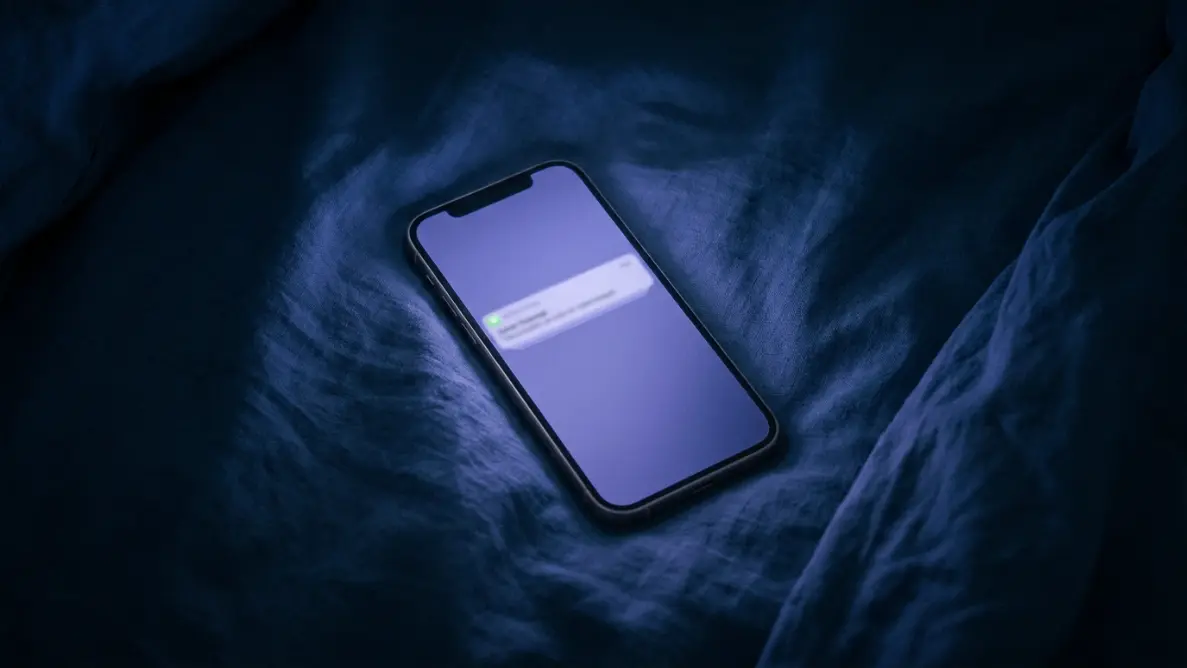
Why Quantum Entanglement Does Not Explain the Text
The word “quantum” appears around thinking about someone before a text arrives because people want language big enough for the feeling. Ordinary coincidence sounds too flat. Telepathy sounds too extreme. Quantum entanglement sits in the middle as a beautiful, mysterious phrase.
But it needs boundaries.
In physics, quantum entanglement refers to particles whose states remain linked in ways that challenge ordinary intuition. That does not mean two human minds can use entanglement to send text-message signals. Caltech explains that a common misconception is that entangled particles communicate faster than light, but experiments do not support that interpretation, and quantum physics cannot be used for faster-than-light communication.
So no, thinking about someone before a text arrives is not evidence that your mind and their phone were quantum-linked.
Quantum language may be used metaphorically to describe closeness across distance. Keep it clearly in that category: the physics source concerns particle correlations, not thoughts traveling between people.
A metaphor can describe how a moment feels; it cannot supply a scientific mechanism.
A more useful question is what you already know about the relationship. Are you comfortable with contact? Was there a practical reason for the message? Do you need time before answering? These questions can guide an action without solving the coincidence.
This is also why Thought Transmission: Can Someone Feel When You Are Thinking About Them? fits naturally beside this subject. That question looks at the wider idea of mental connection, while this article stays with the narrower and more concrete event: a thought followed by a message.
The text does not establish a hidden law of physics or a hidden truth about the relationship. It gives you a real communication to read, with whatever context you already know.
How to Read the Message Without Turning It Into a Prediction
The danger is not curiosity. Curiosity is useful. The danger is turning one strange text into a rule you start obeying.
A thought followed by a text does not automatically mean you should answer, reconnect, confess something, or take the timing as permission. A meaningful moment can still require judgment.
Start with the content of the message. Was it specific or vague? Did it connect to what you were thinking, or did only the sender’s name match? A text that says “I had a dream about you” carries a different charge than “Do you still have my charger?”
Then look at the emotional shift. Before the text, what was the thought doing inside you? Was it warm, tense, nostalgic, irritated, curious, calm? After the message arrived, did the feeling settle or become louder?
That before-and-after contrast is often more revealing than the timing itself.
Relief, pressure, or excitement can be a starting point for asking what you want from the conversation. A single reaction cannot diagnose an attachment or tell you what the sender intends. Give yourself time to consider the actual message.
This is where many people misread the event. They ask, “Is this a sign?” before asking, “What did the message actually change?”
If the text did not change anything, the timing may be the whole phenomenon. If it reopened a real emotional thread, then the moment deserves more attention.
And if the experience was not limited to a text — if you had already felt the person’s presence, sensed their mood, or noticed their name appearing in other places — then the question moves closer to What Does It Mean to Feel Someone’s Presence When They Are Far Away?. That is a related pattern, but not the same one.
The key is precision. Do not flatten every strange contact into one category.

The Text May Matter Less Than the Part of You That Reacted
The next time it happens, do not rush to crown it as destiny or crush it as nonsense. Both reactions close the moment too quickly.
Look at the exact shape of it. Who appeared in your mind? How long had it been since you heard from them? What did they send? Did the message match the emotional tone of your thought, or only the timing?
You can describe the timing as a coincidence, or use synchronicity as a personal interpretive framework. Neither description establishes that your thought prompted the sender to act.
The same caution applies to Mercury retrograde claims: timing may feel meaningful without proving cosmic control.
The most useful answer may be less dramatic than the one you wanted, but more honest. The message is not automatically a command. It is a contact point.
Sometimes it shows that a relationship still has a rhythm. Sometimes it exposes an unfinished thread. Sometimes it simply reminds you that the mind notices timing more intensely when emotion is involved.
The text matters. But your reaction may matter more.
Because the real signal may not be that they texted.
It may be that their name still had somewhere to land inside you.
This article treats thinking of someone and then receiving a text as a symbolic, reflective, and interpretive experience. It does not claim to prove telepathy, diagnose emotional states, or replace professional guidance.




Alex Turner
Alex Turner is the editorial pen name used for articles published on Signs of Universe. The website covers dreams, symbolism, and cultural interpretations for informational and reflective purposes. Alex Turner is not a medical, mental health, scientific, or spiritual authority.


You May Also Like

Song Playing at the Right Time Spiritual Meaning: Coincidence or a Sign from the Universe?

When You Keep Seeing Signs But Nothing Changes: What Synchronicities Might Really Be Asking of You