Labyrinth Symbol Meaning: History, Myth, and Modern Symbolism
Labyrinth symbol meaning is commonly understood today through the idea of a journey toward a center and a return from it. In modern spiritual practice, that journey may be interpreted as reflection, release, insight, renewal, or transformation. But those meanings are not a single ancient definition passed down unchanged from Knossos. The symbol has accumulated different layers over time: Greek myth, civic imagery, medieval Christian architecture, and contemporary contemplative practice.
That distinction matters. A Bronze Age palace at Knossos, a labyrinth drawn on a Greek coin, the story of Theseus and the Minotaur, and a labyrinth walked in a modern cathedral are connected by history and reinterpretation, but they are not the same kind of evidence.
Labyrinth Symbol Meaning Today: Path, Center, and Return
In contemporary use, a labyrinth often symbolizes a journey with direction rather than a puzzle with choices. You enter, follow a winding route, reach a center, and then return along the same path. That physical structure makes several modern interpretations possible: moving inward can represent reflection or release; the center can represent stillness, encounter, or insight; and the return can represent bringing something back into ordinary life.
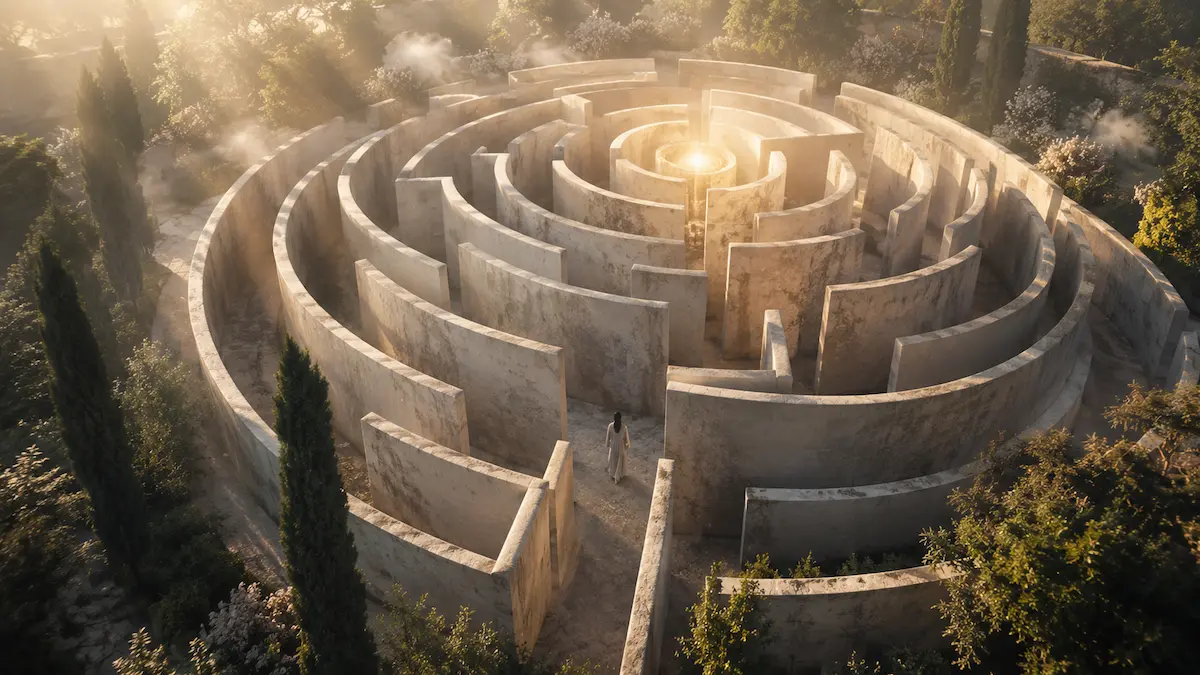
Grace Cathedral in San Francisco describes labyrinth walking as a spiritual practice and a form of walking meditation. Its own framework divides the walk into three stages: releasing on the way in, receiving at the center, and returning on the way out.
That makes journey, center, and return well-documented parts of modern labyrinth symbolism. Transformation is better treated as an interpretation of that sequence, not as a universal meaning built into every labyrinth in history. A person can understand the path as transformative because the walker returns to the starting world after a structured inward-and-outward journey. The historical evidence does not require us to claim that ancient users understood the symbol in exactly that way.
Labyrinth or Maze? Why the Difference Is Historically Messier Than It Looks
Today, the distinction is usually simple: a maze has branching choices and dead ends, while a labyrinth has one continuous path leading to the center. Grace Cathedral uses this distinction explicitly in its instructions for modern walkers.
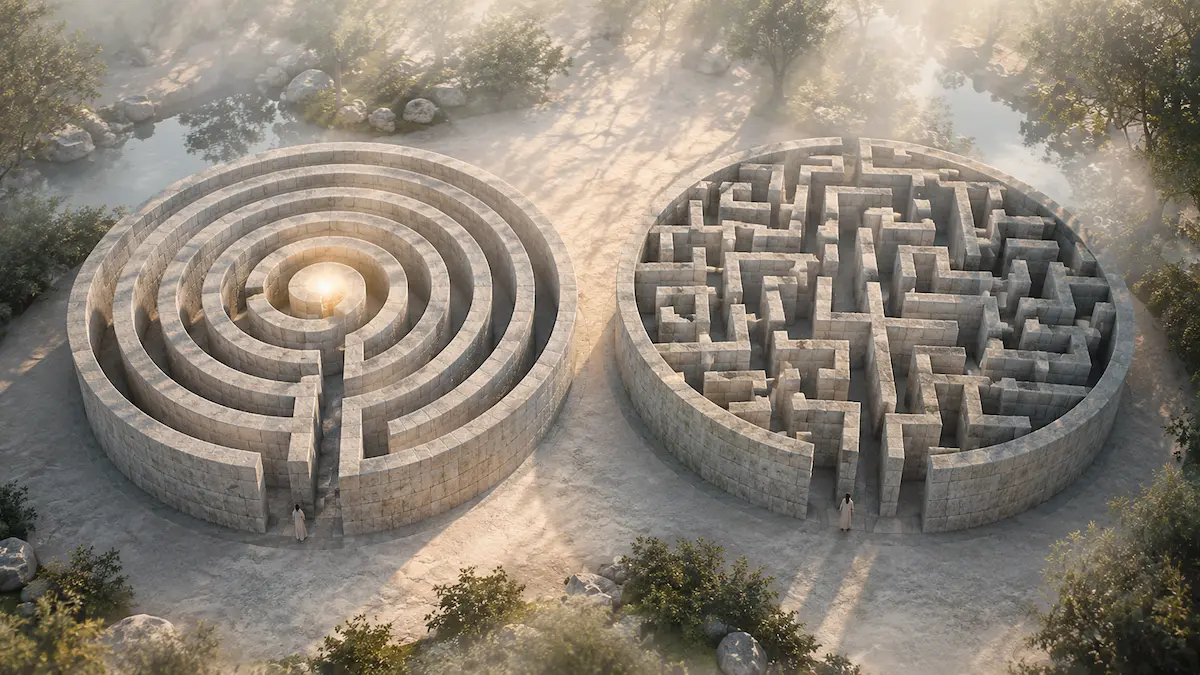
Ancient evidence is less tidy. The Ashmolean Museum notes that labyrinth designs on coins from Knossos sometimes show a single route to the center. In that sense, they look like what many people today would call a unicursal labyrinth. Yet literary descriptions of the Cretan Labyrinth emphasize a place difficult to escape, closer to the idea of a maze. For labyrinth symbol meaning, this difference matters because the physical design and the literary story do not always describe the same kind of structure.
So the modern distinction is useful, but it should not be projected backward as if every ancient writer and artist followed the same technical vocabulary.
The contrast also changes the symbolism. A maze dramatizes decisions, wrong turns, and uncertainty. A unicursal labyrinth can still feel disorienting, but its challenge is not choosing the correct branch. Its form emphasizes staying with a path whose destination is structurally built in.
If the symbolism of an actual detour is what interests you, our guide to wrong-turn synchronicity spiritual meaning looks at that different idea: meaning that emerges because a planned route breaks.
What the Evidence from Knossos Actually Shows
Knossos is where archaeology and myth are most easily blurred.
The archaeological site is real. Excavations beginning in the late nineteenth century revealed the remains of a large Bronze Age complex, later extensively excavated and reconstructed under Arthur Evans. The Ashmolean dates the building Evans called the “Palace of Minos” broadly to about 2000–1350 BCE.
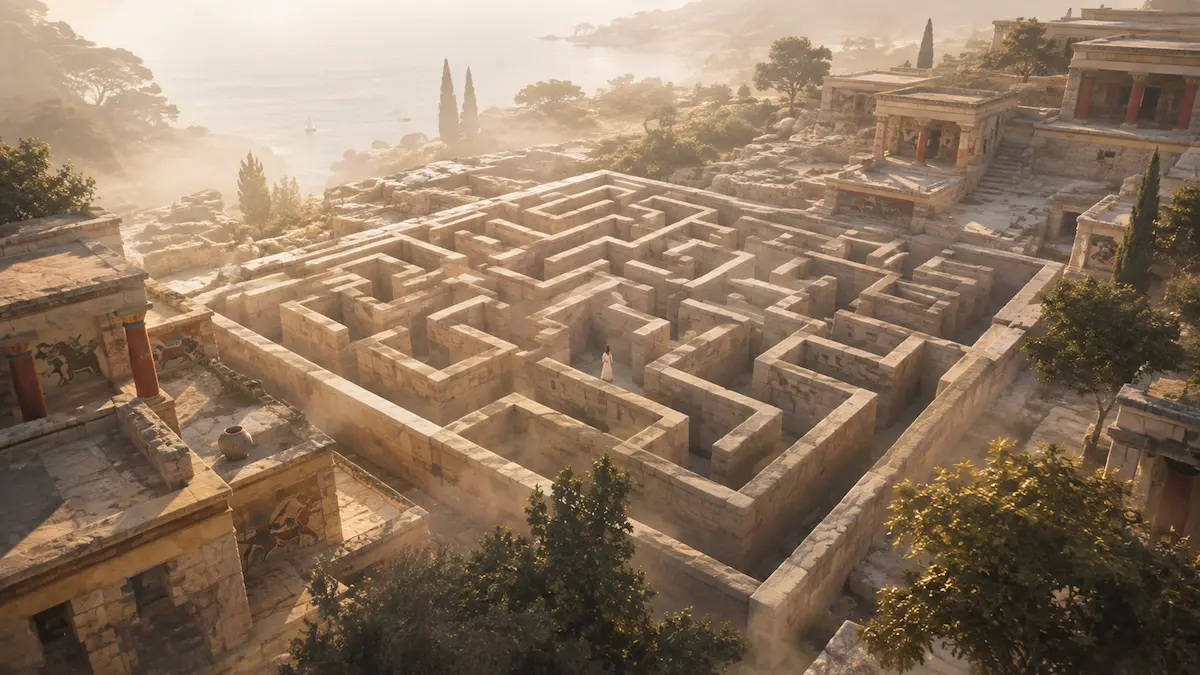
But finding that complex did not amount to finding a historically verified prison built by Daedalus for a literal Minotaur. Evans himself interpreted the palace through the lens of the myth, and some of his reconstructions reinforced that connection. The archaeological building and the legendary Labyrinth therefore need to remain conceptually separate.
The Palace and the Problem of the “Real” Labyrinth
The temptation to identify the palace with the Labyrinth is understandable. The complex had numerous rooms and corridors, and bull imagery from Knossos made the later myth feel especially suggestive to early excavators.
Still, suggestive is not the same as proven. The Ashmolean’s treatment of Knossos emphasizes how discoveries, reconstructions, and myth influenced one another. The site gives us a Bronze Age architectural reality. The story of Daedalus, Theseus, Ariadne, and the Minotaur belongs to a literary and artistic tradition preserved much later.
A careful reading therefore avoids saying, “Archaeologists found the Labyrinth.” What they found was the monumental Bronze Age complex at Knossos, which later investigators connected to a famous Greek myth.
Knossos Coins and the Labyrinth as a City Symbol
Coins provide a different kind of evidence because they actually show labyrinth designs associated with Knossos.
Archaeologist Mariusz Mielczarek dates the first coins of Knossos to around 470 BCE. Early examples used a pattern of four meanders to indicate a labyrinth; later issues used square designs, and eventually circular forms appeared. The Ashmolean likewise describes the labyrinth on Knossian coins as a symbol of the city, sometimes with a Minotaur at the center.
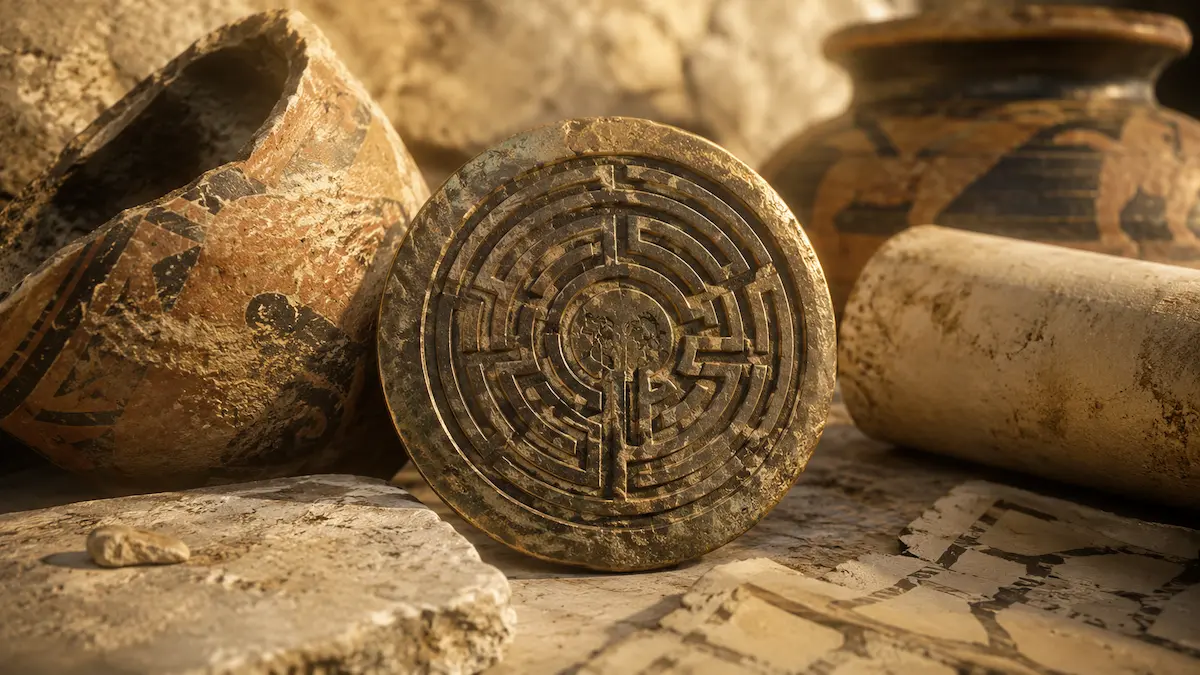
This is important because it establishes something more precise than “the ancient Greeks knew the myth.” By the Classical period, Knossos was visually identifying itself with the labyrinth motif on its coinage.
This material evidence is especially important for labyrinth symbol meaning because it shows that the motif had a documented civic association with Knossos, not just a later spiritual interpretation.
It also creates an intriguing contrast. Some of these coin designs have a single route into the center. The city symbol could therefore be orderly and legible even while the literary Labyrinth was imagined as a place of confinement and escape.
Theseus, Ariadne, and the Minotaur: The Mythic Layer
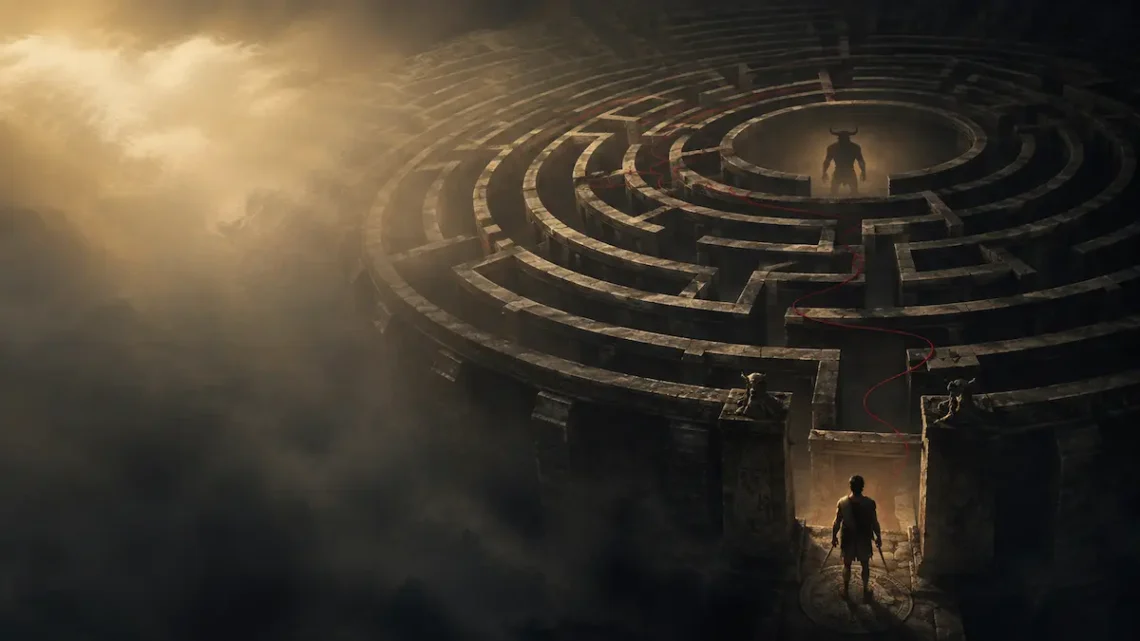
The best-known labyrinth story is the one in which King Minos has the Minotaur confined in a Labyrinth designed by Daedalus. Theseus enters, kills the Minotaur, and escapes with the help of Ariadne’s thread.
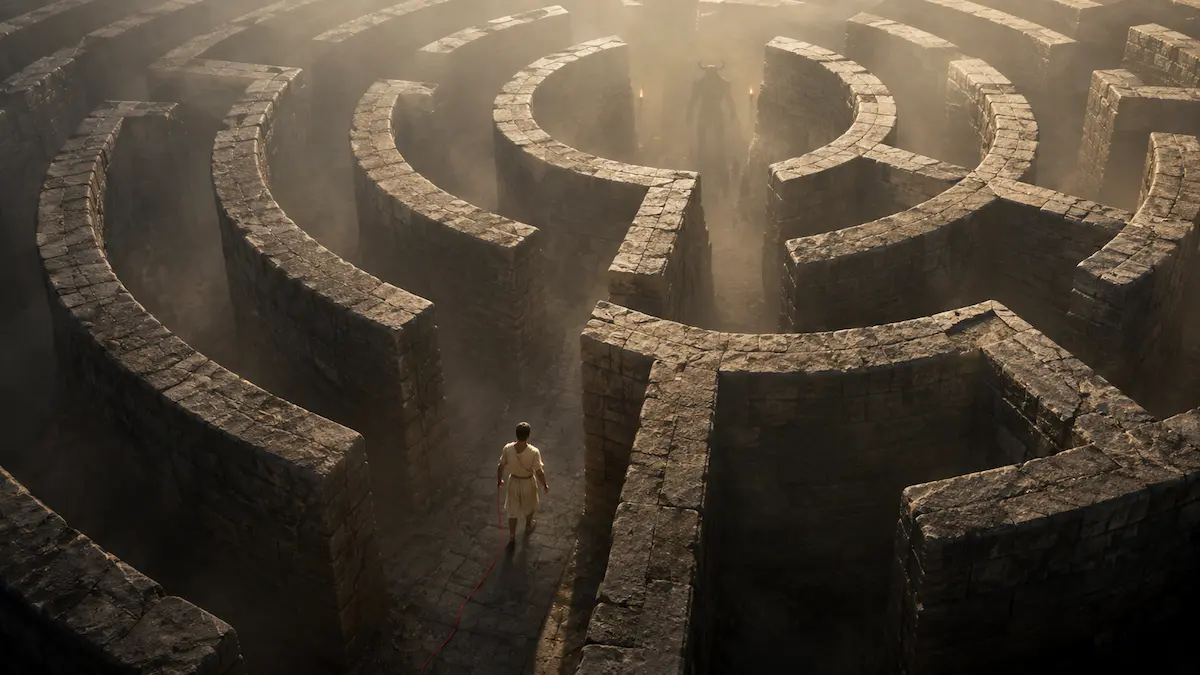
That familiar version should not be treated as one fixed text from the earliest Greek period. The Ashmolean points out that Homer mentions Knossos and says Daedalus made a dancing floor for Ariadne there, but does not mention the Labyrinth. Later authors developed and located labyrinth traditions in different ways.
Visual evidence shows that the Theseus-Minotaur story was already prominent in Archaic Greek art. A black-figure neck-amphora at the Metropolitan Museum of Art, dated to about 500 BCE, depicts Theseus and the Minotaur, with a female figure identified tentatively as Ariadne. The Met notes that scenes of Theseus and the Minotaur became popular in Athenian vase painting.
Symbolically, this myth adds elements that a geometric labyrinth by itself does not contain: danger inside, a confrontation at the center, the thread as a means of return, and escape after the encounter. Those narrative elements help explain why later readers can see the labyrinth as an image of ordeal, guidance, confrontation, or return. But those are interpretations of the mythic story, not archaeological proof of what the symbol originally “meant.”
Here, labyrinth symbol meaning comes from the narrative structure of the myth rather than from archaeological evidence.
A Timeline of the Labyrinth: Evidence, Myth, and Later Meaning
The clearest way to understand the labyrinth is to separate the surviving evidence by period.
| Period | What we actually have | What it can support |
|---|---|---|
| Bronze Age Crete, roughly 2000–1350 BCE | The architectural complex at Knossos and material remains excavated there. | Knossos was a major Bronze Age center. The palace can be discussed as historical archaeology, but not simply equated with the mythical Labyrinth. |
| Before 700 BCE | Homeric reference to Knossos, Daedalus, and a dancing floor for Ariadne. | An early literary link among Knossos, Daedalus, and Ariadne; not yet an explicit Cretan Labyrinth in that passage. |
| Archaic Greece, 6th century BCE | Vase paintings showing Theseus fighting the Minotaur. | The Theseus-Minotaur narrative was established in Greek visual culture. |
| Around 470 BCE onward | Knossian coinage with labyrinth motifs. | The labyrinth functioned as civic imagery associated with Knossos; its drawn forms changed over time. |
| Later Greek and Roman literature | More developed written accounts of labyrinths, Minos, Daedalus, Theseus, and the Minotaur. | The Cretan Labyrinth became a developed literary tradition, but versions and locations were not perfectly uniform. |
| Late 12th–13th centuries | Large walkable labyrinth pavements in northern French cathedrals; Chartres survives from about 1220. | The form had entered Christian architectural space and could be walked, creating a new context for interpretation. |
| Contemporary practice | Cathedral programs and modern labyrinth movements using walking meditation, prayer, release, receiving, and return. | Journey, center, return, contemplation, and personal change are documented modern meanings and practices. |
The timeline reveals the central point: “labyrinth meaning” is not one historical statement. It is a sequence of uses and reinterpretations.
How Medieval Christianity Reframed the Labyrinth
By the High Middle Ages, the labyrinth had entered a very different setting: the floors of major Christian churches.
Art historian Daniel K. Connolly notes that large, walkable labyrinth pavements were installed in northern French cathedrals in the late twelfth and thirteenth centuries, including at Sens, Chartres, Auxerre, Amiens, Reims, and Arras. He dates the surviving Chartres pavement to around 1220 and stresses that there is no surviving contemporary text that simply explains why these early cathedral labyrinths were introduced.
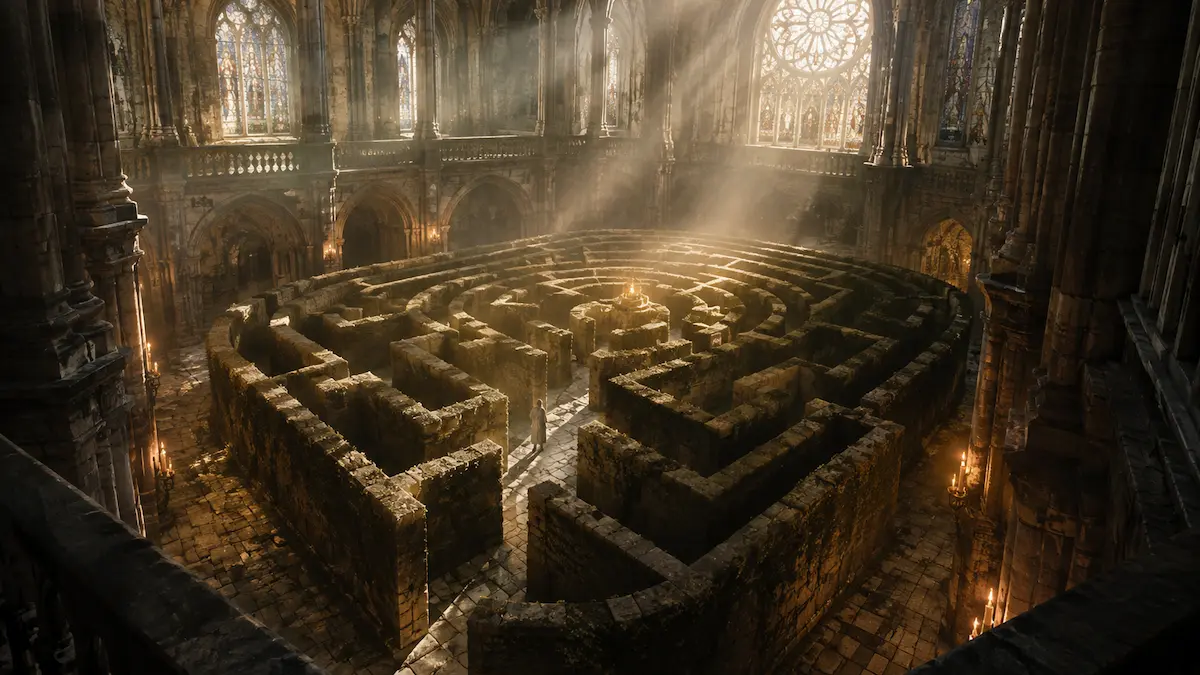
That absence matters. Popular claims sometimes reduce medieval labyrinths to a single function, such as “substitute pilgrimages” used by people who could not travel to Jerusalem. Connolly discusses the history of that idea but offers a more specific argument: the design, placement, and walking of the Chartres labyrinth could evoke Jerusalem and create what he calls an imagined pilgrimage. That is a scholarly interpretation, not a license to treat every medieval labyrinth as having one documented function.
The Cathedral of Chartres today explicitly presents its labyrinth as a path of pilgrimage, prayer, meditation, Christian reconciliation, death, and eternal life. Its current interpretive material also connects the labyrinth with Easter liturgy. Those statements document how the cathedral understands and uses the monument now; they should not be carelessly converted into claims that every detail of present practice is proven to have been identical in about 1220.
The medieval layer therefore changes the symbol again. The winding path is no longer only connected to Crete and the Minotaur. It is physically embedded inside Christian sacred architecture, where movement through space can be read through pilgrimage, liturgy, and Christian devotion.
In this setting, labyrinth symbol meaning develops through a specifically Christian context rather than simply preserving the symbolism associated with ancient Knossos.
Why Path, Center, Return, and Transformation Became Modern Meanings
Modern labyrinth symbolism becomes easier to understand once the physical form is taken seriously.
A single path creates a sequence. There is an entrance. There is movement toward a center. There is a center where movement pauses or changes direction. Then there is a return. Unlike a maze, the structure does not require the walker to solve a branching puzzle.
Contemporary practice gives that sequence explicit spiritual language. Grace Cathedral, which identifies itself with the Modern Labyrinth Movement that began there in 1991, describes the walk through releasing, receiving, and returning. The Cathedral of Chartres likewise presents walking its labyrinth as pilgrimage and meditation in a Christian setting.
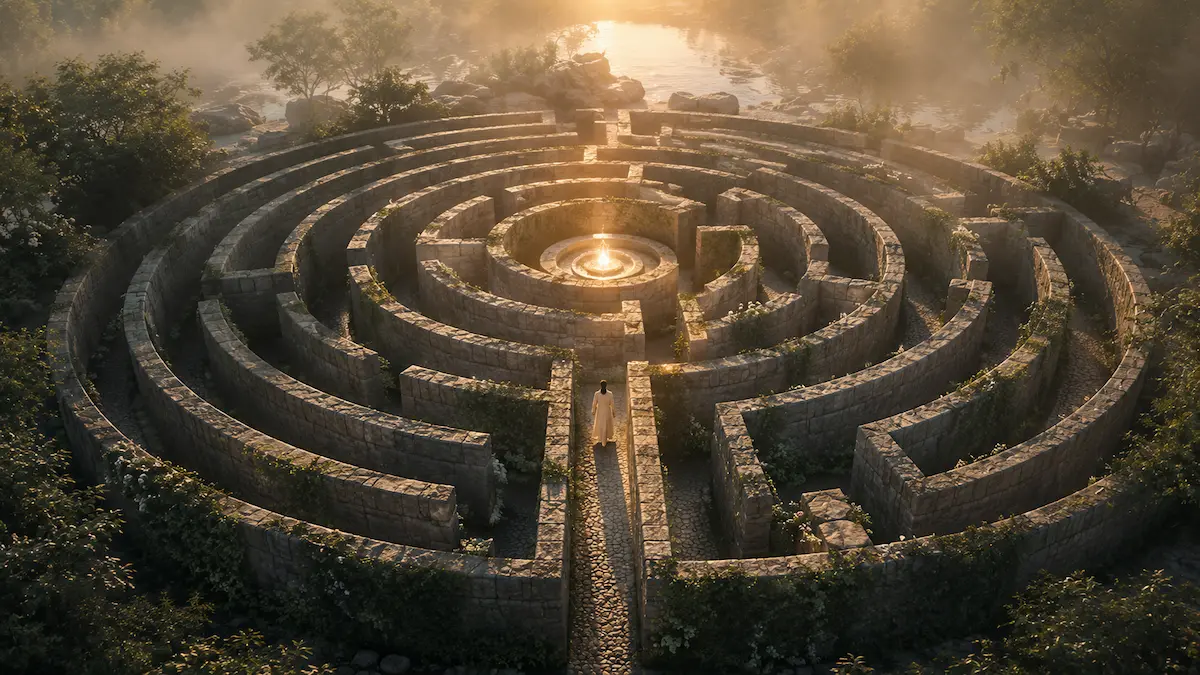
From those documented practices, it is reasonable to understand why transformation has become a common modern interpretation. The form lends itself to a before-and-after story: the person who returns has completed a journey through the center. But transformation remains an interpretive possibility, not a guaranteed result and not a meaning we can safely project onto every ancient coin, vase, or building.
For modern labyrinth symbol meaning, those documented practices help explain why transformation has become a common interpretation. The form lends itself to a before-and-after story: the person who returns has completed a journey through the center. But transformation remains an interpretive possibility, not a guaranteed result and not a meaning we can safely project onto every ancient coin, vase, or building.
This distinction makes the symbol richer, not weaker. The labyrinth can carry modern spiritual meaning without requiring us to invent an uninterrupted secret doctrine stretching from Bronze Age Crete to the present.
One Symbol, Several Historical Layers
The labyrinth has lasted because its form can hold more than one kind of meaning.
At Knossos, we have a Bronze Age archaeological site that later became strongly entangled with myth. In Archaic and Classical Greek culture, we have images of Theseus and the Minotaur and coins that make the labyrinth a recognizable symbol of Knossos. In medieval cathedrals, the form becomes a walkable feature inside Christian sacred space. In modern practice, it becomes an intentional path of meditation, prayer, reflection, and return.
Those layers are related, but they should not be collapsed.
If you ask about labyrinth symbol meaning today, “journey toward a center and back again” is a useful answer. Ideas such as reflection, guidance, renewal, and transformation can grow from that pattern. If you ask what the labyrinth meant in every historical period, however, the answer has to be more careful: its meaning changed with the people, objects, stories, and institutions that used it.
The most reliable way to read the labyrinth is therefore not to search for one timeless definition. Follow the history of the path itself.
Related reading: Finding a White Feather on the Ground in a Dream and Why Finding an Old Key in the Street During Times of Uncertainty May Be.


Alex Turner
Alex Turner is the editorial pen name used for articles published on Signs of Universe. The website covers dreams, symbolism, and cultural interpretations for informational and reflective purposes. Alex Turner is not a medical, mental health, scientific, or spiritual authority.